
©Courtesy of Bleecker Street Media
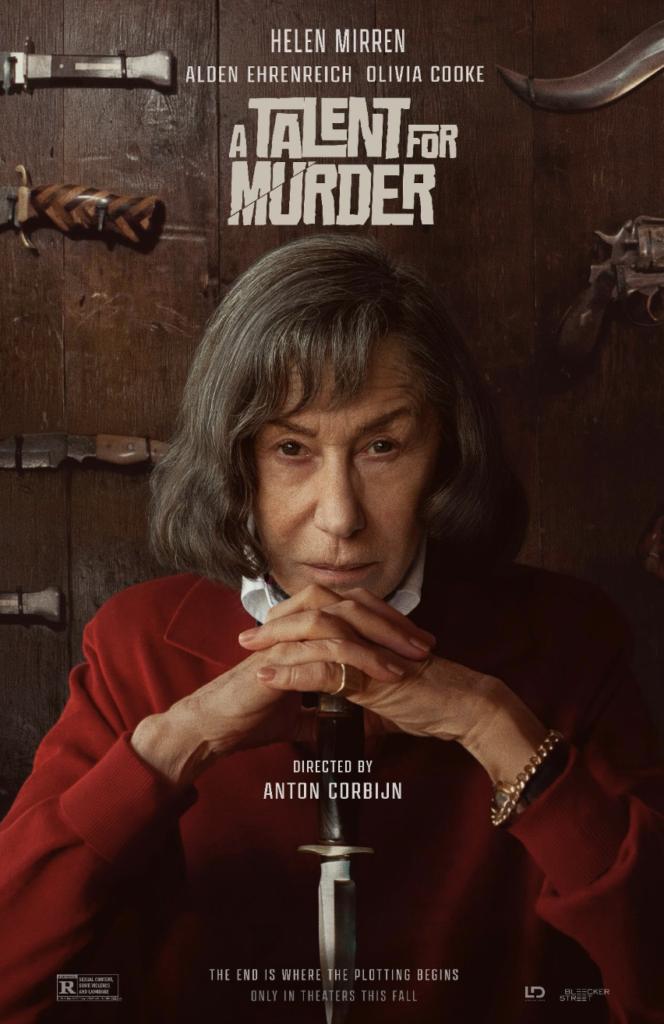
Q : Anton, maybe I would love to start with you. It’s so exciting to see you back with a narrative feature. Tell us a little bit about this play, Switzerland, by Joanna Murray-Smith. When did you become aware of it? What did you see in this cinematically?
Anton Corbijn : I was only aware of it once it was made into a screenplay. I never saw the stage play. And it was brought to me by Gabrielle Tana, the producer and I hadn’t made a movie for ten, eleven years or something, so I was very keen to start again on this particular profession. Because unlike photography, this is very solitary, it’s a very collaborative effort. I enjoy learning from it and, yeah, it was a great experience, I have to say.
Q : How closely did you work with Joanna? I know that she adapted the play for the screen. It is a two-hander, the stage play, as I understand. Bringing it to the cinema, to the stage, to transform it in that manner, what did it take on your end?
Anton Corbijn : Well, like I said, I was only aware of it once it was made into a screenplay. So I wasn’t involved in the transition of it. But, obviously, being aware that it was for the stage play, I wanted to make sure that the film doesn’t feel too much like that, and there’s a lot of outdoors in there, moments. Unfortunately, Helen was locked into the house.
Q : Helen, congratulations on this brilliant, thrilling, dark, and witty performance as Patricia Highsmith. Maybe tell us a little bit about your approach to her. Of course, you played real-life characters before, the Queen(Elizabeth) and Golda(Meir). What made this one different? We didn’t really know as much about her public persona, so how did you approach that?
Helen Mirren : Very on mic. You know, although obviously she’s very famous as a writer, but not known really as a personality. So I had to do a bit of digging and she was quite reclusive and obviously towards the end of her life, extremely reclusive. But she had been pretty reclusive, you know, throughout her life.
I don’t… There was one extended interview with her on BBC Television that was very useful for me, although she was very much… She was younger and very much on her best behavior. Um, then there was a little tiny snippet of her on a panel that I found absolutely invaluable. It’s interesting, sometimes you don’t need a lot of material. Sometimes it’s literally thirty seconds can tell you so much about, about someone. But also looking at photographs of her, reading biographies, and that sort of thing.
Q : Maybe on that note, can I ask what is your approach in general to portray a real-life character? How much of it is trying to stay true to what we know of the person versus how much do you bring from yourself?
Helen Mirren : Well, it’s, you know, it’s difficult. When I played the Queen, I was sort of very tortured by the idea of that until I suddenly realized, that I was gonna go. when I was playing Elizabeth II, I had just played Elizabeth II, and the only way to… There were obviously no film of Elizabeth I or anything like that, so I had to draw portraits. And obviously there you’re looking at the person through the eyes of an artist. And I suddenly thought, “You know what? That’s what I’m doing. I’m doing a portrait as an artist of the Queen.” In other words, it’s as much me in there as there is the actual person. It’s my perception, my understanding of that person.
Having said that, it’s very important that you have to sound like her, look like her, walk like her, talk like her, and all the rest of it. Oh, God. It’s torture, isn’t it? Yeah. I mean, it’s actually being tortured by the torturing you. Anyway, so likewise with Patricia Highsmith, I even though it’s obviously a dramatic story, not a documentary, I found it was really important for me to get as close to the reality, the physical reality of what she was, yeah, and the psychological reality also.
Q : Thank you. Alden, congratulations on this performance. Maybe tell us a little bit about how that was for you on the page when you first read the script, the journey of (Edward) Ridgeway versus this fictional Ripley(character of “The Talented Mr. Ripley”), the sixth book that never happened. How was it on the page, and what kind of stood out to you about it? What were you excited to explore through these two separate roles?
Alden Ehrenreich : That was a big part of the appeal of this film, was to take on both of these characters, and I’ve never done that before, especially two characters that are so completely different.
And then, of course, toward the end of the film, they start to blend. And what is from whose point of view and what is real and what isn’t becomes very abstract in a certain way. And just on your question earlier, one of the things that Joanna Murray-Smith did, you know, the original play is just Highsmith and Edward in a room.
You don’t see Clementine(Played by Olivia Cooke in the film), you don’t see… She’s referenced, but you don’t go outside. There’s no scene on a train. And so the line of things kind of blending was really clean. And in the whole– I thought it was really brilliant the way they found a really organic way. A lot of times when you adapt a play, it’s kind of arbitrary. They stand outside instead of inside. But in this, there was a real way in which opening it up to the whole traveling element and meeting Clementine expanded the film, and then the way in which the two characters intersect became sort of more expansive in that way.
©Courtesy of Bleecker Street Media
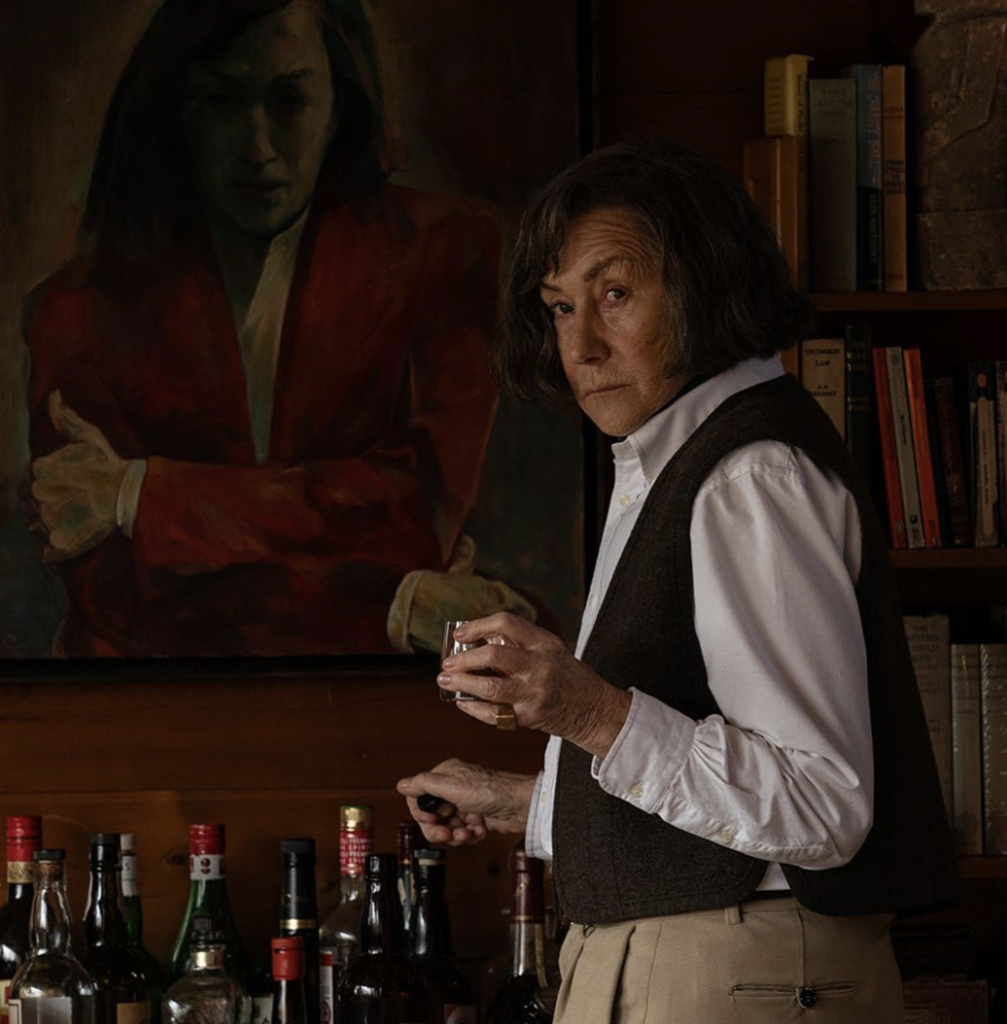
Q : Thank you. And Anton, one of the most thrilling things about this movie is also the setting. There’s such tactile quality to Highsmith’s home. I’m wondering if you can tell us a little bit about creating that, and what were you looking to capture correctly, and how did it come to be? It feels like a set that’s really alive.
Anton Corbijn : Well, you know, I don’t like sets so much, like studio sets. I like the real thing. So we found locations that we liked. And although the film initially was called Switzerland, we only shot two days in Switzerland. And I felt that the title conjured up a difference of image than the film is.
You know, I was thinking of happy cows and bankers, and that was not the case. So we changed the title, we also left Switzerland after two days. So we shot a lot in Italy and England, and the house where Patricia lives is in England, actually. We found it in England. Thank god for massive mountains near London. It came in handy.
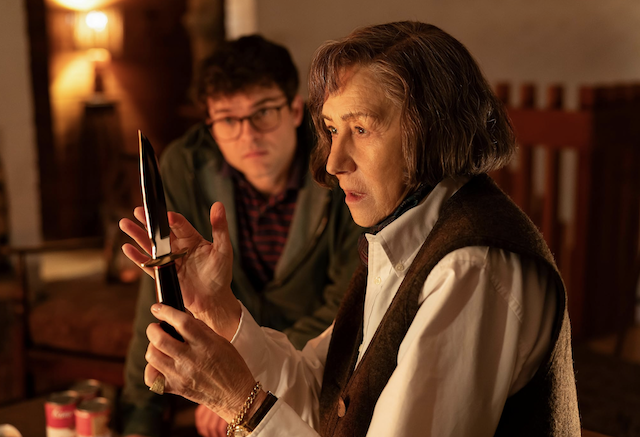
Helen Mirren : It was a great location. It was incredible. It was incredibly claustrophobic and very difficult physically to shoot in because it had a very low ceiling. It was just one long, thin room-which there is difficult because you can only move this way. You couldn’t sort of move like this. You had… It was very linear, and the ceiling was very low, and it overlooked this rather slimy pond, sort of a bit like the reflecting pool in Washington. There’s sort of frogs and weird things in it. And it was incredibly spooky house, didn’t you find?
Anton Corbijn : Yeah, very much so.
Helen Mirren : It was incredibly difficult to shoot in- technically, but on the other hand, brilliant for our sort of emotional and just the interior feeling of the play. So-lit was a great location you found.
Alden Ehrenreich : We would sort of shoot upstairs, and then Helen and I were, you know, people picture movies and all this stuff, and in this case, we each had like a little room in this house.
Helen Mirren : Yeah, it’s like a set.
Alden Ehrenreich : And so we’d just go up together to the room and shoot like eight pages of dialogue and then come downstairs and say good night. It’s like being on a cruise ship.
Anton Corbijn : I think we used every chair, you know, so we tried to make sure things moved around a bit.
Helen Mirren : Yeah. But it was brilliantly, designed-
Alden Ehrenreich : Yeah. Amazing.
Helen Mirren : ..and set dressed. It was brilliantly well done.
Anton Corbijn : It was nicely–because we didn’t change the house in itself, but we changed the interior.
Alden Ehrenreich : And it looked like what her house really… My understanding is that’s really what her- house looked like, right?
Helen Mirren : Yeah.
Alden Ehrenreich : Wow.
Q : Alden and Helen, it’s always said that Ripley and Patricia Highsmith were really intertwined characters in literary circles. I feel like your performances together really capture that intertwined spirit as well. So tell us a little bit about building that rhythm, building that kind of cat and mouse chemistry through these almost Russian Dolls of stories, story within story. How did you work together to find that?
Helen Mirren : Well, we were very fortunate in that a year before we shot, we had one week’s rehearsal with Anton, me and Alden together in a hotel room.
Anton Corbijn : In LA.
Helen Mirren : In LA. But- again, rather claustrophobic situation, just Anton’s hotel room. And, we kind of paced out. We got to know each other, and then we couldn’t make the film for various reasons for about a year after that. But then when we came back to make the film, we had very little prep time, hardly any rehearsal time.
Alden Ehrenreich : Yeah.
Helen Mirren : But that period we’d had was absolutely invaluable.
Alden Ehrenreich : Yeah.
Helen Mirren: And I think we were both lucky in the other partner. I certainly felt incredibly lucky to have Alden as my partner because, you know, there was just a level of dedication and professionalism and hard work and commitment that was extraordinary.
We didn’t have time to mess around on any level. I think as Alden said, but, you know, sometimes we did literally did 20 pages a day, which you know, unheard of in filmmaking, and dialogue-heavy. So it was very demanding in this awful house. But it was perfect for the purpose.
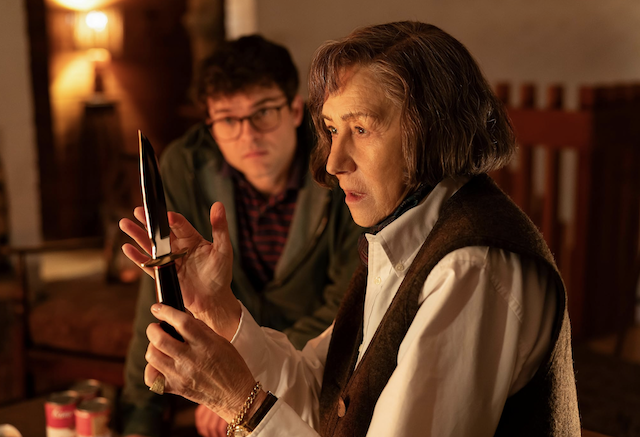
Alden Ehrenreich : We had one spatula in rehearsal- that was in Anton’s room that we used as a knife, as flowers, as snails. And I kept it. I have the spatula.
Helen Mirren : Yeah. Oh, you did?
Alden Ehrenreich :I do, yeah. It’s at my house.
Anton Corbijn : Well, I don’t think we’d ever did 20 pages in a day, but it felt like that.
Alden Ehrenreich : Yeah. Yeah.
Helen Mirren : I think we did. Well, certainly over two or three days. We did like 40 pages over two or three days.
Alden Ehrenreich : Yeah. And that was the big for me, that was the big appeal of this opportunity, was getting to do this chamber piece- and work this closely together, and we had an amazing DP.
Anton Corbijn : Very hands-on.
Q : And Anton, can you maybe talk about navigating these two stories, the real life versus the Ripley story that they’re creating? How much of that was already on the page, and how much of it did you find in the edit, toggling between the two worlds?
Anton Corbijn : Most of it was on the page, but the ending, we, I think we shot both ways in a way, and then we played it in the edit how, how it worked best, and I think the edit we have now I think is very satisfying.
Alden Ehrenreich : You know, we’ve never talked about this yet when we’re talking about the film, but there was a… I don’t know if it’s what gets used, but there was, we shot that last scene where I tell the story about killing my parents. We shot it where I was dressed as Edward, and we shot it where I was dressed as Ripley.
Alden Ehrenreich : And then we did one take, ’cause we shot on film, where we would roll on the beginning of the monologue and then cut, and then I’d go change, and then I’d come back-
Anton Corbijn : Yeah, that’s right.
Alden Ehrenreich : And we’d continue. That’s the one in the film. So it’s not, that blending is actually in camera. It’s actually physical. It’s not a digital effect. It’s shooting on film, changing, coming back, shooting more, changing, coming back.
©Courtesy of Bleecker Street Media
Q : And Helen and Alden, can I ask both of you maybe your collaboration with the costume designer? It’s very important here in terms of transformation. And for you too, Alden, you’re toggling between two characters, so the way they both present themselves is important. What was that collaboration like? How does that sort of enable you as actors?
Helen Mirren : You know, costume is incredibly important, even parts of your costume that are never seen. Maybe, like the socks you’re wearing or something. But we worked with a wonderful costume designers(Gabriella Pescucci and Uliva Pizzetti), basically, in my case, replicated basically what Patricia Highsmith wore. I couldn’t say Ayn Rand(Russian Born American Writer). Somehow, somehow she’s mixed up in my mind with Ayn Rand.
ALden Ehrenreich : They, they feel similar to each other.
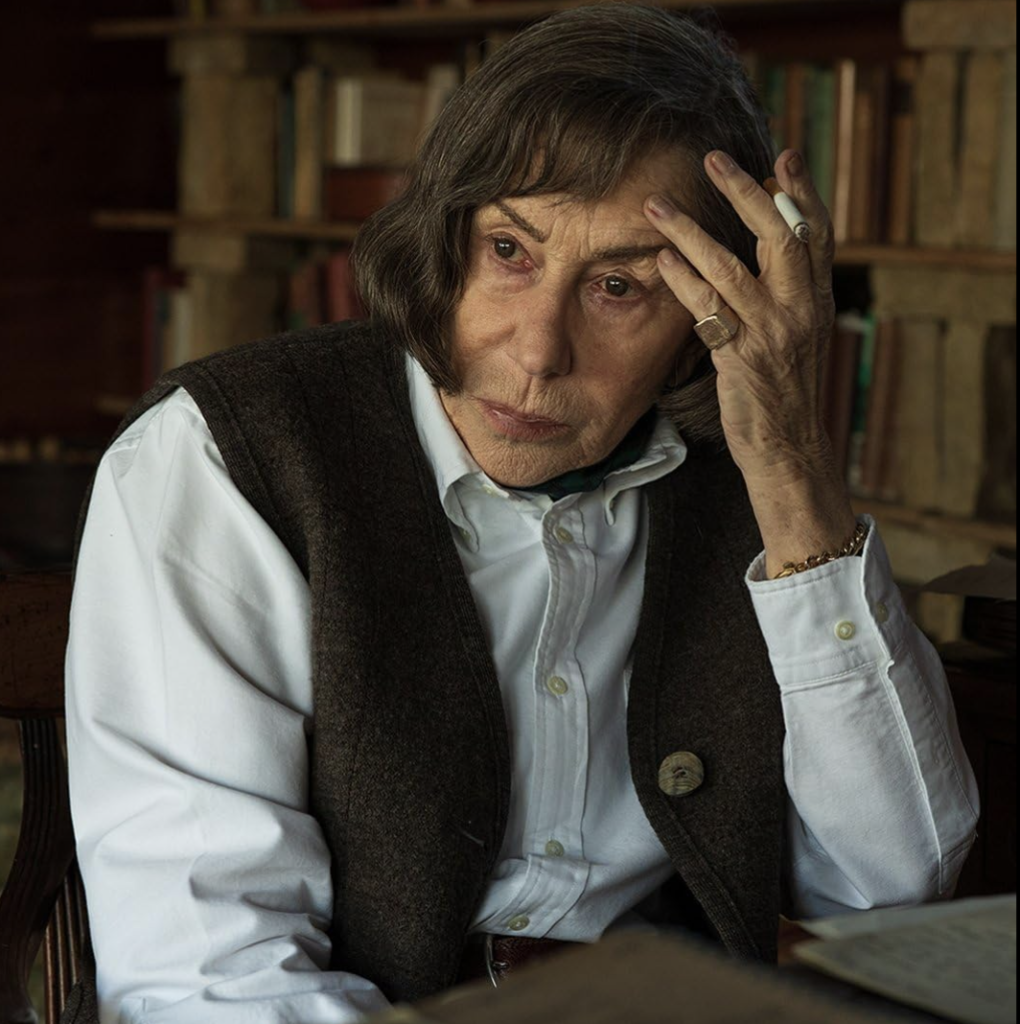
Helen Mirren : I don’t know why. It was very precisely repeating really what Patricia Highsmith wore. Men’s shirts, you know, doing up the men’s way. Men’s trousers cut like a man’s trousers, not like a woman’s trousers.
And then I got them to slightly build up my shoulders, not on the edges, but here in near the neck to give her that sort of hunched, kind of about to pounce kind of look, which is something that I had observed in her when I was watching the little bits of film that I had, I had of her. But costume is incredibly important.
Q : What was it like when people on set saw you for the first time as Patricia?
Anton Corbijn : Unbelievable.
Alden Ehrenreich : Yeah, it was wild.
Helen Mirren : I think it was pretty horrible.
Anton Corbijn : It’s very different.
Helen Mirren : Horrifying probably. I don’t know.
Anton Corbijn : But also great at the end of the day, suddenly Helen comes out.
Alden Ehrenreich :Right, yeah. It’s a completely… It was really striking for me to get to watch a master like her do that, and particularly that attention to costume and, and the effect of that because it really was like, felt like two different people.
Q : And what was it like for you with the costuming and different hairstyles to have some kind of distinct markers for both of these people?
Alden Ehrenreich : Yeah, I mean, the Edward version was really about finding the right… There’s a long stretch of the film that’s just one day, so when that’s the case, you really put a lot of thought into kind of nailing that look. So I think for the first two-thirds of the film, I’m in the same costume, so we experiment- I went into the middle of Rome and went like eight different glasses stores and tried on a bunch of glasses.
And then with the Ripley stuff, it was about part of the Ripley character and mythology is how is his taste for sartorial detail and how, and the Hermès scarf and the this and the that. So it was finding a way that each costume could have a little bit of detail and that kind of almost obsession with elegance.
Q : And I know Olivia Cooke is not here, but I would love us to give her her flowers too. She had a similar challenge as you. What was it like to partner with her, to have her as your scene partner in these two different stories?
Alden Ehrenreich : She’s fantastic. She’s an actor that… It’s so nice to talk loudly, actually. You get a lot. I was so asleep before we got out here, and now it’s like, she is such a terrific actor, and I didn’t know her, but I really wanted to work with her for a really long time, and Anton and I talked about her, I think, the first time we met. And she is an extraordinary talent.
She’s funny, soulful. And our scenes, you know, we had almost the inverse experiences, where Helen and I had lots of dialogue in one house, and Olivia and I had these little moments of dialogue in all of the locations all over Rome. Each of them was kind of a different adventure with her. It was great.
Q : Thank you. And maybe Helen and Alden, we can also take this moment to give floor to your director, Anton. I’m wondering if at the end of the day, and this is a question I love asking to actors, when you saw the finished film for the first time, were there any choices that surprised you? What made working with him unique and stood out for you? Maybe we can start with Helen.
Anton Corbijn : I can leave…
Helen Mirren : I haven’t seen it. You’re, you’re laughing, but I haven’t.
Q : I believe you.
Helen Mirren : I trust Anton absolutely, and I trust Alden absolutely. I always find it very hard to watch my work. I can watch it probably in a year’s time, but for the time being, I just let other people watch it and enjoy it. You know filmmaking is the ultimate absolute collaboration, and it is the artistic, You know, I’m married to a director(Taylor Hackford)..so, I have complete respect for the director’s vision, for the what… That’s what we’re there to kind of serve, you know? So whatever it is is what it is, and it’s all Anton’s, and, it’s what it is, if you know what I mean.
Alden Ehrenreich : Yeah. I mean, it was such a treat. Anton is such a consummate artist, and I’ll talk about you like you’re not here. The part we all knew, of course, would be taken care of so well is the visual because he’s one of the great photographers ever. And so the images and the beauty of that, getting to watch him and Robbie Ryan work together.
And then he just has great taste, so the people he brought on board, even from, you know, the, the producers, everybody who was a part of it, he just hired, like all the best people and created a very free, very collaborative environment. And when I saw it, it was even better than I thought it would be.
Helen Mirren : Yes, I was gonna say, the great thing about Anton was exactly that we were free to invent, to deliver, there was just an absolute freedom on the set for us to do what we’d never felt that I was a robot being pushed here and there. He gave us really enormous amount of freedom.
Anton Corbijn : Yeah, I always think you-hire people because of what they can do and how, how they do things. So I don’t want to get somebody who’s great in this to become this, you know? So I leave always a lot of space for actors to find the role-if you like.
Helen Mirren : Yes. Thank you. You’re quite right. You have to.
Q : Anton, maybe we can end on a question for you. The thing that I love most about “A Talent for Murder” is I feel like this is a movie that maybe Patricia Highsmith herself would really love-because it really has that spirit. What was the most important thing for you to get right about her voice, about her spirit of storytelling?
Anton Corbijn : Well, Helen took care of it, really. It’s basically getting Helen to play Patricia. That was just a masterstroke, the production in a way that Helen is so careful in how she puts Patricia Highsmith together. I felt that was pure, you know, as much as it can be pure, somebody you don’t know. But, we heard later from people who knew Patricia Highsmith when they saw the film that it was very spot on.
Helen Mirren : Really?
Anton Corbijn : It was really-
Helen Mirren : Really? I never heard that.
Anton Corbijn : Yeah. In Zurich, yes.
Helen Mirren : Oh, brilliant. Oh, fantastic. Yeah.
Anton Corbijn : Thank you
Alden Ehrenreich : The people who saw the film said she was just like Patricia Highsmith.
Q : People who knew her.
Helen Mirren : Our editor. Our editor who, she was just speechless after she saw the film.
Alden Ehrenreich : Oh, wow.
Helen Mirren : Oh, I never knew that. That’s fantastic. Oh, that’s great. Yeah. Great to hear. Yes.
Q : Thank you so much for this conversation, Anton, Alden, and Helen. Thank you so much.
Alden Ehrenreich : Thank you.
Helen Mirren : Thank you.
If you like the Q&A, share your thoughts below!
Check out more of Nobuhiro’s articles.
Here’s the trailer of the film.