

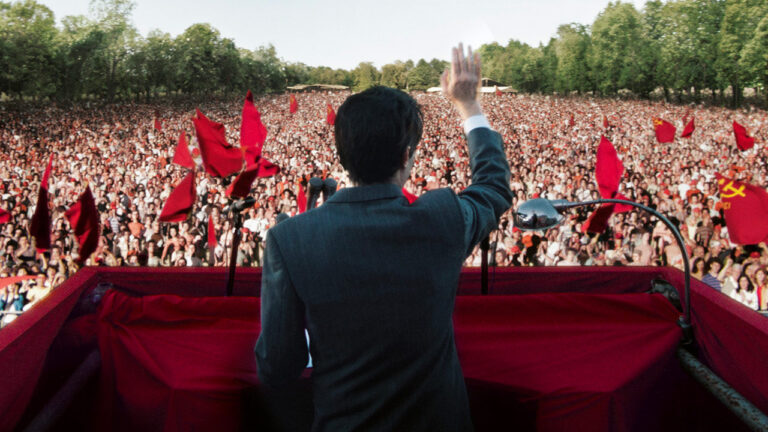
Those who aren’t familiar with Italy’s contemporary history and influential political leaders of the Sixties and Seventies, will have the chance to learn about the statesman Enrico Berlinguer with the film The Great Ambition (La Grande Ambizione), directed by Andrea Segre. The movie, that was first presented at the 2024 Rome Film Festival, is part of the line-up of the 2025 edition of Open Roads: New Italian Cinema.
Enrico Berlinguer’s ideology has been featured on the screen before, with Berlinguer ti voglio bene (Berlinguer, I Love You), a 1977 Italian comedy film written and directed by Giuseppe Bertolucci, starring Roberto Benigni as Mario Cioni, an underclass man in awe of the statesman. The figure of Berlinguer also made a brief appearance in Marco Bellocchio’s Esterno Notte, but comes across as unpleasant, something that filmmaker Andrea Segre fixes in his film.
The period described by The Great Ambition (La Grande Ambizione) goes from 1973 to 1978, which coincides with the hypothesis of the Historic Compromise (Compromesso storico. This was a a project of alliance between the Christian Democracy and the Italian Communist Party. The narrative shows how Berlinguer escaped an attack by the Bulgarian secret services in Sofia; how he was dedicated to the Eurocommunism initiative; and how he made covers of newspapers around the world. Despite Enrico Berlinguer’s strong determination to emphasise that the Italian Communists had nothing to do with the Soviet Union, the timing did not work in his favour. The assassination of the former leader of the Christian Democracy, Aldo Moro, carried out by the Red Brigades in 1978, shattered Berlinuger’s hopes for a New Socialism — a third way beyond the Soviet model and the Social Democracy. The film further includes the footage of Berlinguer’s funeral on June 13th 1984, after some captions that summarise what happened in Italy from 1978 onwards.
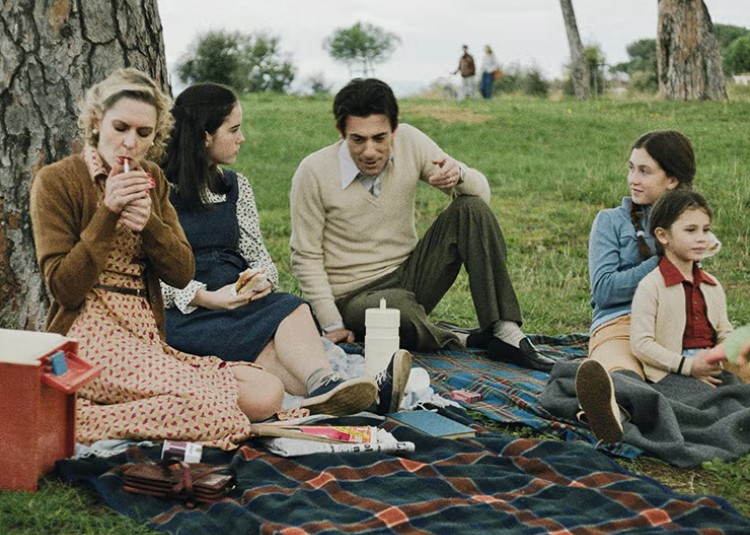
The story of a man, for whom life and politics were inextricably linked, is majestically conveyed in La Grande Ambizione. This is blatant when the film provides insight into the family man. We observe how Berlinguer would discuss politics offhandedly around a dinner table with his wife and children, because politics is a topic for all ages. Berlinguer’s decision to have his offspring live and breathe these issues comes across as a political choice, that echoes the words of Italian writer Natalia Ginzburg when she wrote: “As far as the education of children is concerned, I think they should be taught not the little virtues but the great ones. Not thrift but generosity and an indifference to money; not caution but courage and a contempt for danger; not shrewdness but frankness and a love of truth; not tact but a love of ones neighbour and self-denial; not a desire for success but a desire to be and to know.”
The impressive aspect of this picture is that it was written and performed by a generation that did not witness the political circumstances that are being portrayed. Hence, it is not the nostalgic work of someone who lived this chapter in history, but rather of someone who studiously selected it and reconstructed it to provide a historiographic understanding of what happened during that time.
Andrea Segre is an exceptional documentarian and his chronicle is accurate and compelling, as he uses archival material, creating an effective juxtaposition between footage and fiction. The potency of The Great Ambition lies also in the outstanding performance by Elio Germano, whose psychophysical identification with Berlinguer is impressive (a performance which won him the David di Donatello Award). The rest of the cast (Elena Radonicich, Francesco Acquaroli, Paolo Calabresi, Fabrizia Sacchi), is just as effective in evoking the people that marked this pivotal moment in Italian history.
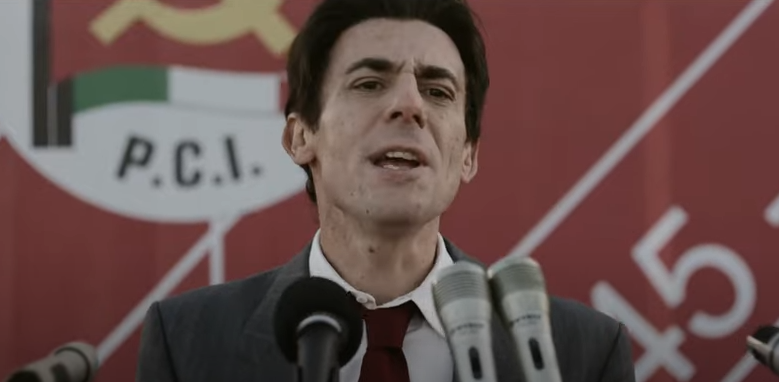
Italian Marxist philosopher Antonio Gramsci (who was the founder of the Italian Communist Party), during his imprisonment carried out by the Fascist government, wrote his Prison Notebooks, that are considered an influential contribution to 20th century political theory. In his writings he discussed how he firmly believed that a political leader must be ambitious, but that this ambition must be “great,” because only in this way does the leader respect, without any personal gain, the people who placed him in that position. This is the kind of ambition that is portrayed in Andrea Segre’s film, who uses Gramsci’s quote to introduce the film, that genuinely mirrors the moral strength and firmness of purpose that distinguished Enrico Berlinguer.
Final Grade: A