

Q: How do you feel about taking this reboot?
Hermione Corfield: It’s a huge honor. I am stepping into a beautifully detailed, very much loved universe that’s had a very successful run for eight seasons.Of course, there’s the pressure to do it justice, to make our show its own thing. But on the whole, the overwhelming feeling is excitement.
Matthew B. Roberts: For me, having led Outlander for the last five, six seasons, it’s been a different transition. We don’t have books to guide us on “Blood of My Blood,” so it opens up new possibilities, but we always want to stay faithful to the world of the Outlander television show.
Q: What is the main difference between this show and the original that will make the audience engage in a real new adventure?
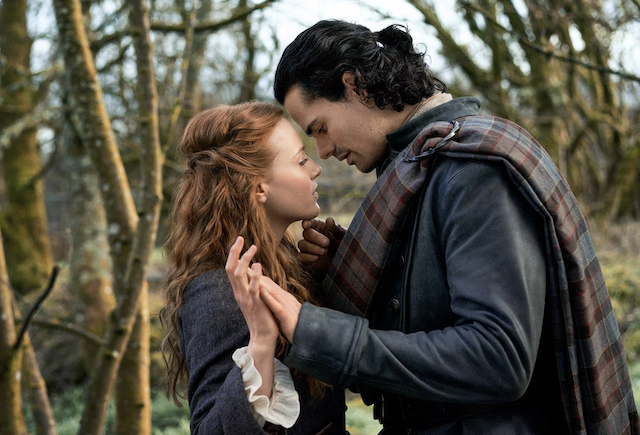
Matthew B. Roberts: There’s so much story to tell that we didn’t ever get to on Outlander. This is more of a prequel rather than a spin off. I always feel like a spin-off is when you follow the characters and they do something totally different than the original show. This is just adding more and more layers to the Outlander universe. We get to find out how Claire and Jamie’s parents meet, how they fall in love, how those love stories intertwine with each other, and how they help create Jamie and Claire.
Q: Was there a particular Claire and Jamie moment that deeply resonated with you and influenced how you approached your character in “Blood of My Blood”?
Hermione Corfield: I don’t know if there was a specific moment. I’m Claire’s mother. Jeremy Irvine and I had a conversation about what traits that she had inherited from both of us. I was keen never to do an impression of Caitríona’s performance, but instead to find the core of Claire and then the core of Julia, and work out in which ways are similar, which ways are different, and then build the layers on top of that in terms of building the character. Of course you’ve got to take inspiration and pay tribute, but I think it’s important to create your own character.
Q: You’re playing a character who is from a modern world but thrown into a very non-modern world. How do you play that level of knowledge that your character has, but not letting it completely dominate her?
Hermione Corfield: It’s a difficult line to tread. One of the big challenges was exactly that, taking a modern woman who’s on the forefront of the suffragette movement working in an office who suddenly finds herself in the 1700s. For a character to be interesting there has to be a level of agency for her, an ability to try and change her circumstances to a certain degree. What’s interesting to watch was done through the obstacles that she’s faced with. She can’t necessarily respond to them as she would in World War I England as a woman of that time. She has to find interesting ways to respond to them within the confines of being a woman that cannot really speak her mind. In a lot of circumstances, she is under threat of violence if she doesn’t do as she’s told. Julia is an intelligent woman who very quickly realises the stakes of how dangerous it would be if she was to behave in the way that she had in the 20s.
@Courtesy of STARZ
About the casting process, what did you do to prepare for stepping into this world?
Hermione Corfield: I was familiar with Outlander and I was familiar with the project. When I got the call saying that they wanted to screen test me, I then realized that Jeremy Irvine was playing Henry, which was a really lovely surprise because he and I have known each other for 10 years, so I was quite lucky in that aspect. Whenever you walk into those chemistry reads, it can be a bit of a challenge, while with him there was an immediate level of comfort, which was a huge advantage. Then it was pretty quick: I got told that I was going to Scotland. So I jumped on a plane and read the scripts on the plane.
Q: What instead was the casting process from your point of view?
Matthew B. Roberts: For Julia, it was very similar. As soon as we saw the read, at least from my standpoint, I was like: “Let’s get her on a plane, get her to Scotland”. Looking at the whole cast, It’s a little different for me because I don’t see the whole: Meryl Davis heads up casting force with Suzanne Smith, I only see the final three or four actors. When I finally see them it’s just something that I look for the characters that I’ve imagined in my head.
Q: Did anyone from the original Outlander cast offer any advice or insight going into this project?
Hermione Corfield: – I met Caitriona several times. Her main piece of advice was to enjoy everything, every single stage of it. A few days ago we had Comic -Con, we had that first big interaction with the fans. She said: “Take every single step and soak it” like the first time we’ve come to LA and had seen the billboards, for instance. Her advice is just to enjoy every single stage.
Matthew B. Roberts: The Outlander cast didn’t know about “Blood of my blood” until it was off the ground, really well into being made. There wasn’t a lot of advice that they gave me.
Q: What aspect of working on the show felt the most groundbreaking or creatively fulfilling to you?
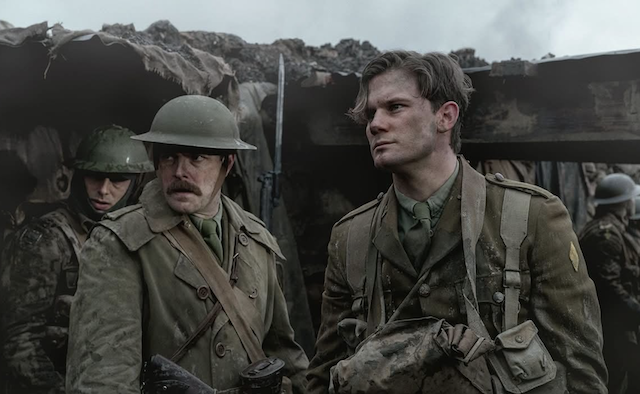
Matthew B. Roberts: There’s many, not just one. When we did the World War I stuff was amazing. Our director of the first episodes Jamie Payne really brought that to life. What we did in the redaction office felt like we were making a 1940s movie, there was something really rewarding about that because it nailed what we were trying to do, create this different timeline. The bridge scene with Ellen and Brian: when I first saw the location I thought they built it, but it’s a real location in Scotland. It was so perfect, almost identical to what’s on the page.
Q: What were the most challenging scenes to shoot?
Hermione Corfield: One day I heard about the worst weather of all time since the beginning of Outlander was the funeral scene.
Matthew B Roberts: The funeral was bad, but in the way that it was the worst, it was also the best. We actually hoped for that kind of day rather than a beautiful sunny Scottish day because it would have put a different light on the funeral. We wanted it to be that rainy day, it was fantastic. IThe challenge was that we had so many supporting artists and the production walking across the country a couple hours away from our studio. That’s always challenging.
@Courtesy of STARZ
What were your favorite spots after so long?
Matthew B. Roberts: With Scotland you can’t go wrong. From the borders to all the way to the north and the islands. Everywhere in between is something magical. It has to do with the light. In the summer, it’s light all the time. In the winter you have these long, beautiful twilights. If you were someone like me who gets up very early, you have beautiful dawns. It’s just the way the light hits the land. It’s a great place and the people are fantastic. They’re lovely human beings.
Hermione Corfield: I love Scotland. I love Glasgow, my sister went to university there, I knew the city quite well before I went. The landscape is just beautiful. Going out into the Highlands and being able to just leave, get in a car and drive for a beautiful walk or go swimming in a lock, that is amazing. We don’t have anything quite like that in London.
Matthew B Roberts: We haven’t in L.A. either. I’ve been there for 14 years. For every place you see for shooting, I’ve probably seen 10 places before we get to that place. So I’ve seen a lot of Scotland, there’s always something new around the corner. I could spend a lifetime there and still not see everything.
Q: What did excite you the most about expanding the original Outlander universe with this origin story?
Matthew B. Roberts: There was so much story there to tell that it was naturalWhen you get into the writer’s room and you start going: “Maybe we could do a flashback or maybe we can tell that story” and you just don’t have enough time in Outlander.
Q: Can you talk about the costumes in this prequel and how they help inform your character?
Hermione Corfield: Trisha Biggar’s eye for detail as a costume designer is so extraordinary. Every single time I go into a fitting, they’ve got some other amazing jacket that’s been handmade from the most beautiful tweeds and wool.bIt all feels, exactly as it should if we were in that era. It absolutely informs the performance, particularly going from 20s, which has looser fits and is a bit more straight shaped. You then go into the 1700s and everything is fitted and corseted and it pulls you in and makes you sit up straight.
If you like the interview, share your thoughts below!
Check out more of Adriano’s articles.
Here’s the trailer for Outlander: Blood of my Blood: