


©Courtesy of Watermelon Pictures
“The Great Ravine” boasts valuable mineral deposits and fertile agricultural soil, but it is claimed by two rival nations. Frankly, it sounds a bit like the Kashmir Valley, especially since it appears in an animated feature produced in Pakistan. Unlike his neighbors, master glassworker Thomas Oliver wants nothing to do with the ruinous war to control the disputed land. He prefers to focus on his young son Vincent’s training in the art of glasswork. Yet, war comes to their seaside furnace anyway in Usman Riaz’s The Glassworker, the first release (of hopefully many more to come) from Mono Animation Studio, which opens this Thursday in theaters.
Viewers know from the prologue that shy Vincent Oliver eventually grows up to become a master artist. Unfortunately, it will not be easy. Even though his father home-schools him, the local boys still bully Vincent whenever the chance arises. It only grows worse after the war ignites. Young Oliver not only inherits his father’s glass-working art and trade, he also suffers from guilt-by-association, stemming from his father’s outspoken pacifist ideals.
The sensitive lad has only one friend, Alliz Amano, but their relationship quickly turns rather complicated. It is clear Oliver carries a romantic torch for her—and the feeling might be reciprocal. However, Amano’s snobby mother prohibits even a platonic relationship with a lowly underdog like him. She expects Alliz to always remember her position as the daughter of revered Colonel Amano, who transferred to Waterfront Town to shore up the border defenses.
 ©Courtesy of Watermelon Pictures
Inconveniently, Col. Amano “requests” the Olivers’ glass-working services for a top-secret war project. Meanwhile, Waterfront still shuns the dissenting father and his son. That is a lot for the young titular glassworker to handle, but he continues to refine his art, despite the social stigma.
Vincent also occasionally wonders about the djinn living in the grotto beneath his father’s workshop. Some djinns are good, like Idris Elba in Three Thousand Years of Longing, while others are bad, such as those in many recent Middle Eastern horror films. This one has yet to reveal its true nature. Instead, it mostly just lends a slight fantastical flavor to a very dramatic and heartfelt coming of age story.
Riaz and his collaborators make no secret they took great inspiration from Studio Ghibli, even recruiting Ghibli’s international producer, Geoffrey Wexler, as a “creative consultant.” That Ghibli influence is clearly reflected throughout the film, especially in the character design. In fact, The Glassworker would pair-up perfectly for an animated double feature, both thematically and stylistically, with Miyazaki’s The Winds Rises (which chronicles the life of aeronautical engineer Jiro Horikoshi as he navigates the rising Japanese militarism of the 1920s and 1930s). As a result, any fan of Japanese anime will feel right at home watching The Glassworker.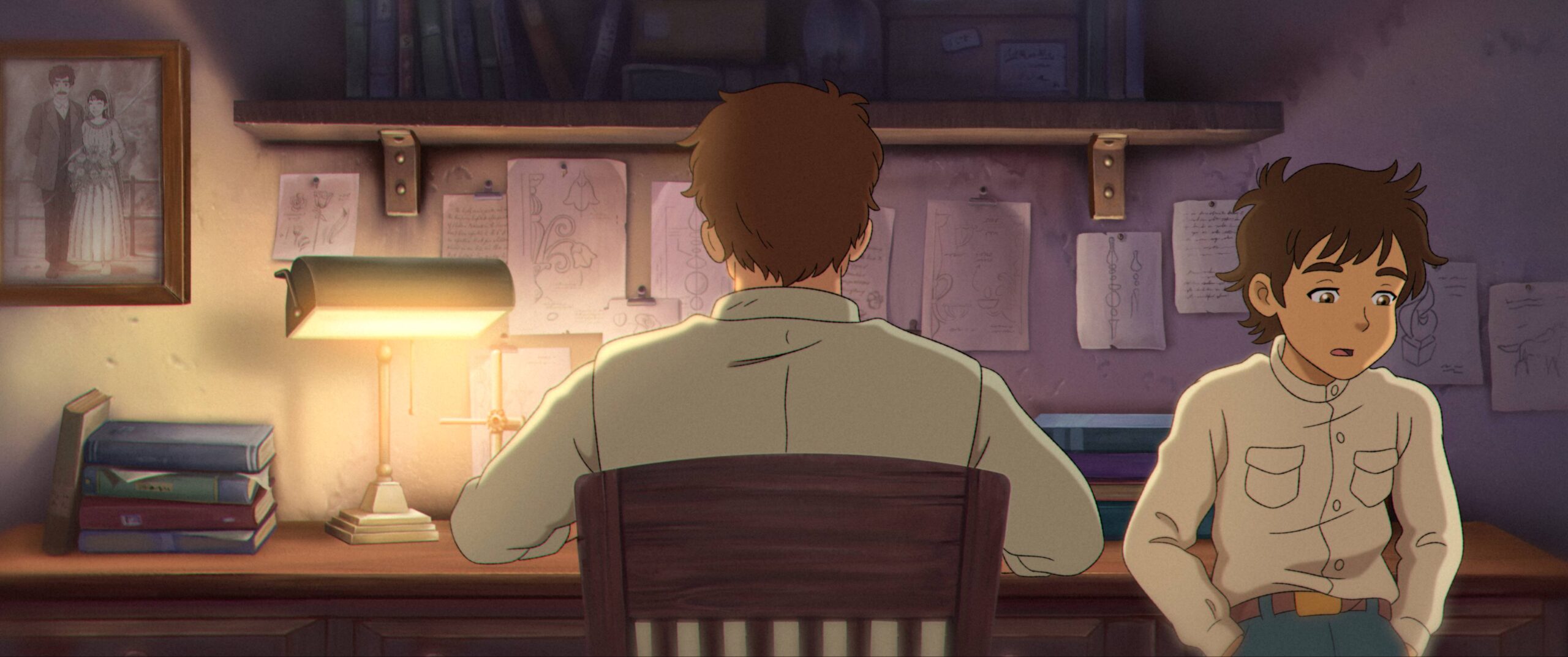 ©Courtesy of Watermelon Pictures
While Riaz’s film has the benefit of novelty, representing Pakistan’s first entirely hand-drawn animated feature, as well as the country’s official international Oscar submission last year, the animation measures up nicely when compared to any contemporary release. Riaz and his fellow animators lovingly sketched and polished a wealth of striking visuals, such as the picturesque town of Waterfront and the pseudo-steampunk-ish amphibious airships patrolling the skies.
As a nice bonus, the film sounds almost as richly crafted as it looks, thanks to the delicate classical score, composed by Riaz and Carmine Di Florio. Fittingly, the orchestrations heavily feature strings, since Alliz Amano is a virtuoso violinist. Among the English voice-over cast, Art Malik’s warm baritone invests Thomas Oliver with audible moral authority, without sounding heavy-handed.
Admittedly, some of Vincent’s melodrama arguably might have been mitigated through better communication, but that also often seems to be the case in “real-life.” Regardless, Riaz and company perfectly capture the bittersweet, feel-good-by-feeling-sad vibe that distinguishes many of the best anime classics. Plus, the anti-war themes are expressed in complex and sophisticated ways that never come across as simplistic or didactic. Highly recommended for anime/animation fans, The Glassworker opens this Thursday (8/14) in theaters.
 ©Courtesy of Watermelon Pictures
Grade: A-
If you like the review, share your thoughts below!
Check out more of Joe’s articles.
Here’s the trailer of the film.