

©Courtesy of A24
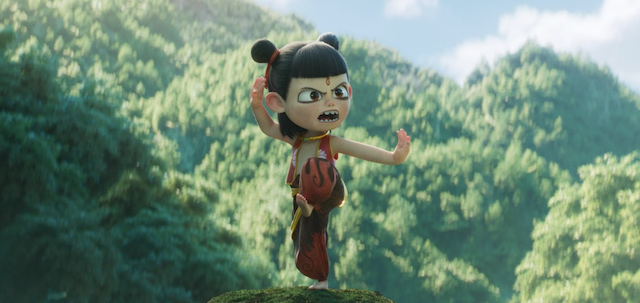
In Wan Laiming’s classic 1961 Chinese animated film, the Monkey King created real Havoc in Heaven. Similarly, in this film, Ne Zhe, the Buddhist guardian folk hero, eventually leads a genuine insurrection against the celestial rulers, worthy of John Milton. Both films illustrate the Mainland Chinese movie going public’s continuing preference for god-like characters, such as Sun Wukong (the Monkey King) and Ne Zhe, despite the Mainland regime’s officially materialist (and atheist) ideology.
Indeed, the near-Divine retain such popularity with Chinese ticket buyers, this animated sequel smashed global box-office records. The Heavens will shake, but Western animation fans will not fully share the adoration for director-screenwriter Jiaozi’s Ne Zha II, which re-releases with a new English dub track this Friday in theaters.
Just as The Monkey King originated in Journey to the West, the popular heroic conception of Ne Zha sprang forth from the pages of the Ming Dynasty novel Investiture of the Gods (ascribed to either Xu Zhonglin or Lu Xixing). However, if you are well acquainted with that 100-chapter tome, try to forget it during Jiaozi’s film.
 ©Courtesy of A24
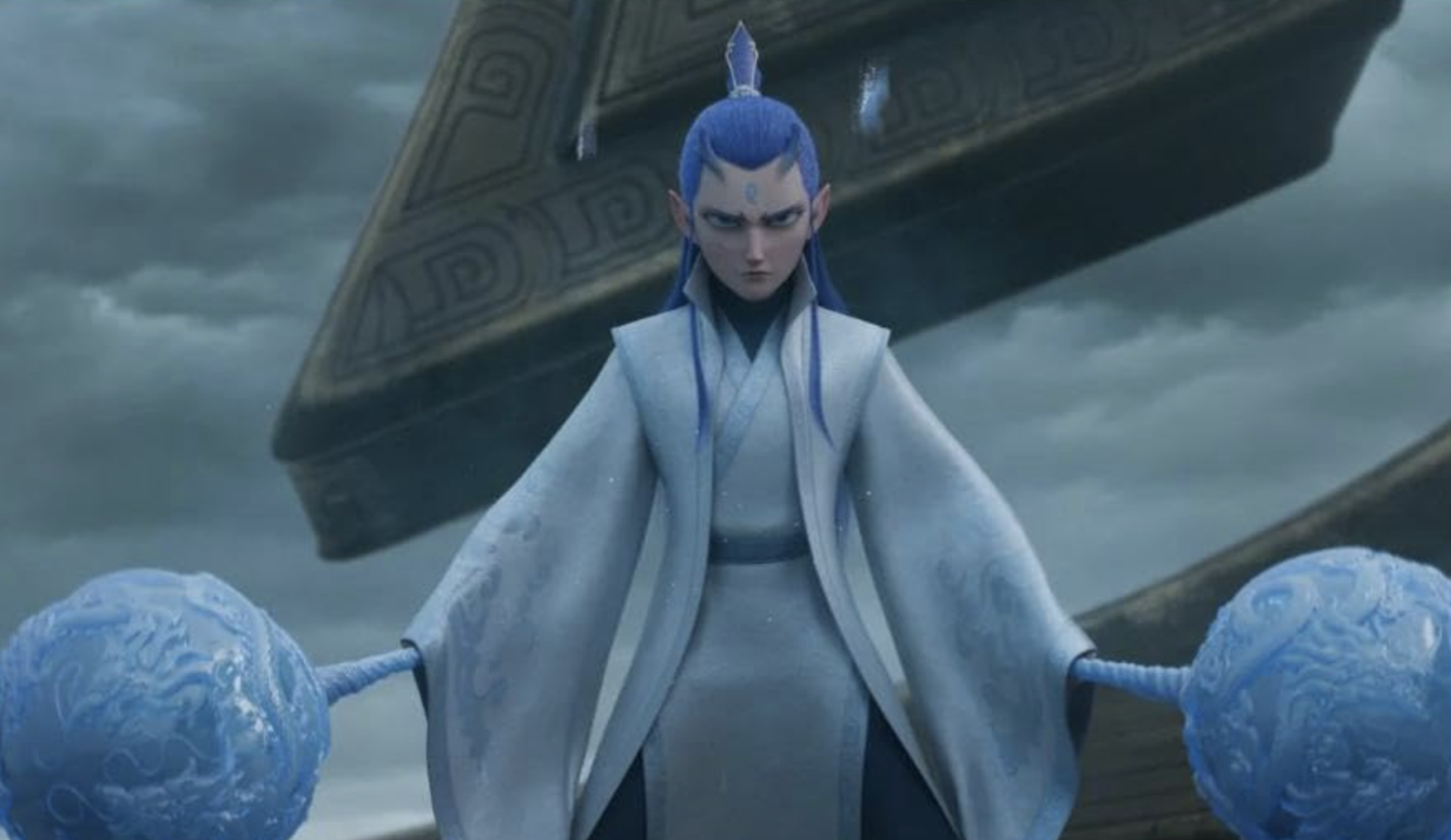
Sort of like a Chinese Romulus and Remus, Ne Zha and Ao Bing were born out of the all-consuming Chaos Pearl, whose power nearly destroyed Heaven and Earth. To avert catastrophe, it was split into the Spirit Pearl and the Demon Orb, out of which Ne Zha and Ao Bing were born, in human form, to mortal and dragon parents—or something like that. Just remember their origins are closely linked.
At the end of the first film, Ne Zha and Ao Bing recombined to foil the curse placed on the Demon Orb’s spawn, but it took a great physical toll. Hence, the sequel finds them both commencing the ceremony of rebirth, when the dragons suddenly attack. Inconveniently, Ao Bing’s flimsy new body and the regenerative Sacred Lotus are damaged in the resulting battle, so his spirit must take refuge, cohabitating inside Na Zha’s body, for the next seven days.
To restore the Lotus, they need a healing elixir from the Chan Sect, who rule the Heavenly domain. However, before claiming the elixir, Ne Zha must first attain immortality, by completing three heroic missions—you could almost describe them as Herculean. Not surprisingly, his body performs at a much higher level when he allows Ao Bing sole control, but the impulsive Ne Zha has difficulty letting go.
 ©Courtesy of A24
At this point, Jiaozi is only getting started. There are roughly two hectic hours of further Heavenly intrigue left to go in the film. Yet, throughout it all, Ne Zhe’s reckless fighting spirit will feel like Deja vu to anyone who has watched more than one Monkey King adaptation in recent years.
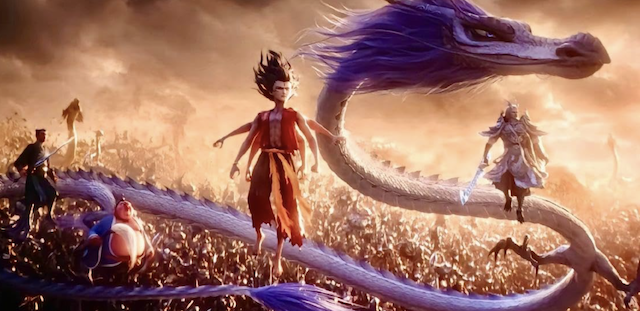
Granted, Jiaozi and the animation team created some memorable visuals, especially when Ne Zha battles a tribe of marmot demons, who are bizarrely cute. Frankly, many viewers will root for the marmots. Nevertheless, most of the fantastical and cosmic elements have ample precedents. Fortunately, the film’s high energy-level does not allow the audience much time to contemplate where they have seen it all before.
Indeed, Ne Zha II boasts plenty of silly gags and epic battles, but beyond the impetuous Ne Zha, most of the characters have little to distinguish themselves, including Ao Bing, who is blandly cerebral and reserved, to a fault. The most dignified-sounding vocal performances come from Vincent Rodriguez III and the great Michelle Yeoh, as Ne Zha’s warrior-parents, Li Jing and Lady Yin, but their characters are frustratingly wooden, even when they are not literally magically petrified for their own protection. In contrast, Rick Zeiff’s shticky, over-the-top voice-overs for Taiyi Zhenren, Ne Zha’ teacher, spiritual advisor, and designated comic relief, quickly grow tiresome.
Frankly, characterization represents the film’s greatest weakness, perhaps by design, as befits the ostensibly collectivist nature of the ideology governing its country of origin. Eventually, the film builds into a grand cosmic battle, in which the opposing armies coalesce into giant aggregated waves, that swirl and crash into each other. It becomes a meaningless blur to viewers, because it entirely lacks human scale. Yet, in a way, it serves as a perfect metaphor for the film.
Frustratingly, the film’s best scene comes in the form of a mid-closing credits stinger, which delivers amusing slapstick comedy out of its clever set-up. Arguably, it is the most original scene in the entire film—and it takes nearly two and a half hours to reach it.
Still, a lot of effort and expense went into Ne Zha II, as the audience can easily see on the screen. Yet, there will be at least a dozen anime features released this year in Japan that are more inventive and emotionally engaging. Yes, this film grossed over $2 billion worldwide, but the overwhelming lion’s share came from China, which box-office commentators should duly note, largely remains a closed market, protected from international releases. The simple truth is Ne Zha II fails to live up to its hype, when it re-releases this Friday (8/22) in theaters.
Grade: C-
If you like the review, share yopur thoughts below!
Check out more of Joe’s articles.
Here’s the trailer of the film.