

@Courtesy of HBO MAX
Q: Can you talk a little bit about the theme that rules Season 3?
Julian Fellowes – I’m always rather fascinated by people who pretend that the loss of money, the loss of position doesn’t affect them at all, that everything can just go on as it did before. Here we have Agnes, who believes in the essentially European concept of greatness by birth that can’t be shifted. She starts out confident that everything will be as normal. Ada, through Cynthia’s wonderful performance, is content for Agnes to pretend that not too much has changed, but of course it has. During the season, we see Ada gather the confidence that belongs to her, that is her right. I just wanted to explore that shift. The English are very given to believing that the loss of money hasn’t affected anything. The Americans are a more realistic nation about how it is now. They understand the change that has taken place, but they don’t feel it’s their business to make the change obvious. It has to be between the sisters, they have to come to terms with what is different. That’s what I was interested in exploring.
Q: When it comes to figuring out the arc of a season, how do you start? Are there certain historical signposts that you want to hit? How do you plan out what you want to do in any season?
Julian Fellowes – We talk it through. We make sure we know where we want to get to. The issue then becomes how we get there. As you know, we like to have some true historical events in it to make it real, make it believable and hopefully make it interesting. But basically, the first thing to settle is where you’re going and then you have a discussion about your route.
Q: In this season, the Russells, who have been an ideal couple, experience their marriage going in a different direction. What was it like to explore that different dynamic?
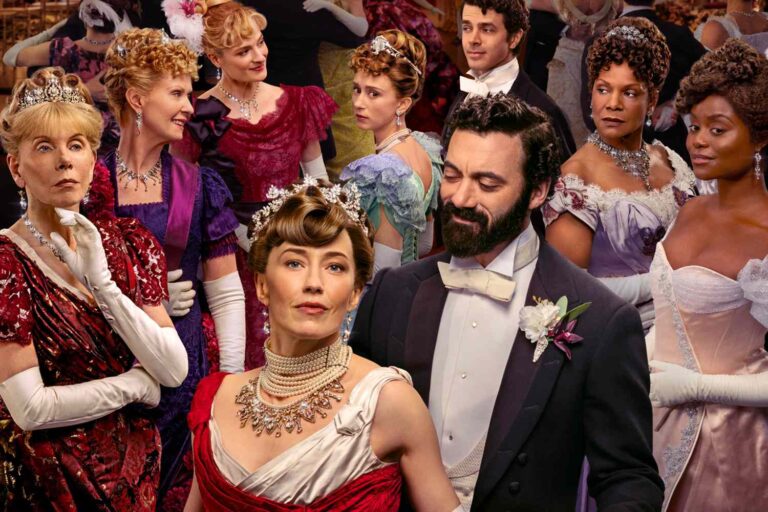
Morgan Spector – I personally found it hard to let go of the marital harmony the two of them have had for two seasons, and find myself searching even in the scenes when we were in conflict for connection between the two of us. The rift that develops between them is not a minor one, it’s a very structural disagreement. What is being expressed through that disagreement are the same shared values, the same shared ambitions that brought them together in the first place. They see the situation of Gladys’ marriage in a fundamentally different way. It’s hard, they were tough scenes to play.
Carrie Coon – George can’t really understand the stakes for a woman. He doesn’t understand our instinct for survival, which is in this case through marriage. Bertha believes what she’s doing is an existential question. She wants her daughter to be safe. She also wants her to be fulfilled and have a sense of purpose, because Bertha knows what it feels to have that capacity thwarted. She’s hungry for her daughter to have the power she didn’t have. There’s a lack of psychological understanding between them that’s fundamental and quite sad.
Morgan Spector – I don’t think George can really let go of the fact that there’s an implicit critique of his own position in society that Bertha is making. If you have to marry an English aristocrat to feel like you’ve arrived, then the status that George has built for himself isn’t enough. That’s another source of sort of tension and unspoken friction between them.
Q: What was it like to play Gladys as she’s a chess piece?
Taissa Farmiga – Gladys is pretty used to being a pawn that Bertha loves to move around. I was quite used to that, to be honest. What’s beautiful about this season is that there’s the big decision, the big moment that happens in the middle of the season that is part of the rift between her parents. But at the end of this season Gladys finally catches a glimpse of: “Bertha was right.” The thing that Gladys wanted most is freedom: to attain that it’s not choosing what you want to do, it’s the power to be able to do it. It brings her closer to Bertha than she would have expected. She thought freedom was running the opposite direction from her parents and especially Bertha’s guidance. And in the end, it actually was turning towards her mom.
 @Courtesy of HBO MAX
Q: What is it about Marian that appeals to Larry? Why are they kindred spirits?
Harry Richardson – What’s really special about their relationship is that they have the opportunity to grow as friends first. At that time they didn’t have the space to be able to go out on the town or to get to know each other before they started seeing each other in a romantic light. Their dynamic’s written very beautifully, that foundation of friendship, that foundation of care for each before they start contemplating a romance.
Julian Fellowes – The exact reason why Larry wants Marian is precisely the same that makes her resistant to the idea of settling down. She wants her life to be something. She wants to do something that adds up to more than getting dressed for the opera or not being late for dinner. That is what he senses in her. He senses an independent spirit who has other things to do. But in that society, it was very difficult for women who weren’t content to simply run the house and run the children. One of the key moments of growing up, for all of us, is when you realize you don’t have to follow your parents’ prejudices. It’s not disloyal, it’s just an acceptance that you are a different person from your parents.
Q: Cynthia and Christine, your dynamic changes pretty dramatically this season. What was it like to explore that and their relationship?
Christine Baranski – It’s not good news for Agnes, but it’s great news for Christine and Cynthia. When the royalty falls off the throne, it makes for a good story making and it also makes for delicious comic moments. We’ve had a lot of fun with it, haven’t we?
Cynthia Nixon – Yeah, it’s been so great. As Christine says, to put these characters in different situations. It’s not interesting to watch the same character do the same thing over and over again. It’s fun to take them and put them in a wildly different situation and watch them flounder and scramble and try and fake it till they make it.
Q: Ada seems to enjoy having the power. Do you get that sense?
Cynthia Nixon – She does. It’s been a long time under Agnes’ thumb, a very long time. She’s thrilled. She’s terrified. She’s trying to do something and she’s making a lot of mistakes. But she’s trying to mature into this great responsibility and power and freedom that she’s been given. And unlike Gladys, she doesn’t have a female relative who is pushing her…
Q: Do you see any parallels from season 3 with what’s happening in our world today?
Julian Fellowes – We were very conscious that we were in another ego world waiting just below the surface to come bouncing out again.I think we’re living in the middle of that now. Politically, the world is so strange at the moment that it’s almost impossible to say who you’d vote for anymore. In terms of the way we hurt each other and the way we scheme, and we care about our own prestige. I think there are many parallels between The Gilded Age and now. The real message you’re giving the public is this is happening then, and this is happening now. You must be aware if a situation like this arises for you, you must be ready.
Q: Bertha is not climbing society anymore this season. She will be controlling it, even within her own family. As an actor, how do you navigate the tension between her maternal instincts and her calculated ambitions?
Carrie Coon – By controlling my own family. It’s good practice. It’s in the story, it is in the writing because I relate to it. I relate the desire to make sure my daughter is successful and safe, or not worrying as much about my beautiful white boy. I’m aware that I have more work to do in order to safeguard my daughter, who’s a very strong-willed person. Respect for female ambition, frankly, something we’re still working on. Women have such a double standard, there’s such a fine line to walk for women in power still. Especially women of color. It feels very relevant to me. Entering what’s happening tangentially, the way this show does, you have some distance from it in which to contemplate your own circumstances more safely. It’s thrilling to get to do it. I have a lot of respect for what Bertha’s doing because I understand why she’s doing it. You may disagree with the way she’s going about it, but it is rooted in a deep love for her daughter.
Julian Fellowes – One wants to represent these arguments as being reasonable on both sides. Some members of the audience should sympathize with both sides of the argument. I agree with you about Bertha.
 @Courtesy of HBO MAX
Q: How much does your involvement and engagement and exploration of these characters impact you both, not only as a performer, but also as an individual?
Christine Baranski – Agnes has had a happy effect on me because I try to speak now in declarative sentences, say exactly what I mean, put a period at the end of that statement, and not apologize. This is a woman who says what she means, whether you agree with her or not. She has the courage to just say, this is the fact, this is how I feel, and she doesn’t spend a lot of time apologizing for it, which is a lesson for all women.
Julian Fellowes – The truth of the matter is, Agnes is a wise woman. She is also a snobbish one and prejudiced, but she is a wise woman. Agnes knows the real issue of the day is whether or not women will get the vote. Compared to that, everything else is not even secondary, it’s a long way in the distance. She has one of those brains that can spot what is the important element. I admire her for that. Soon, not soon enough, women will have the vote. And the whole of politics will alter in the West and she could see that.
If you like the interview, share your thoughts below!
Check out more of Adriano’s articles.
Here’s the trailer for The Gilded Age Season 3: