

@Courtesy of MUBI
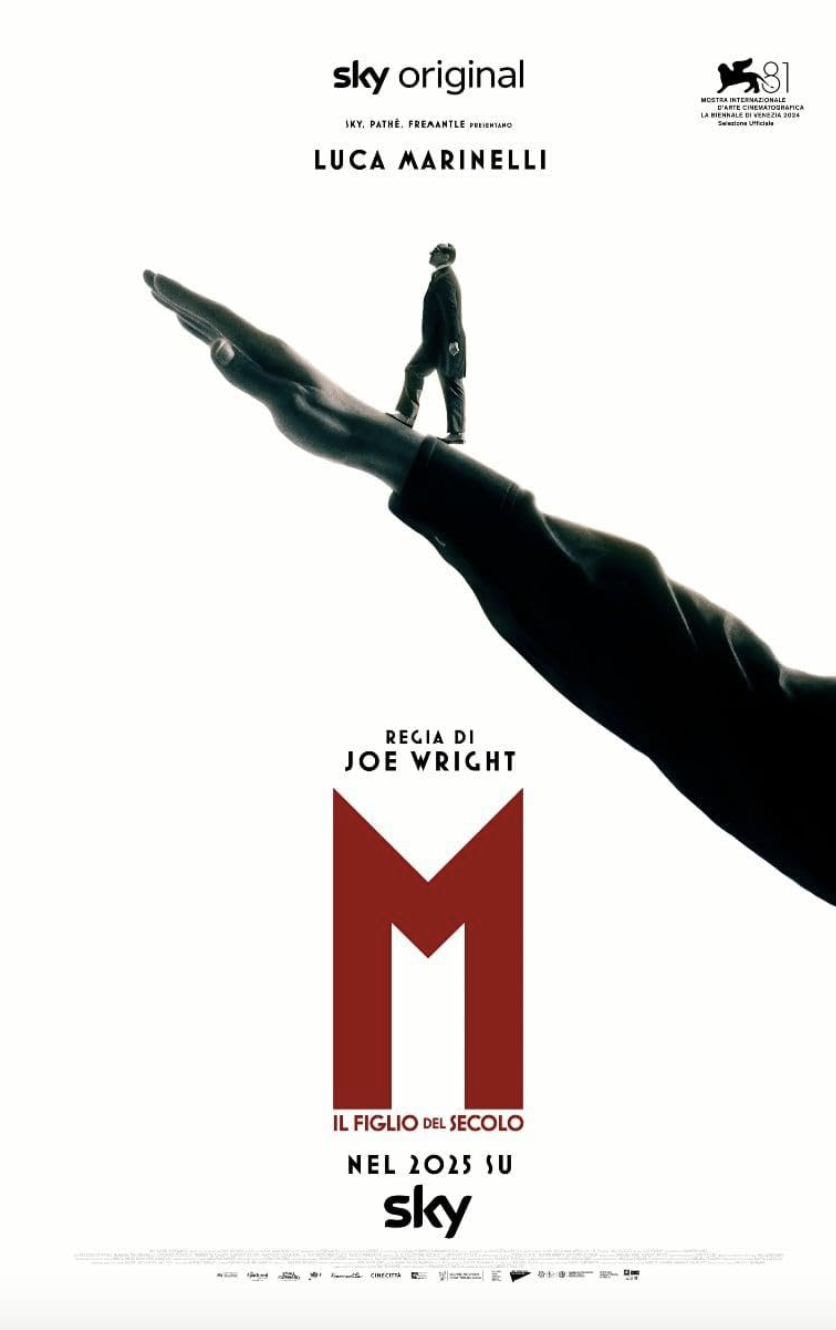
Exclusive Interview With Director Joe Wright
Q: When and why did you decide to break the fourth wall with the main character, letting him talk to the audience and try to explain – or to hide – his mind and feelings?
Joe Wright: In Antonio Scurati’s fantastic book there’s a small section at the beginning where Mussolini talks in first person. That truly inspired us to develop that idea into having Mussolini speaking directly to the audience. It was important for us to break down the barrier of history, of time, and have Mussolini reach across into our living rooms and address us directly. tWe wanted to bring it into the present, because it seems that the parallels are so clear with our contemporary situation that it was important to bring him into the present. This idea that he is attempting to control the narrative which as the show goes on as you know he begins to lose control of.
Q: Following your answer, to me this character is contemporary because he’s very aware of who he is, of his shortcomings or his strength, but at the same time he’s not capable of totally controlling the narrative of Italy under the Fascism. How did you work on this double side of Mussolini’s character?
Joe Wright: It was about trying to understand the man and to see him, see past the demon or the icon and understand the human beneath those projections, those personas. I don’t think it’s very useful to always set these characters as other than us. If we approach them as humans, then we can learn and take responsibility.
Q: The way you decided to direct and to edit the episodes made me think about Futurism, and Leni Riefensthal. Can you talk about the influences, any director or artist that inspired you when you started thinking about how to compose the aesthetic of M?
Joe Wright – All cinema comes into play when you’re thinking about the best way to articulate a story. The futurists were obviously a massive influence. They told me a lot about the feelings of the time, this feeling of speed and momentum and propulsion. The movie A Man With the Movie Camera by e Dziga Vertov, the great Ukrainian movie, was a massive influence. It seemed to tie in a lot to the futurist ideas. Also Scarface by Howard Hawks: I was intrigued by the whole gangster genre, but in particular that one, because of the cinematic stylization, the artifice of it. I was interested in revealing the artifice of the filmmaking so as to try and have the audience apply critical thinking. Not always to be sucked into empathy, but to empathize at times and then be pulled out to reply is some critical thought to perhaps why they were responding in the ways that they were responding.
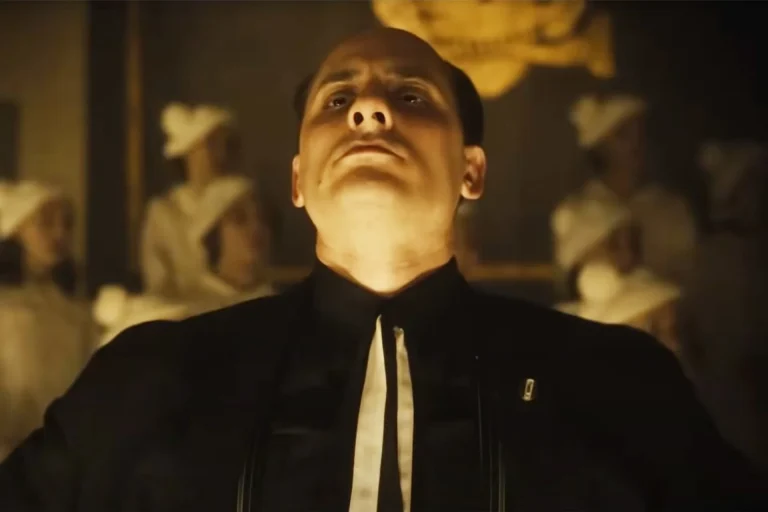
Q: Luca Marinelli, in my opinion, gives the performance of a lifetime. He’s grotesque, funny, threatening. How did you work with him in order to compose all the layers of Mussolini’s persona?
Joe Wright: Luca is, without question in my mind, one of the greatest actors working today. It was a great privilege to work with him. It was very exciting to me, having worked extensively in the UK and in the US, it’s a very different acting. You have a very different heritage in Italy: the British heritage is about text and the American heritage is about psychoanalysis, whereas the Italian heritage is this wonderful physicality that we see in so much of the Italian film and theatre. So working with an actor who is not afraid of physicalization, of action, of vocal arias, was very exciting. I just encouraged him and gave him my faith and belief, we talked about our responsibility as men and towards our own masculinity, and these ideas throughout the 127 days of shooting.
 @Courtesy of MUBI
Q: During the shooting, was there a scene that was particularly challenging to realize not only in a technical way, but also in an emotional way?
Joe Wright: For Luca and I both, the most challenging sequences were the parliament scenes on a technical level, but also as you say on an emotional level, because the words spoken were verbatim of Mussolini. For Luca to actually know that he was really speaking and having to believe in those words was, was really challenging. The whole relationship with Giacomo Matteotti, we both found it utterly heartbreaking and painful.
Q: The series explores Mussolini’s life and politics from 1919 to 1925. If you’ll have the chance to do a second season, how far would you go with Mussolini’s life?
Joe Wright: If I had a chance to do a second season, it would possibly be about his relationship with Hitler. I find this terrifying relationship between the fanboy Hitler, who was writing Mussolini letters of adoration early on and then overlooked Mussolini in power,I realized that I find that relationship very fascinating.
Q: Especially the last episodes we see that Mussolini and fascism become two separate things. There is the personal agenda and the party, the ideals of the party. Do you think that this split can happen also in contemporary politics, in contemporary life?
Joe Wright: Yes, I do. I think there was a psychic split and it was very dangerous for him as a human being, this split personality. He used this bogus ideology to gain the power and the adoration that he craved on a psychic level. I don’t really think he genuinely believed in anything he was saying. A means to an end. It’s pretty clear.
If you like the interview, share your thoughts below!
Check out more of Adriano’s articles.
Here’s the trailer for M: Son of the Century: