

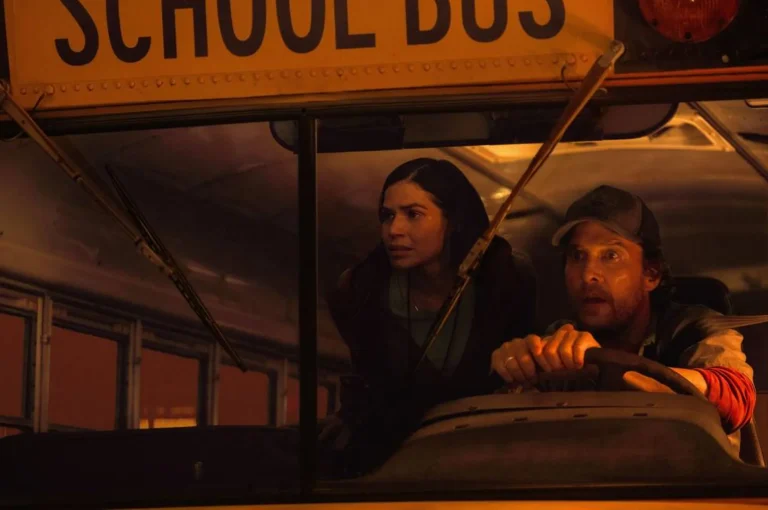
@Courtesy of Apple TV+
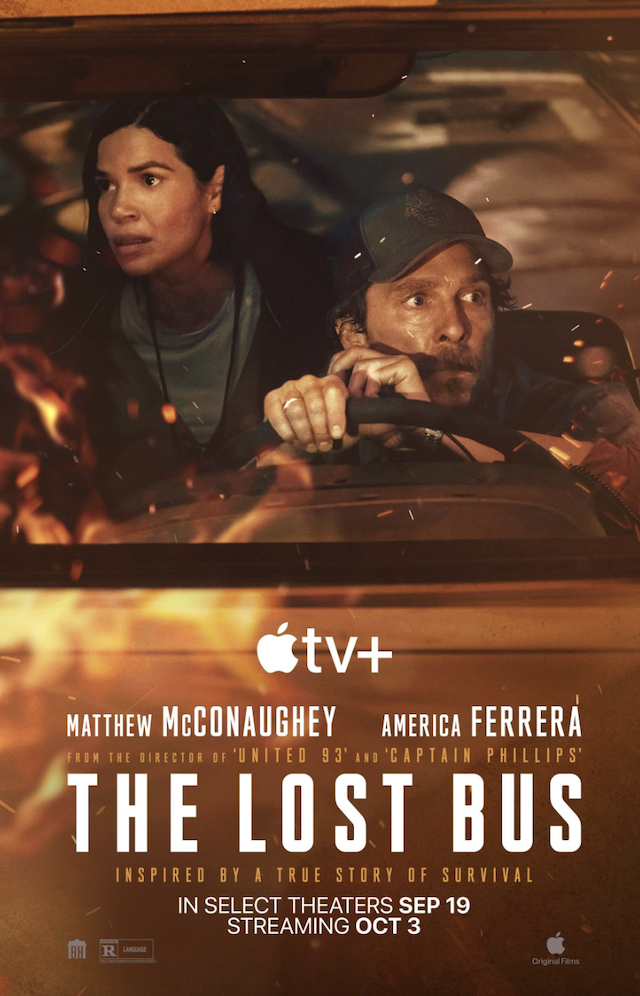
Q: What got you attracted to this movie? Why did you choose this one to continue and come back?
Matthew McConaughey: I had wanted to work with Paul Greengrass but never received a call from him, it was nice to get that call. I like his taste, the way he handles large scope action but also intimate interpersonal drama, the way he balances that in his films. I read the script, I thought it was worth watching and worth making. To know that it was based on true events gave me more reverence to want to be a part of it. There’s a bit of a privilege that comes with telling something entertaining and fictional that the film can be that was based on real life events. It’s devastating, it’s penetrating, it doesn’t shy away from any of the horror and the pain and loss, but at the same time, at the centre of it, this choice to tell a story about these two people, a bus driver and a teacher, who did not wake up that day and think today they might do something heroic.
If anything my character, Kevin, is a guy who avoided things that were hard all his life. And then, just as he makes a decision to evacuate and save his mother and son, right on top of that, he gets a call to go pick up these 23 children. Now, why does someone make that decision? Because to say no to that and go get your mother and son and evacuate them, is that the wrong thing to do? I don’t think that’s our place to say that’s wrong or right, but what is it that makes someone go: “No, i’ll get them”. I enjoy stories that are about an outcast that can do something heroic, do something to survive, do something selfless to help others survive. People that you wouldn’t think would be the ones that would be heroic or act heroically, but circumstances put them in that decision and they make that choice, the right choice and that leads them, in the end, back home. There’s that great line that Paul wrote: “I was late as a son, now I feel like I’m too late as a father”. That’s a nightmare predicament.
America Ferrera: It’s very natural, for me, to look for heroes in everyday people. I was raised by a single, immigrant mother, the heroes in my life growing up that made life possible or bearable or turned-out miracles every day were just people. They were teachers, a teacher who said the right thing at the right time and opened a door for you. I’m really drawn to stories that explore the nuance of heroism. When I first read the script, it’s obvious that there’s this massive act of heroism: what they were called to do on that day, what they stepped up to. I was also fascinated with the more silent and invisible acts of heroism, particularly for Mary who was on a bus with 22 kids who she knew.
Both Mary and Kevin made the choice to take care of the children who were in front of them. I got to speak to Mary and Kevin, they were around and very generous with their time and their thoughts. Mary mentioned to me how she saw her duty and responsibility was to keep these kids alive, but she was deeply trying to mitigate the trauma and the emotional damage. Every time that she pushed down her own fear and her own needs and what was going on for her to sing to the kids, to play games with the kids, to distract the kids, to help them feel like you’re safe and you’re ok, there’s deep emotional intelligence and work and heroism in that.
Q: Can you share a moment in your life where you find yourself helping someone?
Matthew McConaughey: I’m going with my kids, something that I’ve learned now that they are teenagers. I always thought that there are two paths as a parent: you’re the parent, and then maybe hopefully later on you become a friend. What I’ve found now that my kids are teenagers, is that there’s a bridge between those two, and that’s being a big brother to them. There are many times I now find myself hearing something that’s troubling them, and then instead of teach them, sit them and put an arm on their back and go: “Let me tell you a story about when I was your age and this happened to me” and they go “Oh, really?”, so they don’t feel like the world is revolving around them, they’re the only ones having this problem. Most of the problems we share, in some way, it’s universal no matter how much time’s changed. I’m finding that big brother position. It’s been really fun and valuable in helping my kids out.
American Ferrera: I remember getting to college and feeling so unprepared, so unready. And I didn’t know exactly what to do with that feeling and that energy but then I learned about this program of mentoring, there were programs for the students to go out and tutor and teach the kids in some schools. I really related to those kids. I joined the program and throughout my education I had this connection to these kids who were two blocks away from the University but at the same time worlds away from ever getting to access it. That to me felt like I was giving my time, my presence, and I saw the impact that had on those kids, but it also gave me so much. That is the trade off in those acts of reaching out a hand, you learn about yourself, you learn about things inside of you that you didn’t know existed. That is true for what happens to Kevin and Mary on this journey of caring for these kids, they have to find parts of themselves they didn’t know were in there.
 @Courtesy of Apple TV+
Q: Going through this movie as an experience, what have you learned? What is the new respect that you have for the fire in real life, on the set?
Matthew McConaughey: Mother Nature or natural disasters are, no matter how much planning or protocol mankind may have, it’s not an equal battle. This movie does bring up in direct and indirect ways about us, our ongoing time that we need to spend with humanity. What our relationship is with Mother Nature in this coexistence because we’ve still got some more balancing we can do. That must be done, there are still choices we can make that can help balance our relationship with nature.
America Ferrera: One of the big takeaways both in Paradise but also in more recent fires in Los Angeles, and other natural disasters, is the reminder that when you’re faced with that kind of disaster, people are all you got. It’s your neighbor who’s going to help your grandma out of the house, it’s your friends who’re going to be in the right place at the right time to get your kid out of the school. They’re a reminder of how much we need each other and how important it is for us to acknowledge that. Fire doesn’t care who you voted for, what you think about climate change, it’s a disaster and we’re humbled in front of it.
Q: How much real fire did you have to cope with during the movie? Can I talk a little bit about that fire?
Matthew McConaughey: We had a lot of people to rely on because those fire scenes we were shooting in live action on the lot and there were a lot of gas pipes with a lot of fire. While it’s a gas pipe, it’s still fire, hot and it still burns. The coordination with the pyrotechnics, with the stunt people, with so many departments, there’s hundreds of people that had to be coordinated for bad things not to happen, for injuries not to happen. It was ordered chaos, the chaos had order but it was still dangerous. If timing was off in one of the scenes, there could have been injuries. I thank Paul Greengrass, he doesn’t make the easy things hard and he doesn’t make the hard things hard. For him to be able to handle such a large coordination with the amount of fire and falling poles and power-lines and wind machines blowing at the same time, it was wonderfully in order.
Q: Playing a real person, as you have portrayed in this movie, is your technique different from facing a character that is totally fictional? What have you learned from the two particular persons that you have portrayed this time around?
America Ferrera: I have played characters who were real people, Helen Chavez in the Cesar Chavez movie. That had a certain level of responsibility, you want to do that person justice. Paul was very clear from the beginning that this was a story inspired by these events, inspired by these human beings, but that we were absolutely creating our own characters and our own specific character journeys for the screen. I spoke to Mary and I got an incredible foundation from her, but Paul and I took a lot of liberty to craft what was the journey we were most excited and interested in telling on the screen. There were times I did really take from what Mary gave me but there were other times where Paul pushed me to let that all go.
Matthew McConaughey: My answer is quite similar to America’s. There’s a foundation I got from Kevin, retelling how he felt that day with the sequence of events, which were very close to the ones we had in our movie. We had agreed early on that we were telling our own version of this that could make the best movie while still being true to the spirit of what happened.
Q: We haven’t seen you since 2019 on a film, you took this extended hiatus until The Lost Bus. What was it about that you needed to take that time? Can you talk a little bit about this time and your comeback now?
Matthew McConaughey: It’s been a very creative six years: I did more writing, became a writer, I guess, and enjoyed fatherhood along the way, which has always been primary for me even when I was making films. I wouldn’t look at it as time off, I was creating, making other art, trying to create art in a different way. If I had played Kevin six years ago, it’s not the same Kevin I just played. Having real life experiences, that’s where I’ve always gotten my inspiration from. Sometimes it takes time off to go through a certain chapter and say I’m going to live my life in a different way, which gives me a new perspective on the craft of acting too. One of the things I was reminded of when I came back and acted as Kevin in The Lost Bus was how much I love acting.
 @Courtesy of Apple TV+
Q: What is your favorite movie from Paul Greengrass and what kind of direction was he giving you for this movie?
America Ferrera: I’m a huge fan of Bloody Sunday, I love Captain Phillips, I love the Bourne movies he directed. United 93. Paul has this masterfully smooth way of making you feel like you’re never doing the work. The way we shot a lot of these scenes, we would rehearse sequences of scenes, up to thirty, forty minute long sequences of scenes, then we would wait for the light to be in the right place in magic hour, and then we would shoot for one hour. There was all this tension in these moments but it was all in the right way, servicing what he wanted on screen. All you can really do is be in the moment and react. Paul made it all feel so incidental. He made me a better actor, made my performance better by making the circumstances feel as present.
Matthew McConaughey: He likes behavior, the lines are important but what you say is not nearly as important as how you say it or what you do. This script ran up to 150 pages before we were shooting, but on set, once we started shooting, I think the script was 36 pages. It wasn’t about the specific dialogue as much as what the scenes are about. He likes behavior. You’re not looking for moves, you’re just reacting.
Q: How was working with those kids? How was working with the fire? How was it working keeping them upbeat, quiet?
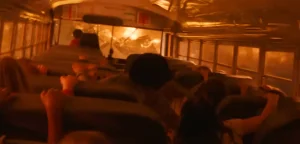
America Ferrera: They did start calling me Teacher America! They did look at me immediately as the adult that they had to listen to. I spent a little bit of time with them before we filmed, I just showed up and played games with them. I tried to have somewhat of a connection to them before we got on the bus. Whenever there was anything dangerous we were doing, the kids were not on the bus. The kids were often on the bus when we were on stage and it was much more controllable. I must admit, I was a little concerned because it’s an intense ride where the stakes are life and death and they’re playing that all day long for weeks on end. But these kids were screaming and yelling and crying, and then they’d yell cut, they’d go back to singing songs and playing clapping games. They were pros and they were very well cared for and looked after. All the way that Paul works to make all the performances from actors, non-actors and children alike helped capture as much realism in the kid’s performance as you see on the screen.
 @Courtesy of Apple TV+
Q: You have never worked together before, so what have you discovered from each other, from the way of working, that you can apply to your future career or just enjoy while the movie is being made?
Matthew McConaughey: I didn’t have any expectations. I try to go, especially with acting, without an expectation, because I’ve gone in with expectations before and been wrong or been overly right. On meeting America, she already came in loaded with a POV of who the foundation of her character was in Mary Ludwig, very direct, she’s very affirmative with your choices. Our characters meet like two strangers who have completely opposing views of how to go about it. We didn’t necessarily talk about that. Our best conversations were in the scenes. She didn’t manufacture opposition but came from the affirmative note of this is who my character is, how I’m portraying her, and what I need, and how that opposed what I was going. That sets up for good drama. I just really enjoyed her approach, and I got to know her since and enjoy her off-screen as well but really enjoyed working with her.
America Ferrera: I learned a lot working with Matthew. I really appreciated how we just got to work. We found our ways towards each other as co-workers and actors and eventually spent more time looking at each other. I love people who take their job seriously, who have reverence for the work. I respected and felt so much permission by just watching Matthew being in his space. He needed to hold Kevin’s space.
If you like the interview, share your thoughts below!
Check out more of Adriano’s articles.
Here’s the trailer for The Lost Bus: