

©Courtesy of GKIDS
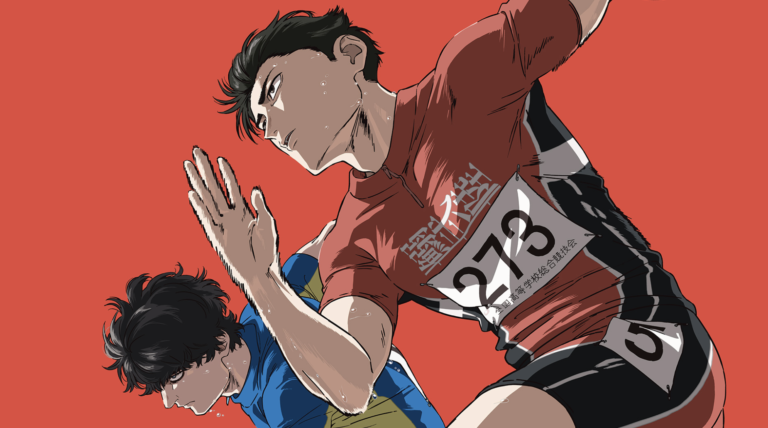
When asked why he runs, a junior high track star replies “to win,” as if it’s a stupid question, but it isn’t. In fact, several Japanese track stars at various stages of their careers must wrestle with that question throughout this film, especially during losing streaks. Yet, they keep running in Kenji Iwaisawa’s anime feature 100 Meters, based on Uoto’s manga, which GKIDS will release in theaters this Friday.
Even in elementary school, Togashi stands out as a potential track-and-field champion, because of his perfect form. On the other hand, the new transfer student Komiya lacks grace and stamina. Yet, his relentless drive so impresses Togashi, he offers to informally coach his shy classmate.
It is clear from the start how differently they approach the sport. Togashi runs because it makes sense. He has a clear talent that everyone encourages, much like Nigami, the leading junior high prospect, whom Togashi races in a media-sponsored exhibition. In contrast, Komiya runs driven by existential impulses worthy of a Dostoevsky novel. He wants to narrow his field of vision and lose his sense of himself. ©Courtesy of GKIDS
Togashi’s inevitable loss to Komiya induces a crisis of confidence that leads the rising contender to temporarily retreat from track competitions. Nevertheless, a few years later, the small but dedicated track team at his new high school rekindles Togashi’s passion for running. Ironically, the very same Nigami also happens to be an inactive member, who similarly lost his competitive fire after a bout with injuries. Together they motivate each to race again, while Komiya makes even greater waves smashing records at his provincial high school.
Throughout their careers, Togashi and Komiya must contend with the long shadows cast by two veteran athletes. The Zen-like Zaitsu once inspired Komiya with his cryptic and seemingly contradictory advice, while the more combative Kaido serves as an ironic role model for Togashi. Both established runners have thought sufficiently hard on the question of why they still run, so they can articulate answers (albeit in their own eccentric ways) that might mean something to their younger colleagues.
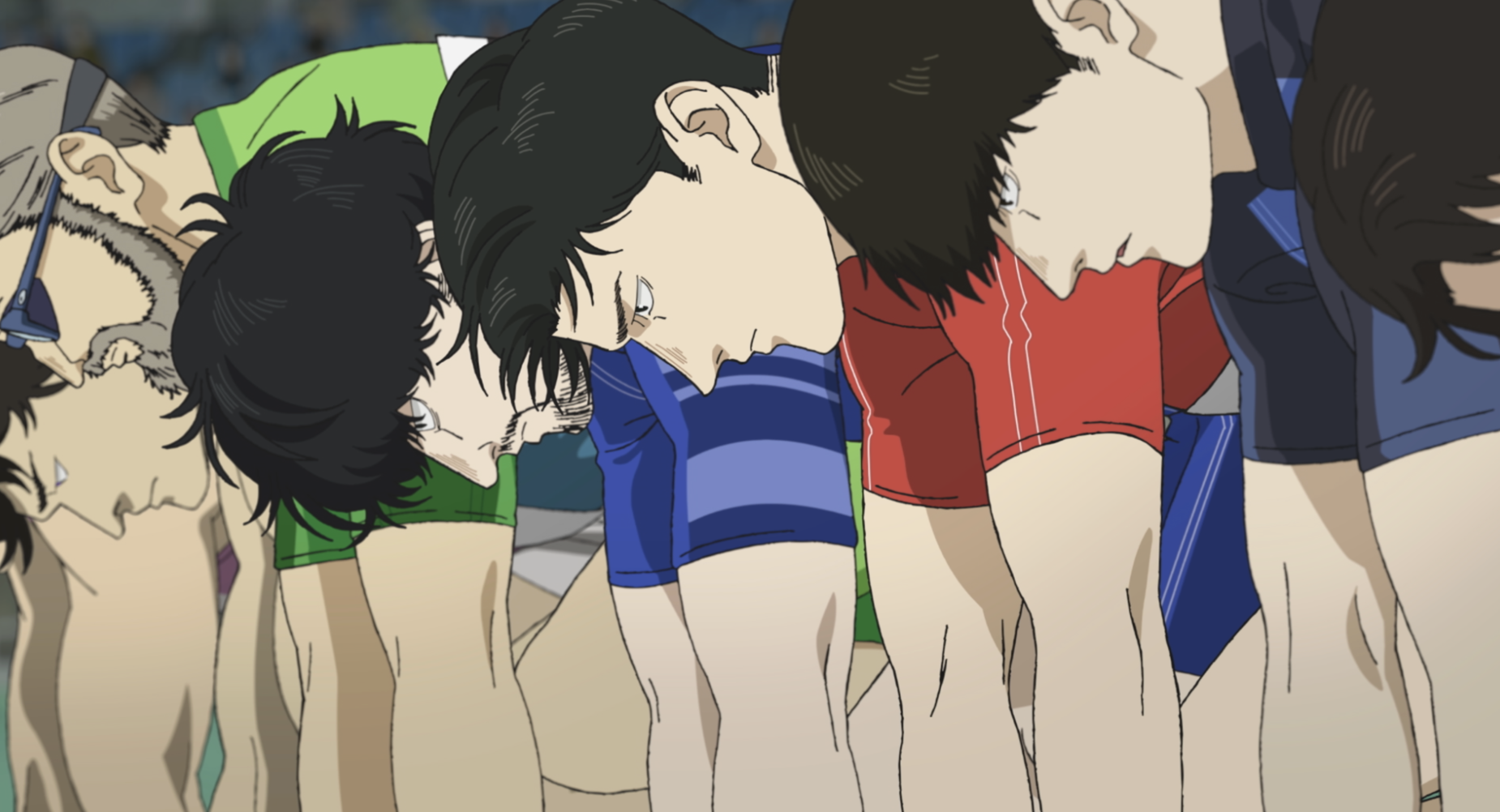
Indeed, this is really what 100 Meters is all about. Viewers might be [pleasantly] surprised by Iwaisawa’s complete disregard for the conventions and cliches of sports movies. If you pine for more training montages, you should look elsewhere. Technically, it builds towards a big final track meet, but who wins is almost beside the point.
Consequently, most of the conflict is mental (and self-contained) rather than physical, which the animation nicely conveys. Iwaisawa and the Rock & Roll Mountain animation house often shift into a looser, sketchier style to depict moments of high stress and agitation for the characters. It makes the film quite visually dynamic, while helping to open-up the characters.
In fact, there is little traditional “characterization” in 100 Meters. Instead, we learn the persona of each runner by how they pursue and relate to their sport. Yet, viewers will probably think they know Togashi, Komiya, and Nigami better through their resulting interpretations than characters who have pages and pages of backstory available. It is an intriguing approach that succeeds quite nicely in this case.
Perhaps fittingly, the most distinctive original Japanese vocal performances are Kenjiro Tsuda’s growling work as Kaido and Koki Uchiyama’s laidback, slightly tripped-out voicing of Zaitsu. Still, popular anime voiceover artist Aoi Yuki and Shota Sometani (known for Sion Sono’s Himizu and Takashi Miike’s First Love) do a nice job expressing the younger and older Komiyu’s social awkwardness and acute anxiety.
Frankly, 100 Meters proves again that some of the best sports movies are anime films. Like the Haikyu! franchise does for volleyball, Iwaisawa’s adaptation of Uoto’s manga really digs into the heart and the neuroses of short-distance sprinters. Highly recommended as a sports film for viewers who don’t ordinarily like sports movies, 100 Meters opens this Friday (10/10) in theaters.
©Courtesy of GKIDS
Grade: A-
If you like the review, share your thoughts below.
Check out more of Joe’s articles.
Here’s the trailer of the film.