

©Courtesy of FX Network
The underground conspiracies and myths that drive such seemingly wholesome Middle American cities as Tulsa are finally infiltrating mainstream culture. The new neo-noir television series, The Lowdown, is the latest project that explores the myths that have shaped the society of Oklahoma’s second largest city.
Oklahoma-based filmmaker, Sterlin Harjo created and executive produced The Lowdown. The new show spiritually follows in the footsteps of his previous FX drama series, Reservation Dogs. The protagonists in the two shows, which are both set and shot in Oklahoma, expose and reconcile the limitations of life in their communities.
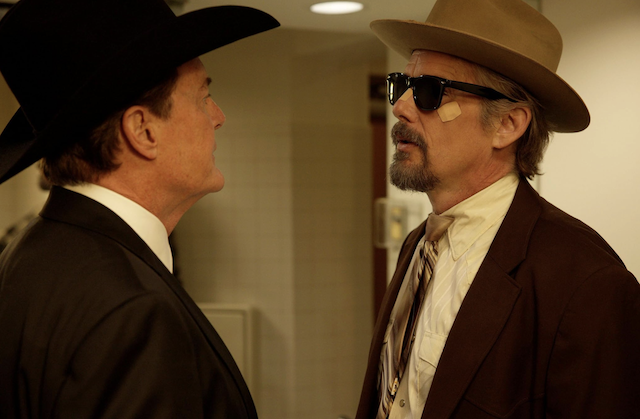
Harjo also served as a writer and director on The Lowdown. The crime drama stars fellow executive producer Ethan Hawke, as well as Keith David, Kyle MacLachlan and Jeanne Tripplehorn.
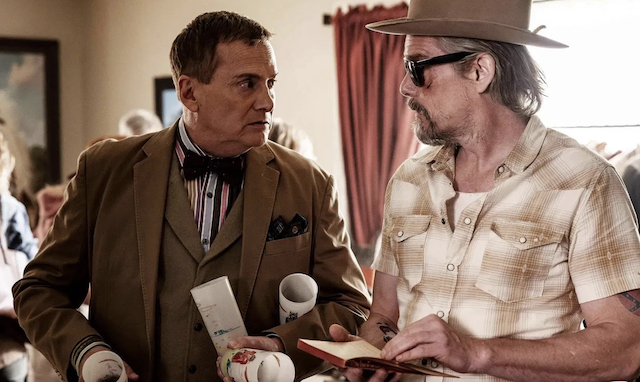
The Lowdown follows the gritty exploits of citizen journalist Lee Raybon (Hawke), a self-proclaimed Tulsa truthstorian. His obsession with the truth is always getting him into trouble.
Lee lives and works in a rare bookstore in the middle of Tulsa, which proves to be a local refuge and unofficial community hub. While Lee’s not idealistic, he is fiercely committed to exposing corruption, even when it puts him at risk.
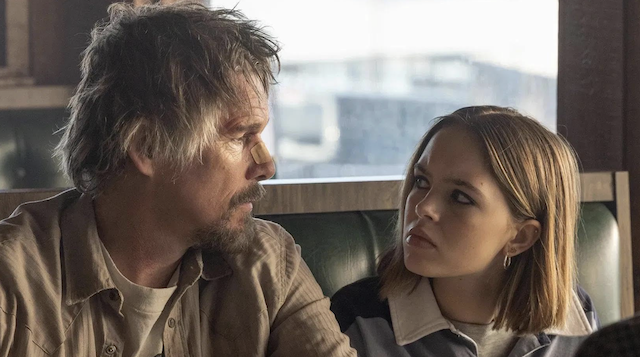
The journalist’s constant detective work pulls him deep into Tulsa’s underworld. As a result, he’s often take away from his 14-year-old daughter Francis (Ryan Kiera Armstrong). The precocious teen has inherited his father’s curiosity and longs to join him on his adventures.
Lee’s ex, Samantha (Kaniehtiio Horn), is exasperated by her former partner’s endless digging. But she still sees the good in him, especially when it comes to Francis, the one thing they’ve never stopped caring up for.
The publication of Lee’s latest exposé – a deep dive into the powerful Washberg family – is immediately followed by the suspicious suicide of Dale Washberg (Tim Blake Nelson), the black sheep of the family. Lee knows he has stumbled onto something big.
Following a trail of clues Dale has left behind, urging someone to dig deeper into the circumstances surrounding his death, Lee does just that. What Lee finds is that Betty Jo (Jeanne Tripplehorn), the grieving widow, seems to be more interested in her brother-in-law Donald Washberg (Kyle MacLachlan), a gubernatorial candidate, than in her late husband. Powerful forces want to prevent Lee from learning anything more.
Lee has also gained the attention of a mysterious stranger who seems to appear whenever Lee least expects it. The refined and suave Marty (Keith David) shares Lee’s appreciation of great literary minds. Marty seems unusually interested in his investigation into the Washberg family.
The first season of The Lowdown was produced by FX Productions. The season’s eight episodes are currently airing on Tuesday nights at 9pm ET/PT on FX, and then premiere the next day on Hulu.
Harjo, Hawke, David, MacLachlan and Tripplehorn generously took the time recently to participate in a virtual press conference. The filmmaker and actors talked about creating, producing and starring on The Lowdown during the interview.
©Courtesy of FX Network
Q: Sterlin, you’ve called The Lowdown Tulsa noir. What drew you to tell this kind of story in Tulsa? Hoes the city itself shape the world and the tone of the series?
Sterlin Harjo: Tulsa felt like the right place to set a noir. In noir, we’ve explored Los Angeles, New York City and even New Orleans. But there’s so much sort of political and cultural activity happening in the middle of the country, and Tulsa felt like the right place. It has the right amount of grit, history and secrets to set this story in.
For a show that’s about someone fighting for truth, there’s a longstanding need for the truth in a place like Oklahoma. So, that’s where we find our hero.
Q: For all the panelists, what was your favorite part about filming The Lowdown in Tulsa?
Kyle MacLachlan: Breakfast at the Cherry Street Bakery! I love the people of Tulsa, especially our crew. When I did the pilot, I had a wonderful guide. Her name is Jeanne Tripplehorn, you’ve heard of her. She took me around and showed me some sides of Tulsa that I never knew existed, but I needed to see. So I just loved the experience being with you, Jeanne, as a true Tulsan.
Jeanne Tripplehorn: Yes, I was born and bred there.
Kyle MacLachlan: Yes, born and bred. So that was it for me.
Jeanne Tripplehorn: I have so many favorite parts about shooting in Tulsa. Just going back home was so exciting. I think within 10 minutes of my first conversation with you, Sterlin, you said, “You ready to come home?” I said, “I am.” So going back there was really profound for me in a lot of ways. I hadn’t been back home in about five years, so I enjoyed being home again.
Sterlin Harjo: She’s being humble. She is Tulsa royalty. Everyone was so excited for Jeanne to go back home and film this show.
Jeanne Tripplehorn: The first day that I was on set, everybody called me “Jeannie.” Nobody calls me Jeannie outside of my family, really.
When Sterlin first said, “Okay, Jeannie, wait, we’re going to do this,” I went, “Should I correct him?” Then I went, “You know what? This is my new family. This is my family.” So now I’m Jeannie.= with everyone.
Sterlin Harjo: I was always shocked when I heard Jeanne. It’s Jeannie.
Q: That’s great. Keith, what was your favorite part of filming The Lowdown in Tulsa?
Keith David: Well, I had the great privilege of working with all these wonderful folks here who I have longstanding admiration for. I got to meet one of the consultants, Chief Egunwale (Amusan), and got to explore Tulsa with him. It just
doesn’t get better than that, as I had a wonderful time.
Ethan Hawke: My experience started on Reservation Dogs (whose first season was filmed entirely in Oklahoma). I’d been friends with Sterlin for a few years, and he asked me to play Elora’s dad in the penultimate episode.
So after knowing Sterlin for awhile, I was finally introduced to his community. There’s such a strong sense of community in Tulsa. People are really rooting and pulling for each other there. There are a lot of people making art for art’s sake. Whereas when you get to New York or LA, everybody’s making something to get somewhere else. So feels like the creativity that you’re running into is extremely authentic.
he past is very present. You’re aware of that in the architecture and the streets, as well as the way people talk. Tulsa has a very deep past that’s representative of America as a whole. And it was an amazing place to get to meet a huge community of people that were all in a like-minded vision. We were all were serving the same goal. My kids went to school down there, as the shoot was a long one. We were so welcomed that it became one of the best experiences of my life.
Q: Sterlin, did Ethan’s episode of Reservation Dogs indirectly lead to The Lowdown?
Sterlin Harjo: Well, shoutout to Martin Sensmeier, who introduced us. Martin’s an actor and a friend of both of ours. I’ve told Ethan this, but when I was living in New York, I remember reading The Hottest State and thinking, “I’m going to work with Ethan Hawke someday.”
It was just kind of this feeling that I had that I wasn’t stressed about, and I didn’t get worried. I just knew that that was going to happen. Then I watched Boyhood, and I ran into him at the airport. He didn’t know me from anyone, but I found myself walking next to him. I said, “Hey, Boyhood‘s amazing.” He was like, “Oh, thank you, man.” So that reaction was enough.
Ethan Hawke: Thank God I wasn’t rude.
Sterlin Harjo: Yes, that reaction alone was so nice, it just made me want to work with him even more. Then I had the opportunity to, as we worked together on a script before Reservation Dogs.
I then went and made Reservation Dogs, and we became friends. He reached out to me after the first season. He told me how much he loved the show. So at that point I hoped that he would be in this. Then he mentioned, “I’ll be in it.” Then I was like, “Well, let me go write you a part.” So I wrote him as Elora Danan’s father. It’s such a dream to direct Ethan and Devery Jacobs in this two-hander episode.
We just had such a good time, and it was obvious that Ethan had a good time. Tulsa’s a great community. There are so many great artists and musicians. Everyone came on set and was playing music and hanging out. So I knew that I need to work with Ethan more.
This project was something I’d been thinking about for a while. It was really the perfect opportunity to work with Ethan in a bigger capacity. I actually sent him the script under the guise of, I just wanted notes, as a writer.
I didn’t know if he’d want to do the part or not. But I just thought, I’m gonna give this to him, let him read this thing, and see what he says. Luckily for me, he came back and was like, “Well, why aren’t you offering me this part?” So, I quickly said, “I’m going to offer you this part,” and that was really it.
 ©Courtesy of FX Network
Q: Ethan, Lee is described as a self-proclaimed truthstorian who’s always digging, even when it costs him personally. How did you approach showing Lee’s obsessive side, as well as his vulnerability, especially when it comes to his daughter?
Ethan Hawke: Well, I love the expression truthstorian because it’s not really a word. It expresses a true thing for Lee, which is that the intersection of truth and history is so needed that without understanding where we come from, we don’t understand where we are now. So the connection of those two words is sloppy, but it seemed very perfect for Lee.
I’m always drawn to people who really do want to follow their dreams. Following your dreams is easy to say to kids, but when you get into adult life with all its responsibilities, a lot of people compromise those things.
Lee doesn’t, but there’s a price to be paid. That largely shows up in his relationship with his family life and with his daughter. As somebody who has been chasing his dreams his whole life, balancing that with my relationship with my oldest daughter particularly, can be challenging.
It’s a fine balance to be the parent you want to be and the human being you want to be. And sometimes they don’t seem to line up. I think the writing of the show was wonderful because it’s such a big canvas. You get to see all of us in multiple dimensions, and that’s the wonderful thing about- about television-you get this big, epic canvas.
Q: Jeanne, Betty Jo’s grief feels layered. She’s mourning, but at the same time, there’s a suspicion about her closeness to Donald. How did you approach playing a woman who’s living in that gray area between loss and hidden motives?
Jeanne Tripplehorn: Well, Betty Jo’s a survivor. She’s comes from a very small town in Oklahoma. She was definitely a rodeo queen, and she’s kind of a hellcat. But the bottom line is, she’s going to survive and, she’s going to take care of her daughter. She and her family were kind of the black sheep of the Washbergs. But she’s not that sentimental, so she’s going to survive at any cost.
Q: Keith, Marty has this really refined, mysterious energy. He could be a friend or maybe not. How did you keep the audience guessing about his true intentions throughout The Lowdown‘s first season?
Keith David: Well, it’s on the page. You have to play what’s on the page. When we meet Marty, he just kind of appears there and starts talking to Lee to see where he’s at. So, we don’t know who he is; is he friend or foe?
We get to discover that as we go along, because he does keep his arm’s distance. Although, as you mentioned before about his being a truthstorian, Marty is also a writer himself is and is interested in his writing and his thoughts.
Being asked to check him out for work leads him to someplace else. Who is he really about? Also, who are the guys who sent him to check him out? So therein lies its own inherent mystery, which we discover as the process goes on.
Q: Kyle, what was it like playing the heavy on The Lowdown? How did you mix that with your usual charm to make Donald so disarming?
Kyle MacLachlan: Am I the heavy in this series?
Sterlin Harjo: For now, you are.
Kyle MacLachlan: Well, it was a thrill. First of all, getting to work with Sterlin was great. I met him such a long time ago. You did a beautiful post about Mr. Redford, and we were at a lab at the Sundance Festival together, way back when.
I’ve worked with Ethan before. This is our fourth time working together. Jeanne and I have known each since (the 2000 experimental film,) Timecode. I’ve also been a huge admirer of Keith forever. So it was a joy and pleasure to work with them all. Donald has so much to lose because of Ethan’s questioning and his digging into into family. But he’s really protecting his family and protecting himself.
One of the beauties of the script is as we go along, we feel more and more that here’s a guy who’s just doing what he needs to do. He’s struggling against being exposed, honestly – his family being exposed. So that turns him into a real fighter. I think this all comes from a much deeper place of surviving again. So many of the people in this talk about survival and what you’ll do to survive. So, it was a great journey to be on.
Q: Ethan, what have you learned about Lee’s fight for the truth?
Ethan Hawke: I don’t want to speak for everybody, but as an actor, I feel grateful for this job, the world and the role that Sterlin created. As Keith said, it’s on the page, and we perform this writing.
I’m so grateful to be a part of a story that centers on truth and journalistic integrity. When I first started in this business, every with interview I did, I’d get fact-checked. But now, I haven’s been fact-checked in years. Journalism, and the ways that we tell stories and talk about ourselves, couldn’t be more important.
This story is falling at a time where I feel really grateful to be doing a press conference and sharing The Lowdown with people the show’s full of love. It’s full of wit, humor and silliness. It also has an undercurrent of a really honest conversation about who we are and how we can intersect with each other.
Q: Sterlin, noir stories often ask big questions about truth and morality. Did The Lowdown make you reflect on how we search for, or avoid, the truth in today’s world?
Sterlin Harjo: I think that The Lowdown is about searching for the truth when it feels it’s not reachable. It’s also about balancing your life and moving forward when you’re still trying to grasp the truth. That’s a very noble endeavor today. I think that for all the people in our world and our country, we need people like Lee. We need journalists and people on the frontlines of morality who are finding what the truth is around them. Also, we need people who won’t give up in that search for truth.
I think that in the end, it’s going to be hard. Yes, sometimes you’re also a parent and you have your life and health. You have real-world experiences that you have to deal with. But its a noble thing to fight for the truth. I think that’s what this show is at its heart.
Q: Sterlin, community is a prevalent theme on The Lowdown, from the larger community of Tulsa to the found community of the bookstore. What is the relevance of this inclusion of the truth?
Sterlin Harjo: We’re sort of shaped by who we surround ourselves with. I had a really big family and community of people that helped me up and taught me things and helped guide me through life. Reservation Dogs was homage to that community. Then I have my Tulsa community, which is a place that I’ve defined as my home. I didn’t grow up there, but it is now my home. It’s like a family, and it’s a beautiful place. I think it’s inherent to my storytelling to take elements from my time growing up with.
Yes, you have main characters, but it’s also about the people around you who shape you. Noir, as a genre, speaks to that as well. You know, it’s about the people who you meet along the way and help you in your endeavors. The people who help you uncover whether it’s truth or lies are so helpful. It’s a story about community, and noir does that really well, so I think it all kind of just fits together.
Q: Sterlin, how important is citizen journalism today?
Sterlin Harjo: I think that it’s all we have left. We have citizen journalists, and it’s up to to these individuals-it’s not up to corporations. It’s up to individuals who want to pursue the truth. I think that’s all we have, and it’s what we’ve always needed. But right now, more than any other time, we need that. We need people to fight for the truth. I think it’s one of the most important things right now.
If you like the interview, share your thoughts below!
Check out more of Karen Karen Benardello’s articles.
Here’s the trailer of the film.