

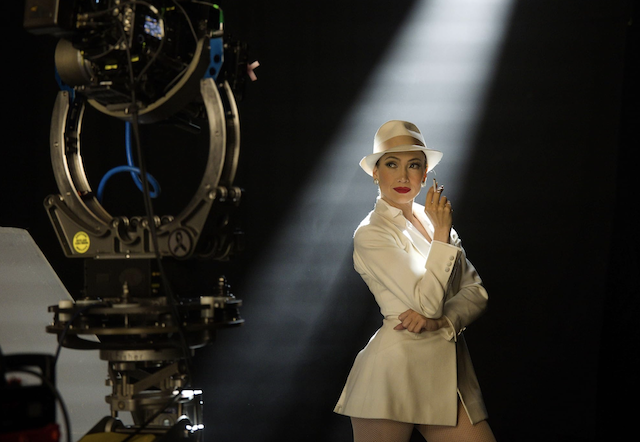
@Courtesy of Roadside Attractions
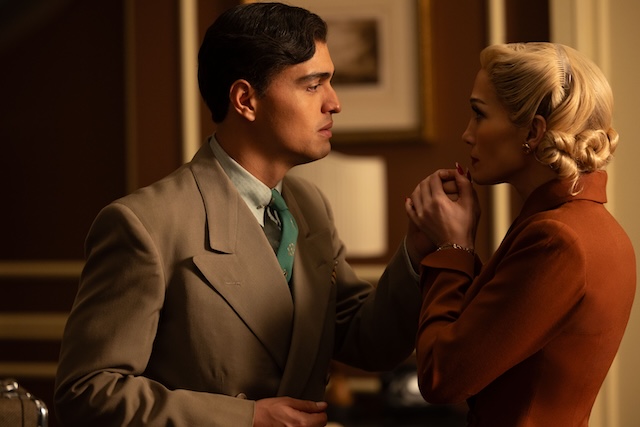
Q: What drew you personally to re-imagine “Kiss of the Spider-Woman” for today’s audience? What was your attraction to it, and what makes this version distinct in your view?
Bill Condon – For me it was the love of the novel. Even if all previous versions had been groundbreaking in their time, Manuel Puig was way ahead of all of them. We’ve just caught up to everything he was writing about gender fluidity. The novel is a love story, a full love story, not a transactional love story. So it was a chance for me to be true to Puig.
Q: What initially drew you to this project and why did you feel this is the moment now for you to take on a role like this?
Jennifer Lopez – I’ve always wanted to do a musical. That’s been a dream of mine, in the back of my head for so long. I got the script from Bill and the minute I read it I was blown away: it had all of the things that I imagined when I was like a little girl. In this script I got to sing, I got to dance, I got to act, I got to play like a big Hollywood movie star! It was like the stuff that dreams are made up of, it was really a no-brainer for me. Like Bill said it is a love story at the core of it, it was also like this beautiful homage to how important movies are in our life. I was taken by it the minute I read it. I knew that it was something that I had to do.
Q: There are a lot of dualities to the characters that you play. How did you approach those dualities in your performance? How did you embrace and navigate?
Jennifer Lopez – It was three different characters that I got to play: Ingrid Luna, the actress that Tonatiuh’s character, Molina, idolizes and is in love with. There’s Aurora and then there’s the Spider Woman. There’s like the dark and the light of two sides of somebody. At the end of the day, you look at it and you say: “Okay, Molina is Aurora.” They’re the same person and then there’s Molina who loves Ingrid Luna.
For me it was making them all just a little bit different, knowing that all of us were the same, we were all searching for love. Spider Woman just wants a kiss, Aurora is looking for her true love, Molina’s dying to be loved, even Diego’s character, Valentin, wants to be seen, wants to be heard as a revolutionary. There were just so many pieces to it. For me, playing each one of the three characters, it was about finding just little nuances. Obviously the costumes and the hair and all of that helped to define each one, but there were different emotional cores at the center of each character as well.
Q: How did you get into the character? Is Molina maybe inspired after someone that you knew?
Tonatiuh – The source material is a testament to the work I mean the work. It was such a launching pad. The world that Bill wrote was poetic. When I read it, I immediately knew, A, how much work it was going to be, but B, what joy it was going to be to do that. I felt like I was getting invited to the Olympics. The way that I approached it, similarly to Jennifer, was the 1940s musicals. I really wanted to exemplify traditional masculinity, so that it could have a strong juxtaposition and contrast to Molina and their genderless form. I lost about 45 pounds in 50 days to get that silhouette, to live that reality of being in a dictatorship inside of a prison cell. It was fascinating, I got to play the totality of the gender spectrum in a film, and that was such a gift. It’s quite touching, not just the relevance of our film, but how it centers the dignity of the Latino and the LGBTQIA community.
In terms of modeling it after somebody, I kept thinking about what star of that era was closeted and in deep pain and I instantly thought about Montgomery Clift. I kept thinking about The Heiress and his performance. I looked at Gene Kelly or Errol Flynn, I tried to steal his hair because that hairline was iconic. For Molina I was just allowing myself to live in that reality, so as we found small choices and as the way started coming off it was a discussion. We just kept trying things until we found the essence, then it was about allowing that essence to come through.
 @Courtesy of Roadside Attractions
Q: You have talked about how in the past you were participating in some student protests back in 1994. Were those the basis or inspiration for getting into Valentin’s character?
Diego Luna – Growing up in Mexico and learning about the recent history of Latin America, this film means a lot.There are so many brutal examples of dictatorships in Latin America. I was in Mexico in the ’90s where a lot was happening, 1994 particularly is a very, very important year for social movements and for community work. The most important part of my past that I got to play with here is theater. My father was a set designer, this film to me is a homage to theater or how much film was theater back then. How films were shot, the dynamic of filming was very close to filming theater, basically. For me, that section of the film was beautiful to experience.
Q: Jennifer, earlier you mentioned briefly the costumes of the film. I want to go back to that masterful work by Colleen Atwood and Christine L. Cantella. How does it inform your performance to be in those costumes, to be in that era?
Jennifer Lopez: It’s the costumes and it’s the hair and makeup. Because my three characters are so different, Colleen was very specific about what she wanted. It wasn’t like other costume designers I’ve worked with, where they come with all of these clothes and they’re like: “What do you think? Who is your character?” She was very specific: this is the suit that I’m thinking of for this. She had a sketch of it, she had color swatches. But it made it very clear for me where I was in each moment because we’re not making a whole movie in the musical. She was like: this is your traveling here, you’re doing this here, you’ll have a suit here, you’ll have this long dress here and this gold. It made it very simple for me to understand exactly who I was at that moment. For me, the costumes are a very big part of understanding the character and making the reality come to life in that way.
Q: Were there any names that you personally held close or thought about?
Jennifer Lopez: We talked about Judy Garland for Ingrid Luna, we looked at some of her performances for that. I think Ava Gardner, Lana Turner were the ones that we looked at for the hair for Aurora. Audrey Hepburn for the Spider Woman for a minute, right? Yes, we did.
Q: The story balances fantasy and survival, dazzling musicals on one side and political imprisonment and forbidden love on the other side. How did all of you as stars and writer director embrace those truths within the movie?
Bill Condon – When I was writing the script, it became clear this is the first time there’s only been one movie that gets narrated. The musical was invented for this film. I was always worried about the fact that we were going to invest this time with these two prisoners in the cell and then interrupt it with musical numbers, and then go back and that would start to be something that the audience resented. So it was very important that the story of what’s happening in the prison cell continued through the movie within the movie. It’s not being interrupted, we’re actually learning more about Molina through the story that he’s telling. There’s a great moment when Valentin wants to hear more about the movie and then by the end he is projecting his own feelings onto Armando.
Tonatiuh – My ethos as a performer has always been to allow my body to serve a larger purpose. We are championing communities with this story and reminding people of the dignity and the values of both the LGBTQIA community, the Latino community. There was an essence here where that felt like there was a purpose and entertainment at the same time.
Jennifer Lopez – Like Bill said, Manuel was ahead of time. But also, it’s not done. I feel like the story and the message is not done yet. It needed to be told again to this generation. We need to remind people of the humanity of these communities. We need to remind people that love is love. It’s a story that I think will keep being told until everybody gets on board with the fact that we’re all just people and we all should just be loving each other.
 @Courtesy of Roadside Attractions
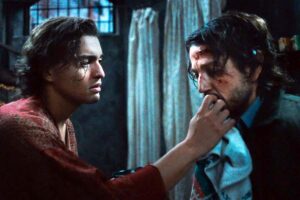
Q: The relationship between Valentin and Molina begins with conflict but grows unexpectedly into intimacy. What did you discover about yourselves as actors while navigating that shift from tension to tenderness?
Diego Luna: This connects with the previous question because to me, that’s the core of the film, what these people allow themselves to experience. It doesn’t matter the conditions. Today you know how to build these walls to protect us from what’s going on out there, while the film tells that the solution in fact is in the exact opposite reaction, being vulnerable, opening up. As actors you couldn’t achieve any of these if you were not completely connected to the other, not just us as actors but with Bill mostly. We were trying to channel something that for Bill is pretty clear.It was dangerous, it was fun. It was sometimes very demanding. It was everything. We were stuck in prison for weeks. We shot two films. One that is about the beautiful experience of movie making in New York, but then we went to a prison in Uruguay, where we just didn’t see the sun, and we shot this story every day. It was very intense and unique, and that shows in the film.
Tonatiuh – Bill gifted us something that is uncommon in filmmaking, which is we shot the prison in sequence. So the first time that Molina walks into the cell and sees Valentin was the first time that I got to see Diego in full character. As actors, we build not just the relationship as our characters, scene by scene, but as people we got to know each other moment by moment. The love, the connection, the vulnerability, the trust, it was like this that was like happening between the two of us. It got to the point where like as I was saying goodbye, the tears just flowed out because I didn’t want to say goodbye to Diego. There was this need for one another because we were all we had.
Q: Can you name a film that is your personal safe space? A film that you really hold close and you turn to?
Bill Condon – It would be Vertigo. It is a movie that I keep coming back to.
Jennifer Lopez – The first movie that really impacted my life was West Side Story, because there were Puerto Ricans in it. I had not really seen that in anything else. I loved the Romeo and Juliet story that it’s based on. It had everything I needed as a little girl, I could see myself in it. That was important, the representation. I wouldn’t be doing what I’m doing today if it wasn’t for that movie.
Tonatiuh – For me it’s a television show, Steven Universe Future created by Rebecca Sugar. An animated show really based on psychology. Steven saves the world so many times as a child and finally the world is saved. And he’s miserable because he never healed from all the childhood trauma that he had.
Diego Luna – I don’t know if safe space works for me. I think of movies as a place that can serve the moment you’re living. There’s always a challenge, there’s always confrontation. That’s the beauty of the film we worked on. But I would say Bicycle Thieves, that’s the one that gets me every time.
Q: What was it like to collaborate with choreographers Christopher Scott , Brandon Bieber and Sergio Trujillo for the dancing scenes?
Jennifer Lopez – It was amazing. I do a lot of shows, my own shows, and I do a lot of dancing, but I hadn’t done this type of dancing for years and years. That musical theater, jazz, technical style of dancing, Broadway style of dancing. It was challenging, but so much fun. It was something that I had wanted to do for so long. I just loved it. The choreographers were great, they were collaborative. I sat in there while they were creating, they let me input, I told them what I could do and what I couldn’t do.
Tonatiuh – They put me through the Broadway boot camp. You know, you get the letter, you get the offer and now you’re gonna sing and dance next to Jennifer Lopez. It’s time to train. I felt like Rocky, But I’m a Capricorn: I love the challenge.
Diego Luna – It all made sense once you got there. The problem was when I was alone because they work with mirrors. I don’t, like mirrors are dangerous to me, as an actor, you wanna avoid mirrors. You’re always confronted with what you’re doing, it’s difficult to accept. But once I was dancing with them, it was just something else.
Jennifer Lopez – We didn’t have a lot of time, it was appropriate to be panicked because we were a small independent film, like 12 numbers in 20 days. We had to shoot all of these numbers in 20 days. It was a lot for anybody, even if you’re a dancer, to learn all that choreography. We didn’t have a long rehearsal period. We weren’t together all that long, all of us. We had to blend it together when we did. Also Bill wanted to shoot everything in one take. We had a lot on our plate and it was very, very challenging.
If you like the interview, share your thoughts below!
Check out more of Adriano’s articles.
Here’s the trailer for Kiss of the Spider Woman: