

©Courtesy of GKIDS
Honestly, animation was probably the only way to adapt Amélie Nothomb’s otherwise “unadaptable,” “biographical” novella. Describing the world as she supposedly saw it as a three-year-old toddler, her book-club-friendly The Character of Rain reads something like Look Who’s Talking in the style of Terrence Malick. Regardless, the title rugrat character has a lot of growing up ahead of her in Mailys Vallade & Liane-Cho Han’s Little Amélie, or the Character of Rain, which opens this Friday in theaters, from GKIDS.
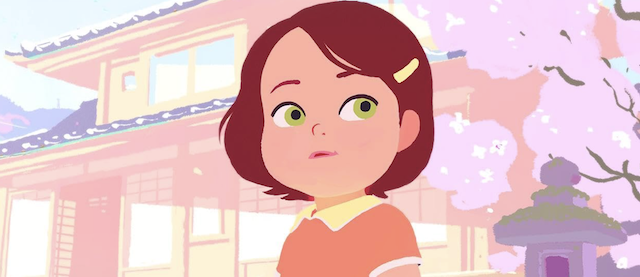
Initially, Amélie, the newborn daughter of a junior Belgian diplomat posted to early 1970s Japan, perceives herself as the center of the universe, so she logically concludes that makes her the godling of her realm. Somewhat contradictorily, she also sees herself as a tube, in which food goes into and out of. Her family largely considers her in similar terms, because of her near-catatonic state. However, her sudden awakening brings more stress rather than joy, because “Little” Amélie quickly becomes a real crier, with a powerful set of lungs.
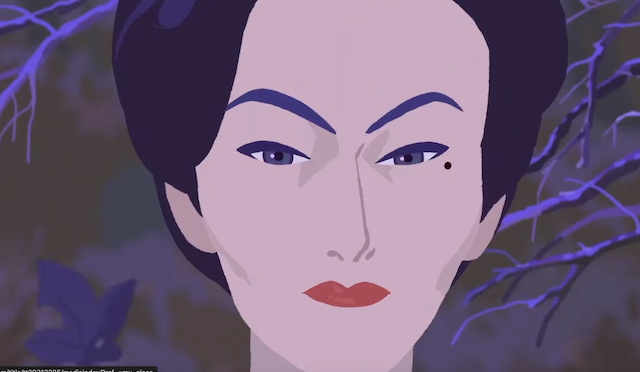
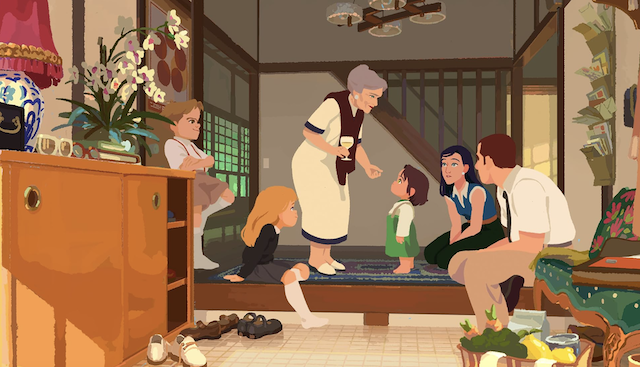
Providentially, her visiting grandmother manages to partially tame Amélie with the soothing taste of white chocolate, from her family’s native land (better that than a Pilsener). In most other respects, the inquisitive Amélie identifies with the Japanese culture of her beloved nanny, Nishio-San. Consequently, Amélie assumes she is Japanese. Yet, she remains ignorant of Japan’s tragic wartime history, which left the family’s severe landlord, Kashima-San so embittered towards Westerners like her.
 ©Courtesy of GKIDS
Clearly, Amélie has a lot to learn about a lot of things. Yet, the film undeniably suggests that process is the whole point of life. Little Amélie is deceptively simple, but it conveys a great deal of wisdom. She inevitably finds pain outside her protective shell, but that comes with growing up. Yet, that the film never comes across as heavy-handed or New Agey as that might sound. Instead, Vallade and Han largely maintain a light touch and a childlike (but never childish) perspective.
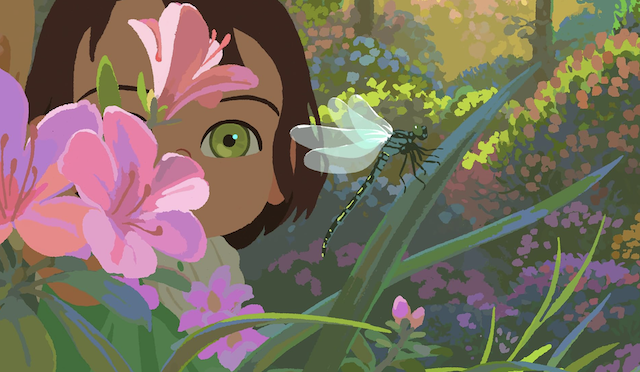
Together and separately, the co-directors previously worked as animators on several notably distinctive animated features, including Sylvain Chomet’s The Illusionist, Remi Chaye’s Long Way North, and Jeremy Clapin’s I Lost My Body. Similarly, they render Little Amélie in strikingly vivid colors that suggest the equal influences of Henri Matisse and Studio Ghibli. (In fact, Chaye returned the favor, creating inviting background art for Vallade and Han that evokes the tranquility of Japanese landscapes.)
The brightness of the animation is perfectly matched by Mari Fukuhara’s shimmeringly percussive and upbeat score, which perfectly suits Amélie’s liveliness. Her cascading piano runs also perfectly underscore the film’s water motifs. Fans of anime soundtracks will want this one.
 ©Courtesy of GKIDS
Indeed, Little Amélie has an unusual vibrancy that really helps it stand out. Han and Vallarde also convincingly channel the youthful perspective of their central character. She has her humorous moments, but Amélie is an animated character with a lot of serious epistemological issues on her mind.
Arguably, Little Amélie is a contender to breakout with adult audiences in the way Flow did last year. The artistry is evident in every frame. Perhaps more importantly, just about every viewer should relate to the film, because it focuses on the profound experiences of everyday life most people share, such as birth, death, and parenthood. Frankly, Fukuhara also deserves a nomination for best score, but that might be asking too much from the not-so-adventurous Academy. Highly recommended for animation connoisseurs, Little Amélie, or the Character of Rain opens this Friday (10/31) in New York, subsequently expanding throughout the U.S. on November 7th.
 ©Courtesy of GKIDS
Grade: A-
If you like the review, share your thoughts below!
Check out more of Joe’s articles.
Here’s the trailer of the film.