

@Courtesy of HBO
Q: Did you always want to continue exploring this world? Knowing there’s so much material in the novel, was that always the plan?
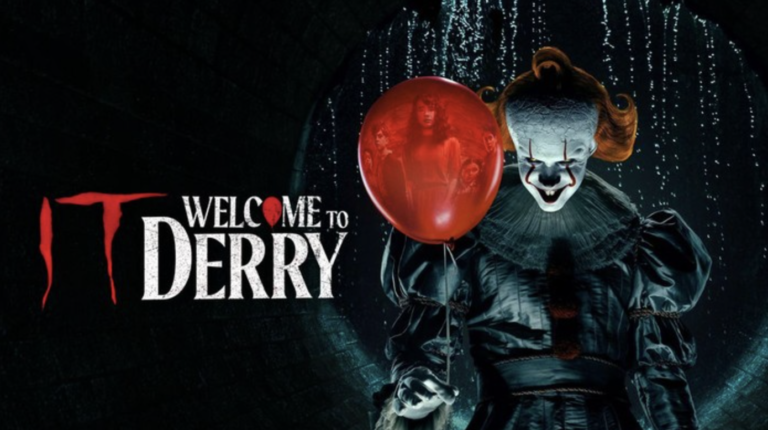
Andy Muschietti: Not always. It started when we were finishing “IT: Chapter 2”. And I started having conversations with Bill Skarsgård. We were high on the experience and it was speculating about making an origin story of Pennywise. How did IT become the clown? We thought there was something there, a great story. The book is very cryptic, Stephen King intentionally makes it very mysterious. It’s exactly what drew us to that. I went back to the book and realized that there’s so much story starting with the interludes. I found myself visualizing an invisible hidden story within that incomplete puzzle that Stephen King created. It just felt exciting and then that’s how the thing started. I talked to Barbie and we decided to go on. On this new stage, it was different because we were derailing, we were detouring more. The movies are arguably more literal because we’re covering what the main story is. This is different. Stephen King at this point had enough confidence in us or in the possibilities that we could bring that he said: “Just go for it.” He’s reading and blessing everything every single step. He was very open to this hidden story that I was talking about. It involves a lot of creation that is not something that you have in the book.
Q: In addition to scaring us, this show explores race relations, found family, community, and historical trauma. You previously starred in another Stephen King adaptation with “The Stand.” What is it about the world of horror that makes such a great conduit to explore these wide-ranging themes, and what excited you about Leroy?
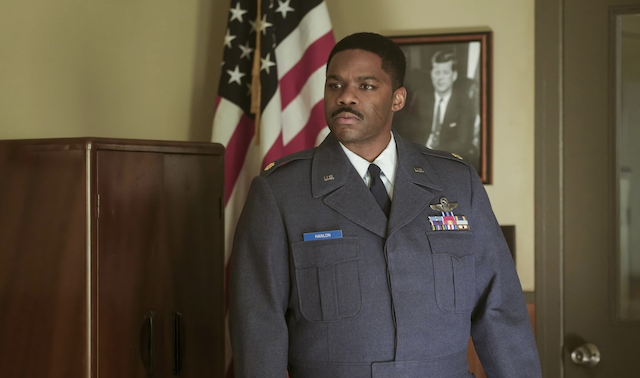
Jovan Adepo: Initially it was just getting the opportunity to work with Andy and Barbara. I’m a fan of their work, so getting a chance to play a character that is essentially the inception of the Hanlon family coming into Derry was an exciting prospect. The character himself relates to my father a lot. He was in the Air Force, a very strict military man, so I was very familiar with Will’s upbringing as a young man trying to understand his father. Horror gives so much space for freedom and telling stories. Being involved in this particular world was really exciting and gave us a lot of room to play.
Q: And Taylour, what drew you to the project itself?
Taylour Paige: We spoke in depth, two hours in our initial meeting. We talked about fear, the weaponizing of fear. I’m all about signs. My grandmother was born in the late 1930s, she passed away in 2021. I think about the dreams that died with her. She was so funny. Like Lucille Ball, funny. She had bars. So, when they presented this 1962, I was like: “Oh yes, I get to include my angel grandmother.” The layers of a woman that’s bursting at the seams. She feels she has so much to offer the world and is swallowing all of that you must be in 1962.
Q: This show does have humor as well, in order to balance out the screaming…
Andy Muschietti: Stephen King mixes tones, he basically puts a scoop of everything that he likes in the same world. Because that’s what life is also made of. It has comedy, it has drama, it has horrific events, so we’re doing the same thing. I remember many, many years ago I was reading the book “Thinner” by Stephen King. It was signed as Richard Bachman. It’s about a curse, this guy gets thinner and thinner and thinner, and he has to overturn the curse while he’s looking for the perpetrators. In the middle of the night he goes to a trailer camp. He can’t see anything, but there’s a sound of a fart. Stephen King’s like “And I recognized immediately that it was a fart of a dog. And I realized that that’s the dog of the junkyard that I was looking for.” That’s an imprint that I have.
Q: You get to bring to life one of the most iconic characters from Stephen King’s mythology, a young Dick Hallorann, who we first encounter as the caretaker in “The Shining.” Was it intimidating or exciting to step into the shoes of someone so iconic?
Chris Chalk: I did look to the past because I want to respect the people that have been so generous to lay a groundwork of great ease for me. It’s a character that had already been written excellently. It had already played excellently. Then when I got the script, it was already written excellently. No, there was no intimidation. It is great joy to get to pull something from all of these performances and then co-create with Andy, Jovan, Stephen, Taylour. That’s the exciting stuff, we’re discovering who he is as we bring him back from what people know. He’s such a gentle soul in the versions that you know. It’s just not that. He’s having a human experience, learning to live with devastating psychic powers. It seems cool until you realize everyone around you is depressed. Then it’s not super fun.
Q: Can you tease for the audience Rose’s character and the story of the indigenous community? How does it fit into the world of Derry?
Kimberly Guerrero:For those Stephen King fans out there, you know that there’s always this underlying layer of indigenous storytelling underneath it, but we never get to explore that storytelling aspect. We don’t get to know the story. So Rose and her community and Derry represent that story. There were humans that encountered this creature first. Rose is the direct descendant of those people.
Q: What appealed to you about entering the world of Derry?
James Remar: Playing the same thing straight through is not something that requires any effort, but to have a turn and to play someone who may be a villain, who’s resisting villainy, that’s challenging. I resist villainy when I approach a character that’s authoritarian, because I have to uncover that character’s humanity so I can fall in love with him. It’s impossible for me to play somebody I hate. I have to find something that I love and can respect, and treat them as human beings.
You work so well with the young actors who play your children. Did that develop naturally?
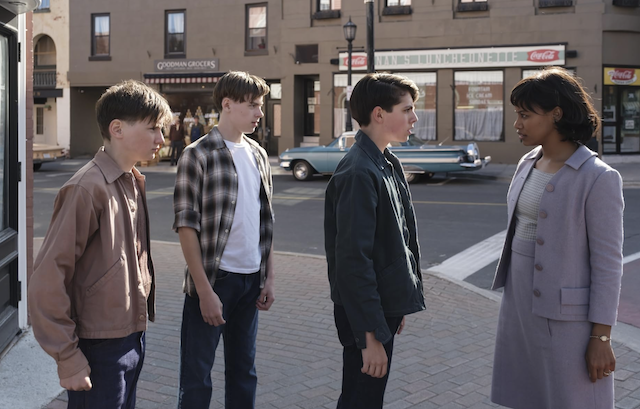
Jovan Adepo: These kids are incredibly talented. Just to specifically talk about Blake, and I’m sure Taylour can agree, he takes the work so seriously. I would tease him so much about it because I forget that he’s a kid because he takes the work so seriously. In between takes, he’d always come over and he’d be like: “Mr. Jovan, could you take a second to talk about the scene with me? Can we talk about stakes and what’s happening at this moment?” You can tell that he cares about the work. All the kids share that type of passion for storytelling. But on the other side of that it reminded me, as an actor, to not take myself too seriously and remember to just be in the moment and to play.
Taylour Paige: I love those children. Last night Blake mentioned something, he was like: “It’s hard to watch things because you’re like, I wish I did that differently.” And I’m like, “That will be with you for the rest of your life, career and life, but it’s okay. We strive to get better and also give ourselves grace. You’re incredible.” He’s so sweet. All of them break my heart in the best way. They’re just incredible.
Q: Is IT representing the idea of all these things coming back to haunt us? And are they showing us ourselves and are the changing us for the good?
Andy Muschietti: Everything we have faith on is for this thing to take. Your fears are the opposite of that. You fear everything that might truncate any dream. Does IT exist because we believe in it? And that’s why kids see it so much and they are the prominent victims of this thing, because adults don’t believe in things that don’t exist. Is IT real, or is it something that we create? And that’s when it becomes basically a metaphor. It’s a beautiful subtext. It’s just the crystallization or the incarnation of losing what we have more hope on.
Q: Did you have these discussions on set? Like did you ever ask what IT is? Or did you not want to know and just rely on the script?
Chris Chalk: I don’t think we necessarily had the conversations about what IT is, but we have our own interpretations. We’re all artists who are obsessed with our thoughts. We know the inevitability of facing fear, so we could develop our own personal way to deal with it. Look at the cycles we’re living in in all countries. We are stuck in these cycles of fear.
James Remar: I’d like to address the idea of emotions living in the land or in objects. Everything has a life force, everything is connected by the same energy as what causes your heart to beat. I had a very specific example of that once when I was leaving Tokyo and I was looking out the window and the entire ground crew, as the aircraft was departing: the entire ground crew was lined up after they’d serviced the aircraft, they bowed to the aircraft to bless it on its journey. It made sense to me in that instant that everything is alive and everything is connected. I believe that everything’s connected: IT appears in every culture as that which is in the embodiment to unnamed fears. It could be the Boogeyman, it could be Satan, it could be Loki. IT is this malevolent force that somehow exists in the hearts of people too.
Taylour Paige: That environment creates the perfect place for that to exist. Turning the other cheek, scapegoatism in a way, this city doesn’t deal with their shit. So everything is playing with each other. This is very strange. We are not okay. This country’s not OK. I have a sense it doesn’t have to be this way, that just doesn’t have to exist.’ But it does and that’s our human experience.
Kimberly Guerrero: We’re in a unique time to be born. To be walking on this earth at this time and it’s such a gift as an indigenous person because our voices have been silenced for so long. But we haven’t stopped telling our stories. The relationship with the seen and the unseen, that veil is very thin for us. It’s an exciting part of this story that you all will get to see exactly how thin that is.
Q: What emotional core did you want to emphasize in the pilot? Does it kind of mirror throughout the entire series?
Andy Muschietti: There’s different bloodlines and different arcs for different characters. I’m going to talk about the one dominating one, which is probably the kids’ story. One of the big themes in the book is: all the virtues the children have just disappear when they turn into an adult. The adults become like the enemy to everything that is beautiful about childhood because you lose it. King knows this because he is a child, he struggles to keep the child within alive all the time. This is what, among other things, this book is about: keeping the child inside alive. And this is the one thing that is prominent for this season, and for this show in general.
Q: Which is the most challenging part in acting in this series? Maybe sometimes acting opposite something that isn’t there?
Chris Chalk: No, no, no no, it’s there. That’s the thing about coming into a project where they’ve already created a world: working with the same crew, the same similar props, similar concepts. We’re not faking it, it’s there. They tell us every single thing that’s in the scene. We get to see the storyboards in a lot of instances. Andy’s so generous. Andy comes in, he has an idea of what he wants to do, but then he goes, “Well, what do you guys think?” So it stays so flexible, it stays so collaborative. So it’s tough when you say what’s so difficult. Nothing. Because I’m getting to do my job. I don’t think the genre’s hard because my job is to play a human being having a human experience. Andy’s job is to make it scary. It does require us to be vulnerable and open, and be willing to play, but how could you not be when they’ve already given us the space to do so?
Q: How did you decide to end the first episode in that shocking way?
Andy Muschietti: We wanted to set up the table, to get people a sense that nothing here is sacred. Nothing here is safe from this evil. That will keep you at the edge of your seat for the rest of the show because no one is safe. That’s our way of doing it. What we did with Georgie at the opening of “IT”, what we did with Adrian Mellon, you know, we’re doing in the show. Not only at the beginning of episode one, but also at the end. Pulling the rug like that, I know it’s shocking, but we felt like it was a subversion that this new story needed as part of the innovations that we wanted to bring. It’s an experiment, because I haven’t seen it before. Weird things will happen in this show.
If you liked the interview, share your thoughts below.
Check out more of Adriano’s articles.
Here’s the trailer for IT: Welcome to Derry: