

@Courtesy of MUBI
Among the several masterpieces that Gena Rowlands and John Cassavetes realized together, A Woman Under the Influence (1974) set the bar about portraying the psychological and emotional difficulties of a woman confined in often suffocating social roles of wife, mother or housewife. The truth and intensity which that movie was able to convey to the audience has been unmatched by any other since then. Die My Love included.
This premise was necessary to explain why the new feature film directed by Lynne Ramsay hasn’t been as effective as the previous We Need to Talk about Kevin and You Were Never Really Here. The probably unnecessary but (for me) unavoidable comparison with A Woman Under the Influence penalizes Die My Love even more than its obvious problems.
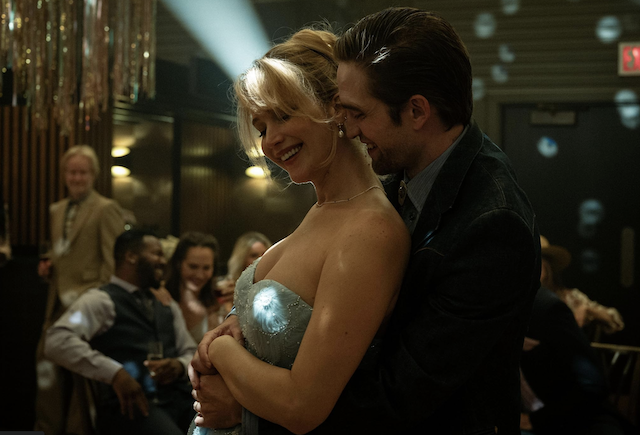
After a beautiful long shot that opens to the audience the main setting, the screenplay written by Ramsay, Alice Birch and Enda Walsh – and mashed on the novel by Ariana Harwicz – slowly develops a story and at least a character that in the end result as quite conventional. The classic house in the middle of nowhere in rural Montana is exactly what you would expect as the worst possible environment to take care and raise a newborn baby. Why has the protagonist Grace (Jennifer Lawrence) ever accepted to move from New York City and settle there with her son? The answer brings in the biggest flaw in the movie, meaning Jackson’s character played by Robert Pattinson.
@Courtesy of MUBI
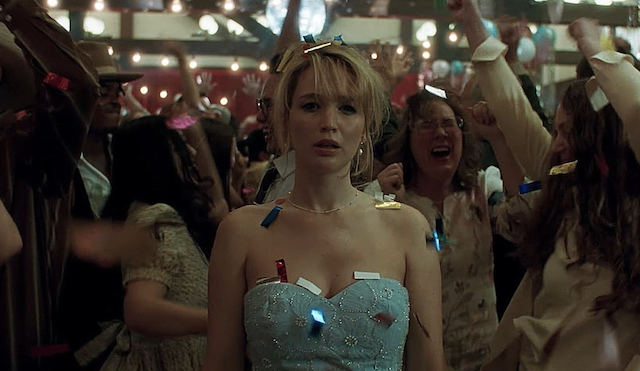
Distant father, lousy husband, failing caretaker, this man seems to be extracted directly from some melodramas from decades ago, lacking any possible complexity. His completely not understanding what’s going on with his wife until her mental breakdown is even too obvious, makes this psychology extremely mono-dimensional. Despite Pattinson’s effective performance, Jackson is unbelievable even when he starts showing some kind of empathy with Grace. Another problem with the screenplay is in the progression of the events, which isn’t always logically clear. For example the wedding sequence doesn’t really work at that time of the story, it seems more like a flashback, making the audience guess what’s going on and why it is happening right there.
Jennifer Lawrence is one of the best actors the last ten, fifteen years, no double about that, and she confirms it with her bold performance in Die My Love. Her embracing Grace’s character is poignant, painful, full of little nuances that make the viewer feel deep empathy for her personal struggle. Unfortunately she isn’t supported by Lynne Ramsay’s vision: the director in fact tends to suggest too much when she should instead explain, and vice versa.
This way Die My Love becomes a movie based more on fascinations on atmospheres than a believable psychological progression about Grace’s struggling with depression. Until a final sequence that is beautiful to watch, full of metaphors and so on, but in the end almost inconsequential with what was previously going on. We agree that you don’t need necessarily to explain with words and dialogues Grace’s condition, but nonetheless you need to make it understandable using fundamental tools like screenplay, cast, editing etc. Die My Love accomplishes that only in certain moments, while missing a comprehensible narrative structure that could have helped both the characters’ arc and the audience to go through this complicated movie.
The cinema of Lynne Ramsay is not or has never been subtle. And that id great, because it brought us at least a great, disturbing movie like We Need To Talk About Kevin. In the case of Die My Love the director relates too much on her capacity of building strong atmospheres and characters, failing to support them with a story crafted in the right way. The screenplay is not the only problem this movie has, but it would have certainly helped it a lot having a solid narrative platform to work with.

@Courtesy of MUBI
Rate: C+
If you like the review, share your thoughts below!
Check out more of Adriano’s articles.
Here’s the trailer of the film.