

@Courtesy of Netflix
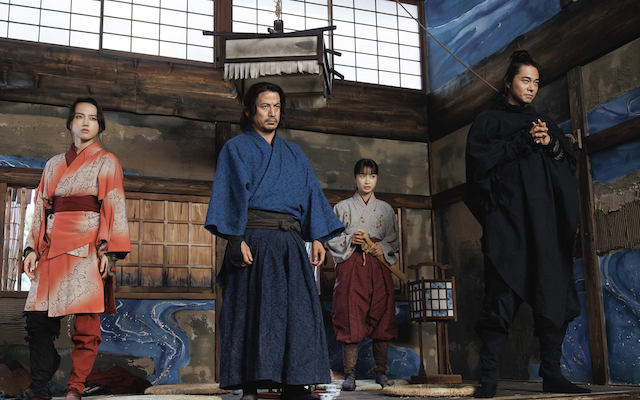
Thanks to the reforms of the Meiji Restoration, being a ronin (a masterless samurai, like Toshiro Mifune in Yojimbo) no longer looked so bad to old school warriors following the Bushido code. Even ronin had a level of status the new government denied the samurai, now called Shizoku. They lost their honor and their swords, but most still had their skills. Some violently rebelled, but a mysterious game offers the former samurai a lucrative opportunity to do what they always did best: kill each other. 292 enter the so-called “Kodoku,” but statistically only nine can survive, according to the point scoring system. Yet, there is a general expectation the competition must inevitably come down to a sole survivor in the six-episode “first chapter” of Last Samurai Standing, based on Shogo Imamura’s manga, which is now streaming on Netflix.
Yes, this is a series featuring bloodsport eliminations, run by a shadowy cabal, that scrupulously maintains a tally of all its surviving players at the end of each episode. It definitely sounds like a Chanbara Squid Game. However, it is important to understand Imamura’s manga, adapted from his previously published novel, debuted in 2022, so the source material could not have been influenced by the Netflix sensation, which premiered in late 2021. Regardless, otaku know Japanese genre filmmakers largely invented this sub-genre with Battle Royale, which the Hunger Games franchise subsequently ripped off.
Frankly, reinventing the survival game thriller for the immediate post-Edo era makes a great deal sense. Theoretically, it levels the playing field, because all the participants have advanced martial arts training. Of course, some have greater talents than others. Also, some enjoy killing more than their fellow competitors.
@Courtesy of Netflix
When it came to killing, Shujiro Saga used to be one of the best. He even had the “Manslayer” nickname to prove it. However, after the humbling of the samurai class, Saga embraced the quiet provincial life as a faithful husband and father, turning his back on his old ways. Tragically, the plague struck down his little daughter and now threatens his wife and young son. Fliers for the Kodoku promised 100,000 Yen to the winner, so he enters out of desperation.
Of course, once you start you can’t back out. The assembled samurai must make their way from Kyoto to Tokyo, but to pass through each checkpoint, they must present sufficient badges claimed from fallen samurai. Ordinarily, that would be no problem for Saga, but he still holds an aversion to his old violent way of life. Nevertheless, he hopes to protect Futaba Katsuki, an innocent young girl who has no business competing in the Kodoku. Sadly, she too has urgent need of funds beyond her modest means.
Like that other show, Last Samurai Standing has its alliances and grudges. In fact, there might be more than one competitor using the Kodoku to settle a score with Saga. Yet, the series really stands out for the way it integrates authenticate early Meiji history into the intrigue behind the game. Right from start, Saga and his possible allies try to think outside the box, to fully understand the nature and reach of the conspiracy protecting the Kodoku
Consequently, Last Samurai Standing feels much less grim than Squid Game, which often seemingly tries to crush viewers’ souls. At least this far, hope remains that more than one of your favorite characters could survive. Still, viewers probably should not emotionally invest in most of the secondary characters.
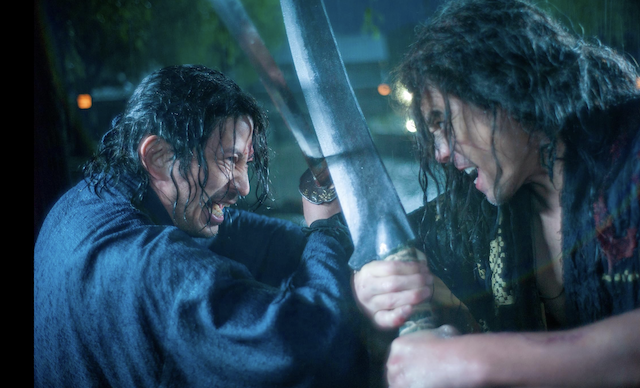
Not surprisingly, much will be left unresolved at the end of the first “chapter,” since the manga ran for four volumes. Regardless, the swordplay and martial arts sequences are uniformly spectacular. Junichi Okada, who serves as action choreographer and “creative director” (as well as starring as Saga), delivers some incredible sequences. He guarantees the series lives up to the hacking and slashing promise of its premise.
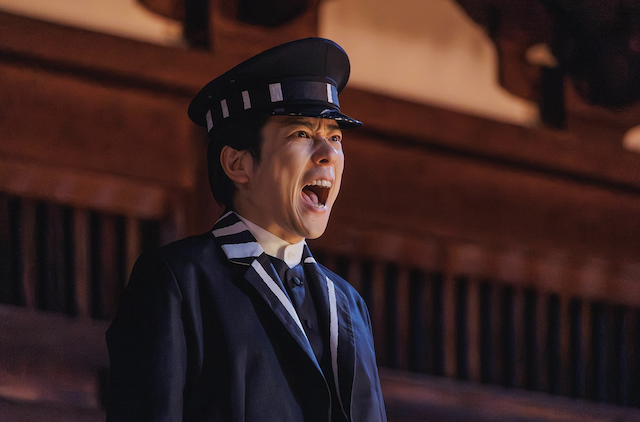
Okada also has the right intensity for the slow-burning Saga. He holds his own on-screen against burly Hideaki Ito, who might rank as the scariest samurai ever, playing borderline-psychotic Bukotsu Kanjiya. In addition to the big, loud Kanjiya, Takayuki Yamada brings a cerebral steeliness to Jinbe Ando, a police officer working as a chief enforcer for the Kodoku, who emerges as another potential nemesis for Saga. Plus, Hiroshi Abe rounds out Chapter One’s colorful rogues’ gallery, as the fierce and almost feral Gentosai Okabe.
Indeed, Last Samurai Standing features many notable Japanese actors in supporting roles. For instance, Shota Sometani ought to emerge as a fan favorite for his portrayal of Kocha Kamuy, an indigenous Ainu archer. Yet, Masahiro Higashide might deliver the most entertaining performance as Saga’s supposed ally, Kyojin Tsuge, whose offers shrewd strategies, but inspires little trust. (He was formerly a ninja, after all.)
You can’t miss the martial arts spectacles, but the historical intrigue is also surprisingly clever. In fact, chapter one puts a radical new spin on one of the most notorious events of the early Meiji Era. Arguably, it reflects a very contemporary paranoia regarding the so-called “deep state,” within a traditional Chanbara period production. Highly recommended for fans of samurai action and conspiratorial political thrillers, Last Samurai Standing is now streaming on Netflix.
 @Courtesy of Netflix
Our interview with Actor Junichi Okada
Grade: A
If you like the review, share your thoughts below!
Check out more Nobuhiro’s article.
Here’s the trailer of the film.