

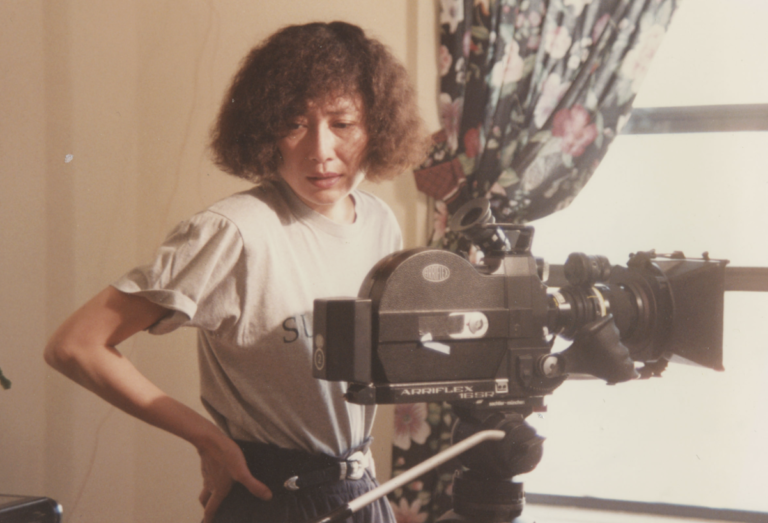
©Courtesy of the Museum of Chinese in America
Shanghai-born documentary filmmaker Christine Choy, whose 1987 Oscar-nominated film Who Killed Vincent Chin? galvanized the Asian-American community, died on December 7 in Manhattan. She was 73.
In a career spanning fifty years, the outspoken Choy made more than eighty films and received dozens of awards, including a lifetime achievement award presented to her in 2023 by the Hot Docs film festival. In the previous year, she had been the subject of The Exiles, a documentary directed by two of her students that won the Grand Jury prize at Sundance. That film depicted Choy’s meeting with a group of Chinese dissidents who had participated in the Tiananmen Square protest in 1989.
For more than thirty-five years, Choy had been on the faculty of New York University’s Tisch School of the Arts, where she chaired the graduate film/TV program from 1994 to 1997 and 2002 to 2005.
Christine Choy was born as Chai Ming Huie to a Chinese mother and a Korean father who was a political exile living in Shanghai. During the Cultural Revolution in China, Choy and her mother fled to South Korea where the family was reunited. In the mid-1960s Choy arrived in New York City, where she quickly became involved in political activism with the Black Panthers and other radical groups.
In 1972, Choy co-founded Third World Newsreel with Susan Robeson, the granddaughter of African American actor Paul Robeson. One of their first releases was a documentary about the 1971 Attica Prison uprising. Choy also directed many other films about the struggles of racial minorities, including From Spikes to Spindles, Mississippi Triangle, Sa-I-Gu, and A Litany for Survival: The Life and Work of Audre Lorde.
Choy’s 1988 film Who Killed Vincent Chin?, which she co-directed with Renee Tajima, examined the 1982 murder of a Chinese auto worker in Detroit who had been targeted because his killers thought he was Japanese. The film was made at a time when tensions were flaring over the perceived threat to the American automobile industry by Japanese competitors. In the years following its release, the film was credited for helping galvanize the movement for pan-Asian identity and activism in the United States.
If I may be permitted a personal note, Christine Choy and I became friends after she read an article about her Vincent Chin film that I wrote for The New York Nichibei, a Japanese-American newspaper of which I was English editor from 1988 to 1994. She promptly commissioned me to ghost-write her memoir, which was translated and published in China and Korea. In 1999 and 2000, I visited with her in Hong Kong, when she was establishing the film school at the City University there.
I was honored when Christine asked me to be literary advisor to her 2007 film Hyam Plutzik: American Poet, a documentary about the Jewish-American author who had been nominated three times for a Pulitzer Prize. Christine co-directed the film with her daughter, Ku-Ling Siegel, and the three of us spent many happy hours on the road chasing down interviews with some of America’s leading poets including Hayden Carruth, Donald Hall, Galway Kinnell, Stanley Kunitz, and Grace Schulman. The film was featured at the Zebra Poetry Film Festival in Berlin, at Jewish film festivals in Jerusalem, Tel Aviv, and New York, and at a screening in Rochester, New York, where Plutzik had taught for many years.
Christine Choy was a larger-than-life figure who was passionate about using the film media to counter racism, oppression, and injustice. She was also noted for her brook-no-nonsense, confrontational personality. According to the Age of the Geek, actress Jodi Long described Choy as “a loudmouth,” “skinny,” and “combative” while another unidentified observer called attention to her “whirlwind Tasmanian devil energy.” She once famously clashed with Robert Redford over her criticism of the Sundance Festival as a “white-on-white” affair that neglected filmmakers of color. The following year, she was invited to serve on the jury.
Christine Choy is survived by her daughter Ku-Ling and her sons Fleeta and Tatanka. A memorial service is planned after the New Year.