

©Courtesy of GKIDS
Q: Director Akimoto, I understand you worked at a game company before joining STUDIO4℃. What led you to enter the anime and CG industry?
Kenichiro Akimoto: That’s right. After graduating from university, I worked at a game company for about four years. It was a company that made what you might call music games. There was a moment during that time when I was given the chance to freely create one or two pieces of video game footage—like the kind that plays during music games—within the series. That’s when I first discovered the appeal of video production.
I started thinking I wanted to get serious about it. Then that company held a kind of maker seminar for the film Tekkonkinkreet, which was made at STUDIO4℃. It was just by chance, but they held a seminar there about how animation is made and how CG is used. It was incredibly interesting, and that really gave my motivation a huge boost. So I changed jobs and jumped into this industry.
Q: You’ve contributed to various roles in STUDIO4℃ productions, such as CGI Director for Children of the Sea (2019), Art Director for Poupelle of Chimney Town (2020), and unit Director for “Fortune Favors Lady Nikuko”(2021). Did you ever aspire to take on the role of Director? How did you receive the offer to direct?
Kenichiro Akimoto: This too, I guess you could call it a series of fortunate circumstances. I was lucky enough to get to try my hand at various things—starting as a CG director, then art director, then directing—and I was able to build up experience in that environment. I happened to be talking with the representative of our company, our boss (Eiko Tanaka), about wanting to try working on some sci-fi projects.
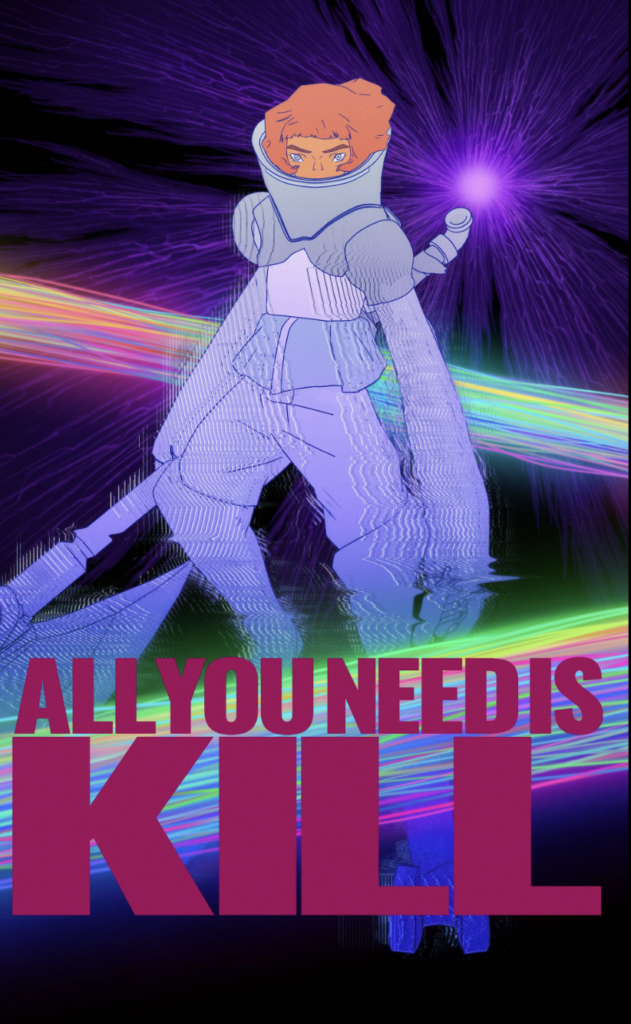
I happened to mention to the president that I’d like to try working on some sci-fi projects. Then, luckily, Warner Bros. approached us with the ‘All You Need Is Kill’ project, asking if we’d like to collaborate. So, we decided to give it a shot, and that’s how I ended up taking on the challenge of directing.
©Courtesy of GKIDS
Q: Based on the original work by Sakurazaka, and with a live-action Hollywood adaptation starring Tom Cruise, what perspective did this anime version take to differentiate itself from the original work and the Hollywood live-action version?
The original novel was incredibly well-crafted, and I found it a truly fascinating read. Naturally, that led me to start thinking about how best to adapt it into animation. Of course, I also watched the live-action version. It took a slightly different approach from the original novel.
While Kenji remains the protagonist, the situations he faces and the story structure were significantly reworked and established as original elements tailored for the live-action film. So, when creating the animation, I wanted to establish something original that was unique to an animated work.
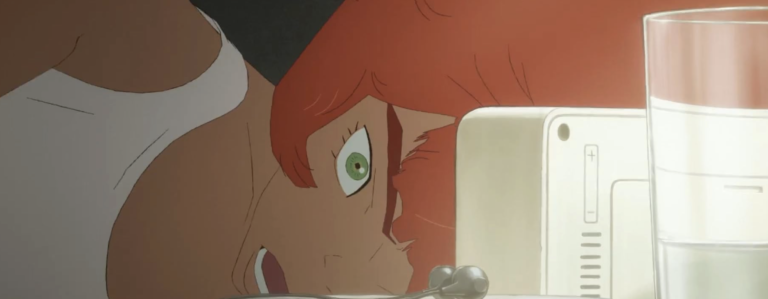
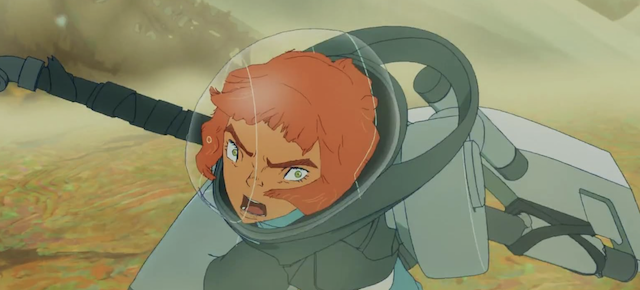
In the original work, the protagonist has changed from Keiji to Rita this time. The original work also depicts Rita’s perspective. In establishing the animation’s originality, we thought it might be interesting to capture the world of ‘All You Need Is Kill’ from Rita’s viewpoint. That’s the background behind how this work came to be.
Q: I think the perspective from Rita’s point of view is really fleshed out and incredibly interesting. How did you and screenwriter Yuichiro Kido expand the content? Even though it differs from the original work, I imagine you still retained the core elements of the source material to some extent. In what ways did you expand the story from Rita’s perspective?
We definitely did some pretty challenging things ourselves, I think. Like how the basic rule is that when you die, you loop back to the same morning again. And the grand foundation—Earth being invaded by lifeforms and humanity fighting back against it—remained the same. But when we shifted the perspective to Rita’s point of view, we made one more change: this time, the protagonists aren’t soldiers. They’re more like ordinary people, closer to our own position.
The reason for that is, we thought it might create a bit more relatability, or perhaps offer more points for the audience to empathize with. So we proceeded by first discussing such adjustments with the writers and also consulting with Tanaka. Furthermore, as she loops and grows stronger and stronger, steadily defeating more and more creatures, I felt I wanted to weave in this story: that this girl, Rita, who has closed off her heart, meets a boy named Keiji and gradually opens up. I thought that approach would foster greater empathy in the audience, resonating more deeply with their emotions. So, we added that as another core element and structured it as a single film.
The reason for that is, we thought it might create a bit more relatability, or perhaps offer more points for the audience to empathize with. So we proceeded by first discussing such adjustments with the writers and also consulting with Tanaka.
Furthermore, as she loops and grows stronger and stronger, steadily defeating more and more creatures, I felt I wanted to weave in this story: that this girl, Rita, who has closed off her heart, meets a boy named Keiji and gradually opens up. I thought that approach would foster greater empathy in the audience, resonating more deeply with their emotions. So, we added that as another core element and structured it as a single film.
©Courtesy of GKIDS
Q: I hear limited animation techniques are being used in this production. What exactly is that, and what kind of effect does it create?
Kenichiro Akimoto: Limited animation is often contrasted with what’s called full animation. Traditionally, in Pixar or Disney works, they divide each second into twenty-four frames, with a complete drawing on each frame. If full-frame animation is what creates that incredibly smooth motion, limited animation uses only about 8 frames per second, or perhaps 12 frames, to convey the animation. If anything, that approach has become the mainstream in Japanese animation today.
Now, I’ll skip over the details of how we transitioned from full animation to limited animation, but the reason I chose limited animation is that the animations I grew up watching were mostly limited animation—that’s a big factor. The interesting thing about limited animation is that it’s divided into 24 frames per second, but it only uses about eight drawings. It makes the viewer kind of fill in the gaps between the drawings—you could call it an optical illusion—where the previous and next drawings linger a bit, and the viewer fills in what they see between them.
I find that movement somehow satisfying. Rather than drawing everything out, I borrow a little from the viewer’s power of imagination. Somehow, that gives the movement a certain flair—a touch of theatricality, if you will. That sense of tension and release—like when you hold back for a moment, then your hand shoots out with that sudden speed—is becoming a unique expression of Japanese animation, I think. I wanted to challenge that further with CG animation, and that’s why I tried this approach this time.
Q: Regarding the character design for Rita, how did you develop her with Izumi Murakami, who handled the character design? Rita’s expressions are unique—she’s approachable yet carries a sense of loneliness—and she’s drawn in a truly captivating way. I think this really shines through in the character design. So, what did you discuss with Mr. Murakami to shape Rita’s character design?
Kenichiro Akimoto: First, I did have a general image in my mind of what kind of person Rita might be. I discussed that initial idea with Mr. Murakami, and then gradually, through writing various scripts and creating different sketches, she evolved into the Rita we have now. One thing, I wonder what it was… She also mentioned wanting to portray a cool woman who doesn’t easily flash a flattering smile.
That really matched my own image perfectly. So we talked about finding references that fit that character—like, say, a character from a movie, a character in a live-action film we could use as a reference. I think the influence of movies I saw back then, probably from around the 1990s to the early 2000s, is probably really strong on me. We talked about referencing the style or silhouette of protagonists from movies around that time, and through all that discussion, her current style gradually took shape.
As you mentioned earlier, I absolutely love this character design. I think capturing that balance—where she doesn’t smile easily but still has this inherent charm—was incredibly difficult. You worked on various expression sets for her, and you managed to express it so skillfully. Plus, the way you designed the expressions is very restrained, keeping the overall look quite flat. That really suits my taste perfectly. it doesn’t pair well with the kind of limited animation we discussed earlier. For instance, if you animate a model loaded with textures, like flowers covered in intricate details, the viewer’s eye gets drawn to those textures instead. It becomes difficult to achieve that beautiful, fluid animation. So, this combination of the flat design and 3DCG feels incredibly fresh to me. It’s a solution that really satisfies me expressively.
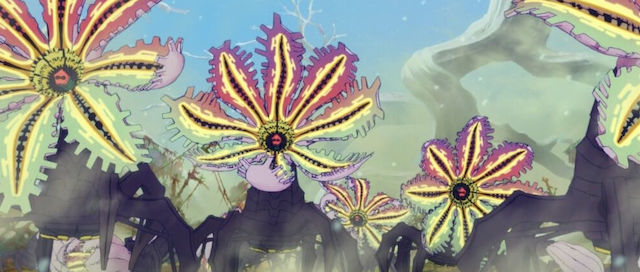
Q: Could you tell us about the concept art for the Darol’s Flower, which conveys the world setting? How did you decide on it? I felt a strong sense of shared existence between nature and humanity, or that kind of message. Could you talk a bit about that message and the character design?
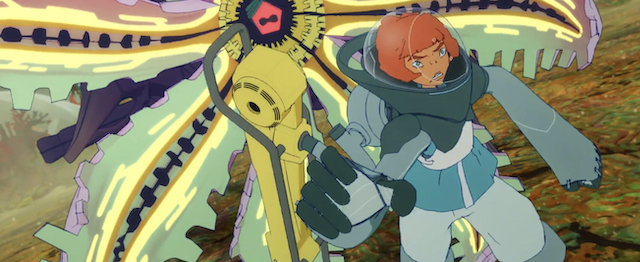
Kenichiro Akimoto: Regarding Darol, it is an original setting unique to the animated work. However, as inspiration, besides the perspective of Keiji mentioned earlier from the original novel and the perspective of Rita that I expanded upon, there’s actually another episode written from the perspective of the alien planet—the planet invading Earth.
That episode probably shows the people from the alien planet, who don’t really understand or care much about Earth’s environment, essentially sending in the mimics with the mindset of terraforming it into a habitable planet. Meanwhile, Earth is being invaded and is in total chaos. I found this contrast incredibly interesting. Essentially, it’s about how things we do without a second thought can have a massive negative impact on ecosystems, or affect them in ways we never imagined. I suspect this happens all over Earth. Trying to express that with a bit of cynicism is kind of the underlying concept behind Darol.
However, I really wanted to express how those flowers blooming there are eerily beautiful. They’re incredibly beautiful yet poisonous flowers, but they’re actually extremely harmful to the Earth and are being constantly altered. I based the design on that fundamental concept.
©Courtesy of GKIDS
If you liked the interview, share your thoughts below!
Check out more of Nobuhiro’s Articles.
Here’s the trailer of the film.