
@Courtesy of Sony Pictures
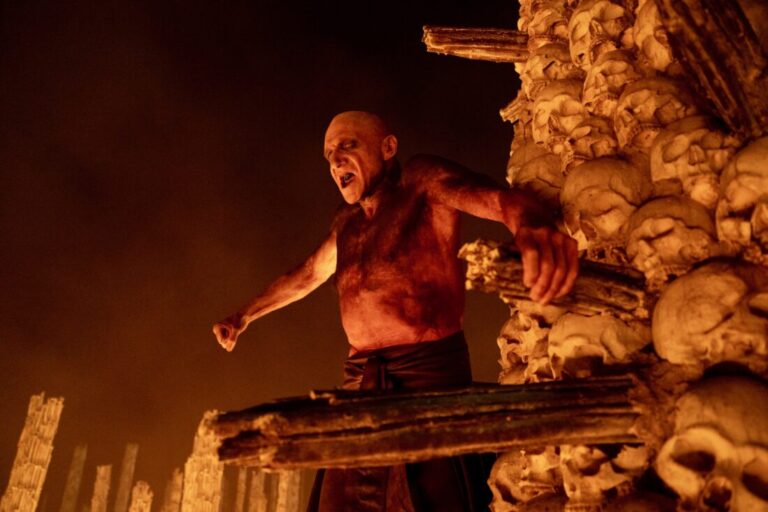
There are two sequences that stand out in this sequel directed by Nia DaCosta, and both are basically duels. The first one is merely aesthetic, a beautifully crafted clash between the penetrating blue eyes of Dr. Kelson (Ralph Fiennes) and the red, crazy eyes of the Alpha Zombie (Chi Lewis-Parry). The director uses tight close-ups in order to make those two colors symbolic, the battle between madness and hope, between chaos and logic in a world that seems to be hopelessly precipitated in a living hell.
The second duel is developed thanks to the inspired screenplay written by Alex Garland. The duel this time opposes Dr. Kelson to the psychopathic killer Jimmy Crystal (Jack O’Connell), and is orchestrated like an irresistible, comedic dance between a man that struggles to maintain his humanity and his opponent who is completely out of control. This could be the funniest, most brilliant scene that you are going to find in a horror movie this year, we can guarantee that. O’Connell and Fiennes are capable of fully embracing the dark and at the same time funny side of their characters, showing a chemistry that is not often easy to find in movies like this.
Their duet is almost a pochade moment in a sequel that is way better than the previous one, especially because it is about fallen angels more than about flesh-eating zombies. 28 Years Later: The Bone Temple puts almost completely aside the running rabid-like monsters and focuses on the survivors, showing how humanity can destroy itself if put in the right (sorry, wrong) conditions. Nia DaCosta shows to have completely understood the tone of Alex Garland’s screenplay, and plays this accordingly with the best of her capacities. Her movie is consequently a highly entertaining horror that doesn’t spare a few truly gruesome moments – result of human violence – and talks about our present through the lens of this genre.
@Courtesy of Sony Pictures
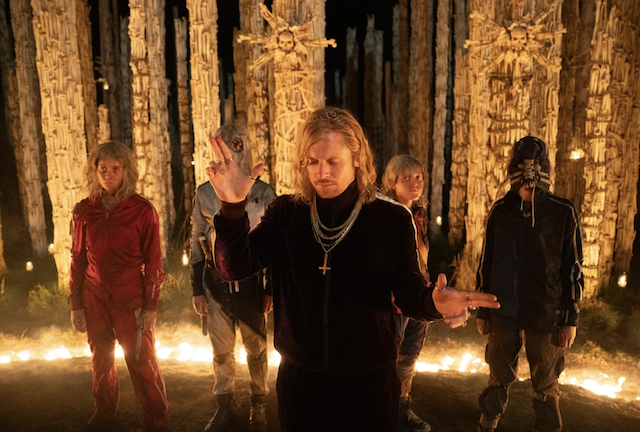
28 Years Later: The Bone Temple is indeed a lot of fun, allowing the audience to experience a wide range of emotions through different tones. Visually, Nia DaCosta has done a remarkable job in order the present her feature film more polished and elegant than the previous chapters, and this helps the viewer not to be disturbed by the raw poverty of the images. Other than that, the director often dares go to the extremes: there are at least a couple of moments in which what we see on the big screen is brutal, and that is good for a horror movie especially when the gore is linked inside a story that makes sense of it, avoiding to make it gratuitous. But the best parts of The Bone Temple is when the movie itself makes fun of the craziness it is showing: the sequence of the encounter between the wild bunch of Satanists and the fallen angel himself is something you rarely experience in a production like this. At least not at this level of awareness.
It was since the first 28 Days Later, released in 2002, that this horror franchise didn’t produce such an effective and entertaining chapter. Nia DaCosta and Alex Garland have realized a movie that fully works on a double level: 28 Years Later: The Bone Temple is first and most important sheer, highly crafted cinema. Second, it works really well also as a metaphor about the social, political, psychological horror we are living nowadays. If the result is so enjoyable, the cast must be thanked as well, in particular Ralph Fiennes and Jack O’Connell. After the flamboyant and irresistible vampire in Sinners, O’Connell confirms with Jimmy Crystal that he is totally capable of depicting charming and terrifying villains. Chapeau.
Rate: A-
If you like the review, share your thoughts below!
Check out more of Adriano’s articles.
Here’s the trailer for 28 Years Later: The Bone Temple: