

@Courtesy of FX
Press Conference with Actors Ashton Kutcher, Evan Peters, Rebecca Hall, Anthony Ramos, Jeremy Pope
Q: How do you think The Beauty reflects the current cultural landscape?
Rebecca Hall: Ryan Murphy has a nose for the zeitgeist and what is current. He makes it subversive and provocative, even more worth discussing. There’s a lot to be said about it, then chase for perfection and what that means. Human beauty is a conceptually complicated thing. It’s not like nature. It’s not like looking at a sunrise. It’s subjective. The idea that you can pay for perfection and therefore you’re handing over your idea of it to someone who is taking your money and might want more of it is complicated. What does that mean? How does it shift? What does it change? Because keeping people in a place of inadequacy is more profitable.
Ashton Kutcher: We’re living in a world where the demand for Ozempic, and Wegovy, and Mounjaro, and all of these drugs: some of them are for health complications, others are just for aesthetic outcome. Then we have this increasing demand for cosmetic surgery, including tourism for cosmetic surgery, people augmenting themselves in order to achieve a look or a feel or a vibe that they think will give them some advantage, or maybe it will just make them happy. You start to ask questions like: is that so wrong? And then you add on top of it gene editing, which is happening in the world today, which can make you healthier. You amalgamate all of that into one thing: it’s a shot and it’s called The Beauty. And the question is: what are you willing to sacrifice for that? What risks are you willing to take? That’s incredibly poignant. Ryan always has his finger on the pulse of the decision that we’re all making on a daily basis. This show gets underneath and explores it and makes you ask those questions about yourself and about what your worldview is.
Anthony Ramos: We now live in a world where things are out there, so much available to us that can enhance our beauty. Essentially make us the person that we’d like to look like on the outside. Society tells us what we should look like on the outside a lot of times. Instinctually, we put that pressure on ourselves: maybe I’m not skinny enough, or maybe my face isn’t trim enough. I’m looking a little too puffy, let me get this facial to flush my face, and so on and so forth. It’s a part of our culture in a big way. This show talks about that on a deep level.
Evan Peters: There’s also a throughline through a lot of Ryan’s projects: the thing that makes you you and makes you unique is the thing that makes you interesting and is to be celebrated. At the end, there’s some episodes that really hammer that in and nobody better than Ryan to spread that message.
Jeremy Pope: I love a piece of art that asks the audience the question: what would you do if there was a drug that you could take that would make you feel like the best version of yourself? The show starts off in a very vain, vanity, physical way. That’s an interesting conversation to be having because there are a lot of things that are being projected onto us via social media, via the news, there’s always a medication that you can take that can change this or do that if you have that. It’s just an active conversation about where you sit on the side of beauty, your perspective of yourself, the inner work, the outer work. To me, that makes for interesting dialogue and conversation.
Q: After acting in this series, did your relationship with your own body or with the idea of perfection change?
Ashton Kutcher: After working on the show I started thinking about what is beauty? This show doesn’t try to define it. It lets the audience define what that is. I just started to ask myself that question: what do you consider to be beautiful? I think every single person that you would talk to probably has a different definition of what that is. For me, imperfection is beautiful. Because imperfection is a representation of the potential. We’re all imperfect and it doesn’t matter. Whether it’s the way you look physically, the choices that you made, how you behave, we’re all these fabulous, beautiful works in progress that are learning and changing over time. I think that’s beautiful. If anything, the show made me think about that, find that honest place within myself, accepting of my own imperfections and ambitious about changing.
Q: What is the dynamic like between Jordan and Cooper? How do they balance each other out as partners?
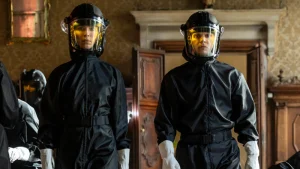
Rebecca Hall: They work together and they are best friends with benefits. They both think that there’s nothing more to it, although it’s a complete lie and they’re just refusing to be vulnerable with each other. There’s a lot of unspoken nonsense and they should just get on with it.
Evan Peters: I totally agree. You’re rooting for them, one of them to speak up and say: wait a minute, I don’t want you to see other people, I just want to see you. I love you.
Rebecca Hall: They’re both very frightened of emotional intimacy.
Evan Peters: As characters, I think that Cooper’s a bit straight edge straight, and Jordan is very fun and funny. They balance each other out.
 @Courtesy of FX
Q: What impact do your characters have on each other?
Anthony Ramos: Jeremy reminds The Assassin of himself. There’s a level of empathy that The Assassin has for Jeremy’s character brings out of him. The Assassin spends a lot of time by himself. He’s a killer, he does it alone. He sees a kindred spirit in this guy that essentially he was intended to kill at first. There’s this level of loneliness and a void that Jeremy fills. It’s really cool to be able to dive into that but also see their relationship grow over time.
Jeremy Pope: Like Anthony said, The Assassin has spent a lot of time alone. And I think the same for the character Jeremy, who is described as an incel, an involuntary celibate, who is looking for connection and affection. This moment he gets to meet someone who sees him and appreciates the weirdness that he is and that he’s bringing. They begin to work as a duo and they begin to find new ways in this new experience and new life. I’ve known Anthony for years, there’s that chemistry that we built as brothers and as family. To be able to translate that into these nuanced characters, some would say villains or bad guys, it was about us excavating the truth and trying to get into the psyche of these humans who are up against difficult stakes. To them, these are the right choices.
Q: Do you see The Corporation as a villain or as someone who genuinely thinks he’s helping humanity?
Ashton Kutcher: I learned a very long time ago you can’t judge your character. Um, you cannot judge your character. He’s doing some pretty abhorrent things, but when you’re playing the characters, you have to play them from the perspective that they believe that they’re doing something right. I have to look at the character as a good guy that’s doing a good thing. I have to look at the character as someone who goes: wait, this will help people live better, happier, more fulfilled lives. And if there is a bastardized version of this drug on the market that is hurting people, I have to contain that before it becomes a problem. By the way, there are people in government every day that make these decisions and somehow make them from a benevolent perspective. They go: well, we needed to kill those people so they didn’t kill other people. They believe what they’re doing is an effort of containment or sanitization, abhorrent behavior. If you twist the way that you see anything in the world, you can find yourself a version that is good. — I was reading Ted Kaczynski’s, uh, manifesto. I’m in a banned book club where we read books that you would be embarrassed to read on the subway, right, because you just didn’t want- wouldn’t want to look at- people looking at you like.
Q: What can you tell about shooting in Italy? Anything from cinematic to culinary experiences: what is your favorite memory from shooting there?
Anthony Ramos: My favorite thing about shooting in Italy was Italy. Everything: the food, the landscape, the architecture, the people, the culture. It’s just a beautiful place, one of the most beautiful places in the world. Getting to be in Venice and Rome was awesome. We had a chance to spend time with each other in a way that we didn’t in New York. In Italy, we’re all staying in the same place and everyone’s hanging out downstairs in the hotel bar for hours, getting kicked out until it closes. We had a good time. Being in Italy also does something to your character, does something to the look of the show. The aesthetic just takes it to another level.
Rebecca Hall: A peak experience on the show for me was leaving my hotel before dawn to get into a water taxi to go to work riding through the water. We saw all of Venice as the sun was coming up. I was just quiet or in the back of the taxi by myself, it was just like: well, this isn’t a usual going to work experience.
Jeremy Pope: One of the more memorable days for me, watching my colleagues do their scene at the Trevi Fountain. We shut down the Trevi Fountain to really hear it in its piece and to take in the architecture. There was something so magical about us. That’s when it really hit that we were making this show internationally. It was going to bring a different texture, a different level of visual currency to the show. It allowed for the show to take on a new kind of character and tone, which is exciting.
Ashton Kutcher: Every time I go to Europe, I am reminded of just how young America is. Every building, every brick, every fresco you see, there are lessons in these walls. Lessons about history, and humanity. There’s also, as a commentary on this show, what beauty has meant through history, what was beautiful architecture a thousand years ago, it has changed over time. The materials have changed. The constitution of it has changed, the lines have changed. There’s a cosmetic adherence to this show that has to include the world. The cinematography of this show is extraordinary. The lighting, the way it’s lit, there’s these all throwbacks to Bertolucci, the way they were playing with the light in the show. Actually going there imprinted something different on this show than what could not have been imprinted if we tried to just approximate it.
 @Courtesy of FX
Q: After playing so many villains, especially in the Ryan Murphy universe, what’s it like being on the good side? What can you tell us about the complexity and goals of your character?
Evan Peters: It was fun. It was exciting. When he pitched it to me, he said: “There’s going to be some great action sequences.There’s a complicated romance with Jordan played by Rebecca Hall,” which was very exciting to play. He said he just wanted me to be normal. That’s strange. The stakes are raised and then he has to go rogue and figure out how to do this thing without help, essentially.
Q: Can you talk about the stunt work in the series and some of the memorable, intense sequences you all worked through?
Anthony Ramos: We learned these fight scenes. We probably did one time before we got to set. And then we were relearning it as we went. Re- relearning this fight as we went and shooting it in pieces, but then also being like: hey, let’s add this extra, this is a cool acting moment.
Jeremy Pope: We don’t really flex, but we were doing boxing training leading up into this show. It was helpful because it was very physical. You have to be ready to make those adjustments. You can’t be too locked in physically to what’s happening because it can change. It becomes more like a ballet, if you will. It is incredibly beautiful. I’m really excited for people to feel and see the work that we put into the show.
Ashton Kutcher: I can really empathize with you guys in these fighting scenes. I had to shoot a scene where I sat in a jacuzzi and I ate 27 pieces of pizza in one day. So challenging…
If you like the press conference, share your thoughts below!
Check out more of Adriano’s articles.
Here’s the trailer for The Beauty: