

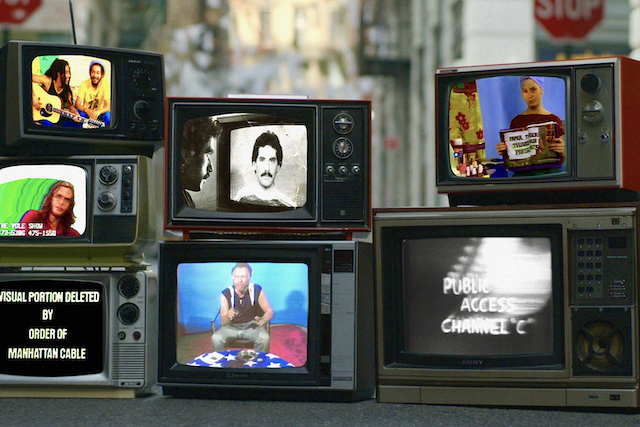
©Courtesy of Sundance Film Festival
Public Access : An unprecedented look inside one of the greatest media experiments to hijack American screens. Rare archives from New York’s underground capture a world of creators who shattered rules, defied censors, and transformed our televisions into a free-speech battleground where anyone could be a star.
The internet and social media platforms may have given birth to influencers and content creators, but decades before their popularization, public access television such as New York City’s Manhattan Cable Television opened up the floodgates for technological free expression. With no editorial input allowed, ordinary New Yorkers had carte blanche to create — from the interactive Grube Tube to Glenn O’Brien’s underground scene free-for-all TV Party and the pioneering LGBTQ+ series The Emerald City. But when sexually explicit programming pushed the boundaries and stirred public debate, First Amendment court battles followed. David Shadrack Smith takes viewers through the unfiltered creativity and chaos of this paradigm-shifting new technology, which presaged today’s media-driven world. As Public Access cheekily warns, “Brace yourself! Nothing you have ever seen before can prepare you for this.
Director : David Shadrack Smith
Produced by : Sara Crow, Anne-Marcelle Ngabirano
Production Companies : Part2 Filmworks, Olive Productions
In Association with : Out for the Count
Executive Producers : Wren Arthur, Steve Buscemi, Benny Safdie
Director David Shadrack Smith & TV Personality Jake Fogelnest
Q : After the invention of handycam, or handheld camera, it’s only natural that people start making some short films or making some content that what they want to say, but I didn’t know that those types of channels(such as Public Access Television) exist that specifically cater towards those ideas, how did you get the idea to make this film in the first place.
David Shadrack Smith : Sure. And I would love to talk about the technology that was so new at the time as well. That started with the Sony Portapack, in fact, the video revolution that kicked off the whole Public Access TV experiment. But, for me personally directing this film, the seeds of it really started when I was a kid growing up in New York late at night at my grandmother’s apartment.
Flipping from, the shows that were on TV, the usual stuff, then suddenly landing on Public Access TV and seeing things you never imagined, but we’re in the same city you lived in.
And it was like the whole underground came pouring in. I think that spirit of seeing these fearless creators like Jake willing to experiment and play with new technology and new access to a TV set, got embedded in my DNA, and many years later that I was actually watching my own children going through their TikTok and Instagram, and I thought, “Wait a minute, we’ve been here before and this is not that different.”
And so putting that all together really made me wanna think about the conversations we’re having today that were also happening then. And the blueprint made back then.
Q : Speaking of blueprint, Jake, you are at the center of this TV phenomenal approach. What are the TV programs that influenced you back then and what motivated you to tackle such a wonderful show like Squad TV?
Jake Fogelnest : The interesting thing was, obviously I was heavily influenced by things like, “Late Night with David Letterman” and “Saturday Night Live” and all the regular things that you could see on television. Much like David, I was also a kid and stumbled across Public Access TV in New York City, seeing strange shows, things like “Beyond Vaudeville,” or even Al Goldstein, “Midnight Blue,” seeing these people doing a show almost hit me in the same way, watching early John Waters films. I was like, “Wait a second. This is just friends with a camera making stuff and it counts as a movie, or a TV show.”
And if they can do that, then why can’t I? Manhattan Public Access, is as simple as filling out paperwork and dropping off a tape, and then you can be on television. That was pretty radical to me in the late 80’s and early 90’s.
Q : David, I’m curious to know, Manhattan Cable TV(which has the Public Access) was owned by the Time Warner. Do they have any specific formative ideas how to get the service to the community? Because it feels like very much like experimental back then.
David Shadrack Smith : I should say and there were sort of some competing cable franchises in New York, TelePrompTer(Corporation), Manhattan Cable eventually, Time Warner, they bought it all. And they’re still buying them all. Although they’re about to get bought, but that’s another story. they really hated Public Access TV. When they were laying cables in New York City.
Some media activists from the alternative media center in New York, coming out of this sort of civil rights movement, you know, thinking access to media for everyone should be a civil right, should be a human right, we should have more voices. So they advocated with the city of New York to mandate that the new cable lines being laid in New York as a paid service into people’s homes.
Had to have some bandwidth allocated to public access channels, meaning literally anyone could walk in, put whatever they wanted on TV. So you know, Manhattan Cable, eventually Time Warner, and they hated it because it was uncontrollable. It was unmonetizable and it was uncontrollable.
And they were legally required to provide it. So for them it was this nuisance. And when more controversial shows started which they did very quickly when artists and punk musicians, and eventually the pornographers realized, “Really? I can just put anything I want on TV”?
Jake Fogelnest : I’ve got a port a pack. I’ll put it on television.
David Shadrack Smith : That’s when they started to find mechanisms to control what was put on the airwaves, and the legal battles started, which continued to escalate throughout the decades from the local New York courts to, FCC and eventually all the way to the supreme court to protect these public spaces from corporate or political interests, that’s a remarkable story.
Q : Jake, let’s talk about your “Squad TV”, because I’ve actually never seen any show that kid was hosting 30 minutes show in the 80’s or early 90’s when I was in Japan. Could you talk about the reactions back then and how it’s perceived and how it’s grew.
Jake Fogelnest : It’s so interesting because the show was essentially me in my bedroom talking to camera, talking about whatever was interesting to me in music, pop culture, movies. And every week, that’s what I would talk about on the show. And I’d show clips of things. Now that doesn’t seem like such a radical idea here in 2026, but, of course, in 1994, 12: 30 at night, people are flipping around the dials in New York City and maybe they see a Devo music video and then.
This 15-year-old kid pops up and that’s Devo, I like Devo. Here’s what happened to me at school. It sounds like any other kid doing a YouTube video. But I sort of did it first and it had this immediate cult phenomenon happened in New York City. I took the subway the morning after the first episode aired and I was recognized.
Then, people started reaching out. I used, “They Might Be Giants” as my theme song and a month into the show, John Flansburg from They Might Be Giants called and then the Beastie Boys called, they were fans of the show.
Can we come to your bedroom and hang out, Kim Gordon from Sonic Youth saying, “Oh, you, you need a haircut? You mentioned on your show you need a haircut. I’ll give you a haircut. We live down the street.” I went from being this 15-year-old kid who was fans of stuff to friends and collaborators with incredible artists from all walks of the entertainment industry.
And I haven’t had much of a day job since then, and I’m gonna be 47. I had ups and downs of course and that’s in this film. But it was wild.
David Shadrack Smith : It really speaks to nobody knew how many people were watching public access. It was never measured. And one of the reasons the corporations that owned it didn’t like it was ’cause they couldn’t sell advertising.
So, there were no Nielsen ratings, no view count like social media, no likes. When you hear a story like Jake’s, you realize its reach into certainly the New York culture, even beyond VHS tapes being shared across the country and going to other public access channels. You started to realize what a vital and authentic piece of culture was coming through Public Access TV.
And I think that’s why so many downtown luminaries were drawn to it. It was so real. It was just a kid in his bedroom talking to you that was completely new original influencer. So now I’m gonna get into boxing. That feels like the next progression for me. (Lol)
Q : In the film, obviously dealing with some controversial things, there’s a tension staff producer and management and Charlotte Shiff Jones, a former vice president of Time Warner. She gave the budget and sort of a protecting the program. Could you talk about how she was actually become the gate to protect those actually public access channel?
David Shadrack Smith : Charlotte Shiff Jones is amazing person. First, she was a woman in the seventies who had risen to the level of vice president at a major corporation, a testament to her intelligence and strength of character. She’s a fierce first amendment believer to this day, she’s still with us, in her 90’s and, she has spent her life in media trying to protect the first amendment and free speech.
But she was, as you said, in a very awkward position between these, board rooms full of older, mostly white men who were really unhappy with what was going on this Public Access channel in their building. She had to play both sides and I think her in a position of that we find ourselves in today so much too of wanting this idea to flourish. Everyone has a voice.
Everyone should be heard. And oh wait, there are corporate interests, there are political interests or community interests that are trying to co-opt or in some cases silence what is being said. She walked a fine line. I think she did it with great care.
When she tried to put mechanism to protect Public access from the hand of might want to change it, as she testified in front of congress on behalf of Public Access, she did what she could in the position that she was in, I think she was a true believer..
Jake Fogelnest : It’s tricky thing to deal with the boardroom and also artists downtown and pornographers on 42nd Street, that is very delicate art in itself, managing both those things, in true effort to serve the public and have the most on the air that you could by contemporary community standards at that time.
Q : This will be the last question. I wanna talk about two of the programs, “Midnight Blue” and also “Emerald City.” “Midnight Blue” is obviously the subject to talk about sex on the television. And also “Emerald City” is representing the gay community as best we could, talking about such as safe sex and AIDS epidemic that they need to protect and all that.
David Shadrack Smith : Yeah, I mean I love both those programs and in addition, “Men in Films” which took the L-G-B-T-Q mantle after “Emerald City” went off the air. Both of them were groundbreaking. In the 70s, nothing represented sexual, diversity of sexual interests. And there was certainly no representation or no positive representation of the gay community.
And this is just after Stonewall. In their own ways, they were completely groundbreaking shows. To talk about sex, to talk about gay life and talk to those communities was a revolution. They were very different. “Midnight Blue” was reporting from what they call the front lines of the sexual revolution and Times Square, it was having fun..
Jake Fogelnest : He was a pornographer lunatic..
David Shadrack Smith : But he really defended the First Amendment to a great expense. And Louis P. Maletta, who had a vision of a kind of gay sex, panoply of shows when AIDS came along, he stepped up and he said, no one is talking about this. And we have a direct line to the gay community and save lives with this powerful medium called television. So they’re hero stories in an inadvertent way.
If you like the interview, share your thoughts below!