

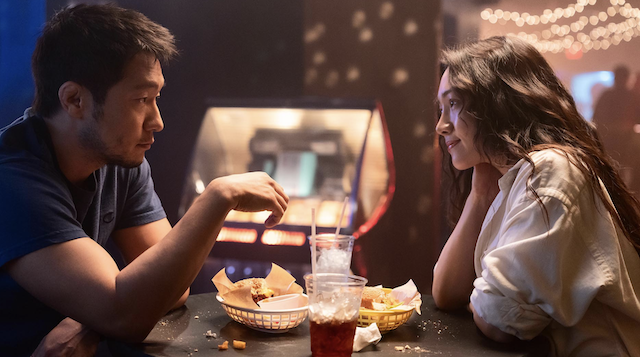
©Courtesy of Sundance Film Festival
The most confident, compelling films trust acting and craft ability over spectacle. Like its American and Korean counterparts, the new romantic drama, Bedford Park built its foundation on the accumulation of small, human moments. It further succeeds as a result of varying element working in careful balance with each other.
Stephanie Ahn wrote the script for the movie. She also made her feature film directorial debut on, and also co-edited, the project. The feature stars Moon Choi, Son Sukku, Won Mi Kyung, Kim Eung Soo and Jefferson White.
Bedford Park follows Audrey (Choi), a Korean American woman who’s haunted by an abusive childhood. Now in her 30s, the caring but equally sullen New York City physical therapist must finally face her emotional past.
Audrey returns to her parents’ home in New Jersey after her mother suffers a car accident. While there, she meets Eli, the man who’s responsible for the accident. Despite them initially being some hostile to each other, Audrey and Eli eventually start to build a loving connection.
The duo soon realize that they’re very different from each other in many ways. But they ultimately connect because their pasts haunt them in similar ways. Having lived through difficult times as children of expectant, watchful parents, the two main characters carry their feelings of hurt and isolation into their adulthood. As a result, they struggle to navigate caring for both their families and themselves, balancing their careers and personal relationships.
In her feature debut, Ahn articulated the complicated emotional landscape of immigrant children who are now still struggling as adults with great vulnerability. Bedford Park expresses human experience with heartfelt honesty that rarely appears on screen.
The filmmaker’s writing and directorial approaches reveal character through behavior rather than explanation. Even when the story leads its characters into situations that feel a bit forced and manipulated, their emotions still remain truly believable.
Choi and Sukku give powerful but equally subtle performances as the protagonists. The actors show how their characters unexpectedly find comfort in each other while still trying to overcome their childhood guilt and anger. In doing so, they find a way to heal each other.
The duo’s performances are the dramedy’s emotional anchor. Playing the will-they-or-won’t-they couple, Son and Choi are intriguingly unpredictable at first. Guardedness and misdirection drive Audrey and Eli’s early interactions.
When the protagonists finally let their defenses slip, whether during an awkward conversation in the car or at the food court, their connection deepens profoundly. Their chemistry grows from a shared sense of recognition rather than simple attraction.
What draws Audrey and Eli together is not just a slow-burn romantic pull, but a deeper sense of feeling stuck in their current situations. Both are caught between the heavy expectations of their families and a growing dissatisfaction with lives that haven’t turned out as they’d hoped.
A powerful line that Audrey delivers is that they both feel that they’ve finally found someone around whom they feel comfortable. Both characters arrive in each other’s lives without preconceptions or demands, as they see each other as they are, rather than as who society expects them to be.
The movie’s cinematographer, David McFarland mainly created Audrey and Eli’s world in drab colors. The lack of vibrant colors helps highlight a sense of confinement in Audrey’s modest family home and Eli’s apartment. The film’s overall dark colors and crowded environments reflect the sense of people feeling emotionally trapped by their circumstances.
Along with the dramedy’s overall muted visual palette, the project’s cinematography also prioritizes patient framing that allows scenes to feel lived in. Audrey and Eli are often situated within lived-in spaces that seem to close in on them, which reinforces the duo’s feelings of being emotionally and culturally stuck.
The visual aesthetic of the story’s settings further develops the story’s sense of authenticity. The movie’s production designer, Javiera Varas filled the protagonists’ homes and shared public spaces with modest details that suggest lives are defined more by compromise than fulfillment.
Ahn also co-edited the dramedy with Malcolm Jamieson in a flourishing, but equally restrained, way. They prioritized Audrey and Eli’s emotional continuity over the story’s momentum. Scenes unfold at a deliberately natural pace, which allows for awkward pauses, unfinished sentences and fleeting expressions to filter into the story. The final version of the movie resists presenting neat resolutions for the characters in a realistically insightful way.
Woven through Bedford Park‘s messy tangle of relationships is a moving exploration of shared Korean and American identity. The protagonists are rendered with a generosity that allows them to define themselves on their own terms.
Bedford Park stands as a testament to the quiet power of restraint. Ahn crafted a story that draws emotional weight from the fragile courage it takes to be truly seen. The muted cinematography, lived-in production design and patient editing work in sync to mirror the characters’ interior lives.
Overall, the dramedy resists easy catharsis in favor of emotional honesty. By prioritizing vulnerability over spectacle, it offers a nuanced portrait of the lingering ache of unresolved childhood wounds.
At the movie’s core are the layered performances of Choi and Sukku. The actors’ chemistry transforms Audrey and Eli’s tentative romance into something deeply affecting. Their bond deepens as they recognize themselves in each other and find comfort in being understood without pretense.
In embracing life’s messiness rather than neat resolutions, Bedford Park affirms that healing begins with connection. The film also embraces the fact that even within emotional confinement, there remains the possibility of quiet hope.
Overall: A-
Bedford Park premiered in the U.S. Dramatic Competition of this year’s Sundance Film Festival on Saturday, January 24 at the Eccles Theatre in Park City. The romantic drama went on to win the festival’s US Dramatic Special Jury Award for Debut Feature for Ahn.
If you like the review, share your thoughts below!