

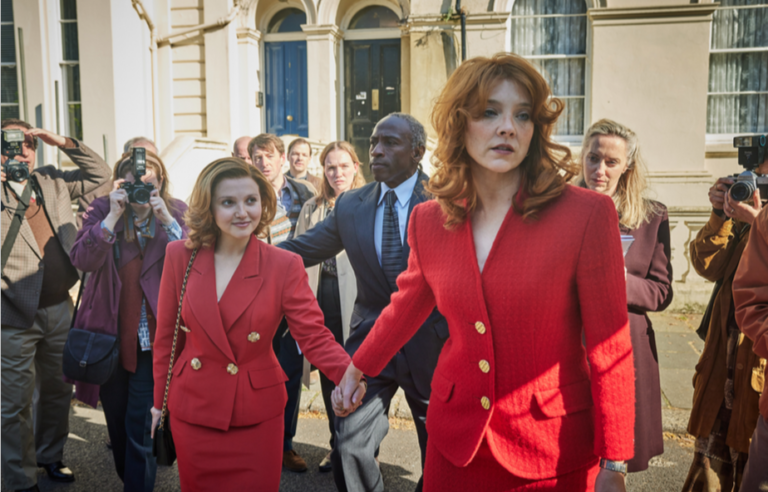
‘The Gone Girl’ phenomenon has brought more attention to the domestic abuse and manipulative behavior carried out by women against men. Along these lines, the BritBox series The Lady explores this social condition, chronicling a true story of a female anti-hero, following her complicated hustle between light and darkness. The drama is inspired by the rise and fall of Jane Andrews, the former royal dresser of the Duchess of York.
Jane (Mia McKenna-Bruce), as a young working-class girl from a small town in Lincolnshire, answers an advertisement in a magazine that leads her to work at Buckingham Palace. Her fairytale life is later crowned with a wedding to a kind and established man (Mark Stanley). However, her propitious fate turns against her, making her realise that moving within the upper-classes might not be as easy as she thought. When Jane cease no longer working for Sarah Ferguson (Natalie Dormer), a new man arrives in her life: Thomas Cressman (Ed Speleers). She pins all of her hopes on who she considers to be her Prince Charming, that will change her life forever. Her existence definitely takes a different turn, but it has nothing to do with the happily ever after she had in mind.
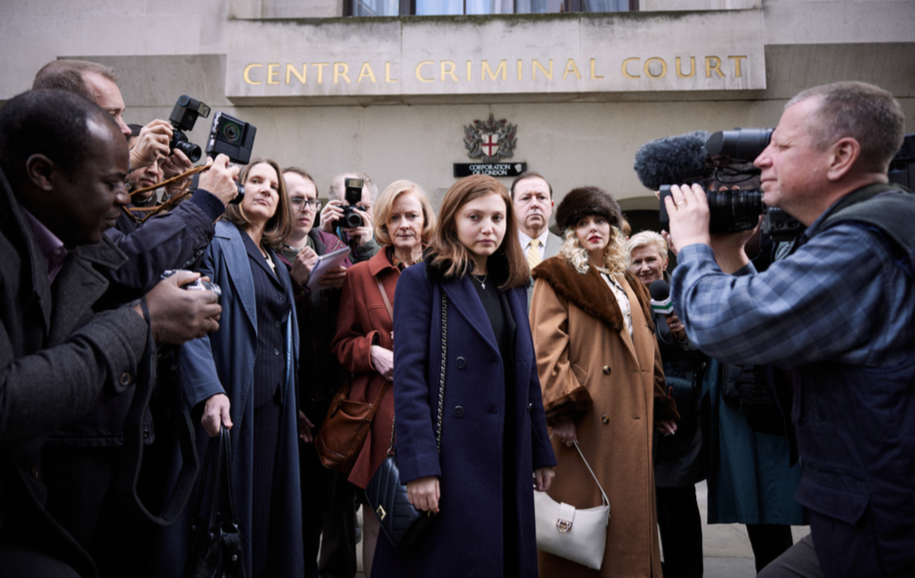
The Lady is created and written by Debbie O’Malley and directed by Lee Haven Jones. It possesses the gist of aristocratic series, since it is brought to life by The Crown’s award-winning studio Left Bank Pictures. Some names have been changed, like the one of Sarah Ferguson’s Italian Count boyfriend, or Jane’s upper-class boyfriend after her divorce. But the essence of the true event remains, as much as the parable of a person’s fall from grace after having experienced the rags-to-riches illusion.
The series is very subtle in bringing forth the topic of classism, discussing social mobility. England is portrayed as a land of snobbery, in a world where people would argue the class system. The people working in proximity with Jane at Buckingham Palace tease the way she dresses, speaks and carries herself. They continuously remind her not to have aspirations above her station. Jane dares to dream the impossible and succeeds thanks to her expertise, as we witness during her royal interview. She proves to be worthy of that gilded world. Yet, she turns out to be the one to self-sabotage the achievements she conquered, that had temporarily allowed her to emerge from the working-class fishing town in northeast England she came from.
The series is exceptionally sensitive in not creating a black or white character out of Jane. She is complex like any human being. Her murderous actions are the consequence of her mental instability. Jane Andrews was later diagnosed with borderline personality disorder. The four-part series doesn’t justify or condone the criminal offense because of this, but it allows a broader understanding of such behaviour. As Debbie O’Malley explained, “The Lady aims to humanise rather than demonise; it is a series which also touches on attitudes towards mental health, the class divide and how women are treated in the public eye.”
In 2001 Andrews was sentenced to life in prison. Two years later she appealed against the conviction on the grounds of fresh psychiatric evidence, which was refused. During the trial her claim of childhood sexual abuse remained unproven. The series explains with a simple text-based epilogue how Jane Andrews was released on license in 2015, but recalled to prison in 2018, following allegations of harassment from a former boyfriend. No evidence was found to support the allegations, but she remained in prison until 2019.
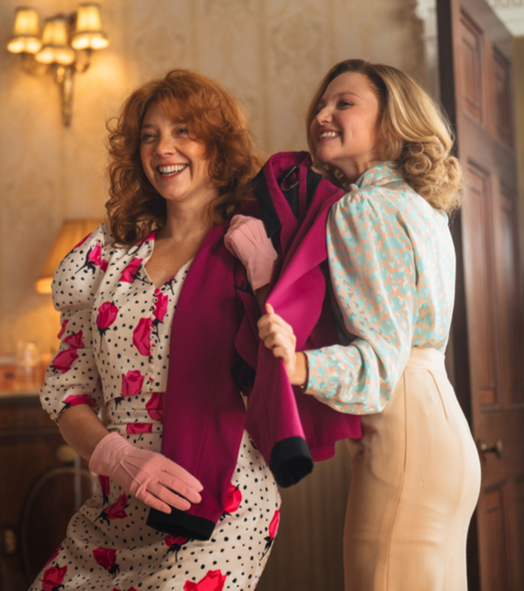
Besides the insight inside the news story, The Lady is a visual delight, to peek behind the curtains of Sarah Ferguson’s private apartments and admire the flamboyant fashion of the time. The hair and make-up designer Amy Stewart and costume designer Emma Fryer immerse viewers in an authentic Eighties world. From bubblegum-pink jerseys and flouncy skirts, to muted Laura Ashley floral dresses and preppy, ‘Sloane Ranger’ outfits. It was a time period in which fashion would allow women to step into their power. History recalls how Princess Diana used fashion to spotlight organisations and charities by wearing statement knitwear to public events.
From a sociological point of view, the series shows how female public figures could be trapped in a meat grinder of frustration for the disparaging media coverage. As Debbie O’Malley said: “For female celebrities in general, and the Duchess of York herself of course, there were some pretty disgusting things written about them at the time. This institutionalised misogyny was something that came up again and again, and is an important theme in the series.” In fact, there is one scene in the series that includes this horrific media shaming when the front page of a tabloid newspaper in the Eighties created a poll asking its readers: ‘Who they would you rather sleep with? The Duchess of York or a goat?’ It was in this very decade that people started acknowledging the ‘Tall poppy syndrome,’ when public figures are ostracised as a form of egalitarianism. This is very well captured by a line of dialogued pronounced by Natalie Dormer as ‘Fergie’: “Like the Duke says, once you join the firm, you’re fair game.”
The Lady looks beyond the headlines and brings to the silver screen a chapter of modern history. The story that is is set over three decades — starting with the 1980s spanning to the early 2000s — questions issues that are ever more relevant today, from class to entitlement, from mental health to the sensationalistic media circus.
Photos are courtesy of BritBox
Final Grade: B+