

©Courtesy of Universal Pictures
Rom-coms often prioritize immersive atmosphere over narrative originality, a familiar weakness of the genre. You, Me & Tuscany follows this pattern to a degree, offering a story to audiences that they will find predictable. But the film ultimately redeems itself through its rich visuals and the understated chemistry between its leads, Halle Bailey and Regé-Jean Page.
Ryan Engle wrote the movie, from an original idea he developed with his wife, Kristin Engle. Kat Coiro directed the film.
You, Me & Tuscany is set against the sun-drenched landscapes of Tuscany and Rome. Anna (Bailey) is a young woman who has abandoned her dreams of becoming a chef. She’s now drifting through her twenties with a series of bad choices, which leads her to lose her house-sitting job and housing in one instance.
 ©Courtesy of Universal Pictures
Anna’s chance encounter with Matteo (de Moor), a handsome Italian who happens to have a villa sitting empty in Tuscany. That knowledge inspires her to jet off for Italy, against the advice of her always-honest best friend, Claire (Scott).
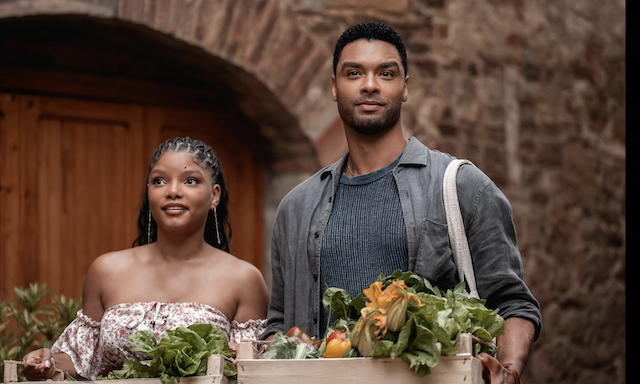
But Anna’s plan to stay at Matteo’s villa, without permission, just for one night, soon falls apart. His mother, Gabriella (Ferrari) shows up at the house unexpectedly. In a panic, Anna allows Gabriella to believe that she is Matteo’s fiancée. That little lie becomes a big problem, though, when his cousin, Michael (Page) shows up, and Anna discovers that the chemistry between them may transform her life.
While Bailey emphasizes Anna’s existential crisis over abandoning her culinary ambitions, Page provides the protagonist both romantic friction and emotional grounding as Michael. Around them, Coiro constructs a rom-com that feels intentionally lived-in, shaped as much by its physical spaces as by its characters.
The production design, led by Elena Albanese, is the movie’s most accomplished element. Rather than presenting Tuscany as a postcard backdrop, the film integrates it into the story’s emotional architecture.
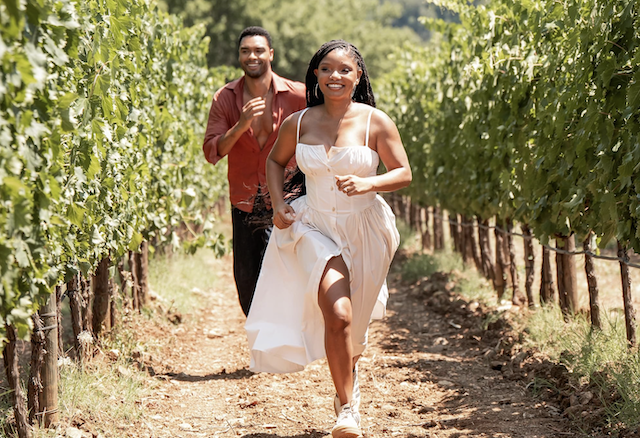
The villa known as Casa Luna, which is central to Anna’s journey, is emblematic of this approach. Its exterior, filmed on a working vineyard, captures the rugged authenticity of the region. Meanwhile, its interior was meticulously constructed at Cinecittà Studios to allow for both narrative flexibility and visual control. The result is a space that feels expansive yet intimate, with layered textures, warm tones and a careful interplay between old-world structure and modern livability.
Albanese’s decision to design multi-directional depth into the set allows the camera to move fluidly. That seamlessness reinforces the sense that this is a home shaped by time rather than a static set.
This attention to spatial storytelling continues in Ristorante Costa, conceived as the emotional heart of the movie. Its design reflects not just a functional kitchen but a place of identity and transformation for Anna. The warmth of the space, both visually and thematically, mirrors her gradual reconnection with her passion for cooking.
Similarly, Michael’s winery, located in the Val d’Orcia region, evokes generational continuity through its layered details and integration with the surrounding landscape. The choice of a real historic vineyard lends the rom-com an almost tactile sense of history, grounding its romance in something more enduring than fleeting attraction.
 ©Courtesy of Universal Pictures
The film’s most energetic sequence, the Bravio delle Botti-inspired barrel race, demonstrates how production design and location choice intersect with spectacle. Relocated from a town center to a countryside olive grove, the sequence gains both scale and visual dynamism. The setting allows for a broader, more cinematic staging, transforming what could have been a quaint local event into a moment of communal exuberance that underscores the film’s thematic investment in tradition and belonging.
Cinematographer Danny Ruhlmann complements Albanese’s work with a visual strategy that balances sweeping romanticism with immediacy. The movie’s reliance on natural light is particularly effective; sunlight filters through vineyards, washes over stone facades and pools softly in interior spaces, creating a visual continuity between exterior and interior worlds. This choice not only enhances authenticity but also allows performances to breathe within their environments.
Ruhlmann’s use of multiple cameras during scenes – often two or three simultaneously – encourages a looseness in performance that feels organic rather than staged. Steadicam work during ensemble and festival scenes introduces a fluid, almost musical rhythm, capturing overlapping dialogue and spontaneous interactions.
In contrast, the occasional use of handheld camerawork in interior moments brings a subtle immediacy, reinforcing the emotional vulnerability of the characters, particularly Anna and Michael. The interplay between these techniques ensures that the rom-com never feels visually monotonous; instead, it oscillates between the grandeur of its setting and the intimacy of its relationships.
Costume designer Massimo Cantini Parrini’s work further deepens this sense of place and character. Anna’s wardrobe evolves in tandem with her emotional arc, shifting from muted, somewhat disconnected urban attire in her earlier scenes to softer, more textural garments that reflect both the Tuscan environment and her rediscovered sense of self. The fabrics, particularly light linens and sun-washed cottons, feel integrated into the landscape, as though shaped by the same climate and culture.
Michael’s styling, by contrast, balances refinement with effortlessness. His wardrobe reflects both his connection to tradition and his ease within it. His costumes avoid the stiffness that often accompanies portrayals of wealth or heritage.
Supporting characters, particularly Gabriella, are similarly defined through costume choices that subtly communicate generational identity and cultural continuity. Parrini’s work does not call attention to itself, but its restraint is precisely what makes it effective. The costumes feel lived-in, not curated.
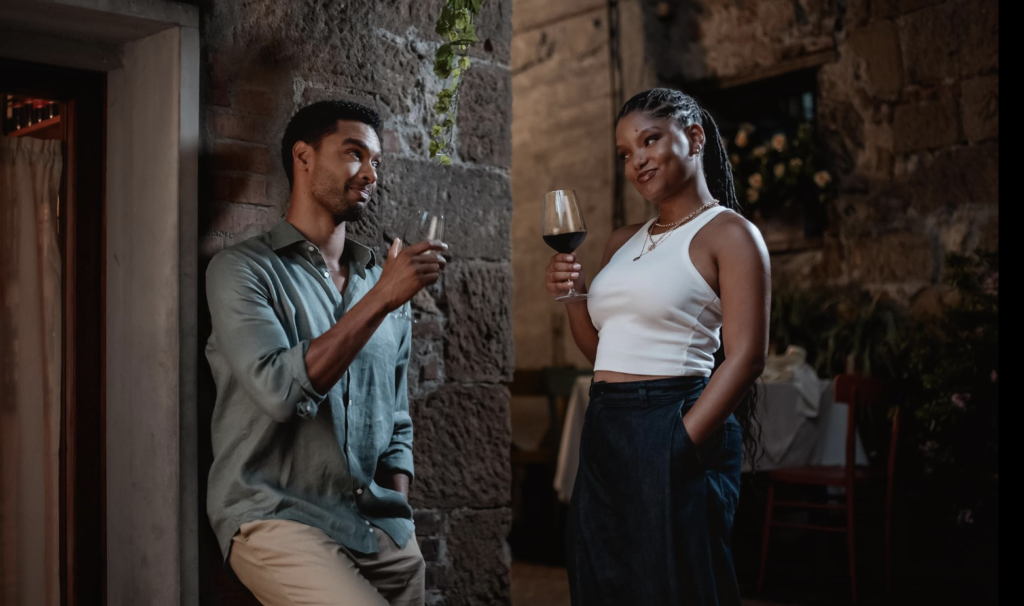
At the center of all this design work is the chemistry between Bailey and Page. Their connection ultimately determines that the film’s romantic premise resonates. Their dynamic is less about immediate, explosive attraction and more about gradual alignment.
The Actors’ Award-nominated Bailey brings a quiet vulnerability to Anna. The performer allows her character’s uncertainty and self-doubt to surface without tipping into cliché. The Emmy-nominated Page, meanwhile, imbues Michael with a grounded charisma that avoids the pitfalls of the archetypal romantic lead.
Their interactions benefit from the movie’s visual and spatial design. Scenes unfold in kitchens, vineyards and open courtyards, which that encourage movement and interaction rather than static dialogue. The camera often observes rather than dictates, allowing moments of connection to emerge naturally. When their chemistry does ignite, it feels earned, rooted in shared experience rather than narrative convenience.
What ultimately distinguishes You, Me & Tuscany is how cohesively its elements work together. The production design, cinematography and costume design are not merely aesthetic choices but narrative tools that shape the viewer’s experience. They create a world that feels tangible, immersive and emotionally resonant, even when the story itself follows familiar romantic beats.
While the film may not redefine the rom-com genre, its commitment to authenticity elevates it above more formulaic entries. It understands that romance is not just about characters falling in love, but about the environments that allow that love to take root. In this sense, Tuscany is not just a setting but a participant, shaping the film’s tone, pacing and emotional texture.
Coiro’s direction ensures that every element. The result is a movie that lingers less for its plot than for its atmosphere. The film features a carefully crafted world where design and performance come together to create something enduringly appealing.
Overall: B+
Universal Pictures will distribute You, Me & Tuscany in theaters this Friday, April 10, 2026.
If you like the review, share your thoughts below!
Check out more of Karen Benardello’s articles.
Here’s the trailer of the film.