
©Courtesy of Japan Society
Japan Society Announces
Kazuhiko Hasegawa’s Anarchic Ethos
A Focus on The Man Who Stole the Sun Filmmaker and Associated Works
May 8–16, 2026
Japan Society is pleased to announce Kazuhiko Hasegawa’s Anarchic Ethos, a long overdue focus on a crucial figure in Japanese cinema, the late Kazuhiko Hasegawa (1946-2026), the widely influential and tenacious director of the monumental picture The Man Who Stole the Sun (1979) and leader of pioneering 1980s independent production outfit The Directors Company (1982-1992)—a cultivator for fresh, new independent talent in the post-studio era, including Shinji Somai, Kiyoshi Kurosawa and Gakuryu “Sogo” Ishii.
Exposed in utero to Hiroshima’s radioactive fallout, the late and uncompromising Hasegawa was led to believe early in life that he would not live long as a tainai hibakusha (unborn atomic bomb victim). These uncertain beginnings would instill in Hasegawa an acrimonious distrust of authority, itself ingrained within the very fiber of his every contribution to film, a sum of only two directed works: The Youth Killer and The Man Who Stole the Sun—both monumental and radical in their own right. Perhaps one of the greatest tragedies in Japanese cinema remains that the towering “Goji”—a nickname from Hasegawa’s college football days—would never make another film. His long gestating dream of a followup, the unrealized epic United Red Army, was rumored for decades with involvements from Kiyoshi Kurosawa and Oshima scenarist Tsutomu Tamura; Hasegawa himself would proclaim, “I can’t die until I’ve made one more,” but it would never come to fruition.
Having entered the industry under the tutelage of Shohei Imamura and then served an assistant director and scriptwriter during Nikkatsu’s Roman Porno era before his two films, Hasegawa’s post-directorial career phase was to build a new future for young filmmakers, leading the independent production outfit The Directors Company (Direkan), named after the Hollywood New Wave venture founded by Francis Ford Coppola, William Friedkin and Peter Bogdanovich. It would be at the short-lived Direkan that Hasegawa’s vision of a “director first” mode of production would flourish, even for a short while.
A young wave of filmmakers—including former The Man Who Stole the Sun AD Shinji Somai and production manager Kiyoshi Kurosawa—ushered in a new era with defining new works of the 1980s. Previously, in 2023 and 2024, Japan Society presented the first North American Shinji Somai retrospective and revived key works by Direkan, including Mermaid Legend, The Crazy Family and the world premiere of Typhoon Club’s 4K restoration. In 1980 as part of a focus on Japanese New Wave, the American premiere of The Man Who Stole the Sun was presented at Japan Society with the East Coast premiere of Hasegawa’s debut Youth Killer presented in 1977.
Kicking off on May 8th with the singular The Man Who Stole the Sun (1979) on imported 35mm, a watershed of Japanese cinema history broaching his own personal history with the irradiating atom bomb, as an apathetic, gum-chewing science teacher threatens to detonate a homemade nuclear weapon, series highlights include Hasegawa’s 1976 directorial debut The Youth Killer on 16mm—a veritable shock to the system in its nihilistic depiction of a parricide—and three films scripted by Hasegawa prior to his debut, including the lauded Tatsumi Kumashiro drama Bitterness of Youth on 16mm.
Tickets: $16/$14 students and seniors /$12 Japan Society members.
Series Pass (Limited): $70/$50 members
Screenings take place in Japan Society’s landmarked headquarters at 333 East 47th Street, one block from the United Nations. Lineup and other details subject to change. For complete information, visit japansociety.org. Tickets are available now.
FILM DESCRIPTIONS
All films are listed alphabetically.
『青春の蹉跌』(Seishun no satetsu)
Saturday, May 16 at 8:00 PM
Dir. Tatsumi Kumashiro, 1974, 85 min., 16mm, color, in Japanese with English subtitles. With
Kenichi Hagiwara, Kaori Momoi, Fumi Dan.
Imported 16mm. Based on Tatsuzo Ishikawa’s bestselling novel, which shares a semblance to Theodore Dreiser’s An American Tragedy (later an inspiration to George Steven’s A Place in the Sun), Bitterness of Youth would mark the mainstream debut of Roman Porno master Tatsumi Kumashiro. Set at the waning stages of the student movements, Kumashiro’s Hasegawa-penned adaptation observes a growing listlessness and pragmatism from within footballer and law student Kenichiro (pop star Kenichi Hagiwara), once politically motivated but now resigned to a life after radicalism, who begins an affair with a high school graduate he once tutored (Kaori Momoi). Sex and politics stagnate under Kumashiro’s gaze, who dynamically lenses this youth drama with handheld shots, zooms and his characteristic long takes, capturing an empty existence, one eclipsed by the growing disillusionment and powerlessness of a once passionate generation.
Evening Primrose
『宵待草』(Yoimachigusa)
Saturday, May 9 at 5:00 PM
Dir. Tatsumi Kumashiro, 1974, 96 min., DCP, color, in Japanese with English subtitles. With Yôko Takahashi, Kenji Takaoka, Isao Natsuyagi.
Following the success of Kumashiro and Hasegawa’s Toho collaboration Bitterness of Youth, Nikkatsu opted to reunite the two under their studio banner. Taking its name from Takehisa Yumeji’s popular song, this Taisho-set Roman Porno finds inseparable ties between love and anarchy in the libertine era. Two anarchists belonging to a revolutionary sect headed by a radical benshi elope with the daughter of a political figure they kidnapped with the hopes of escaping to Manchuria. With its freewheeling nature and a soundtrack by Haruomi Hosono, this self-reflexive silent-era farce-cum-love story evokes the liberating spirit of the French New Wave.
『太陽を盗んだ男』(Taiyo o Nusunda Otoko)
Friday, May 8 at 7:00 PM; Friday, May 15 at 7:00 PM
Dir. Kazuhiko Hasegawa, 1979, 147 min., 35mm, color, in Japanese with English subtitles. With Bunta Sugawara, Kenji Sawada, Kimiko Ikegami.
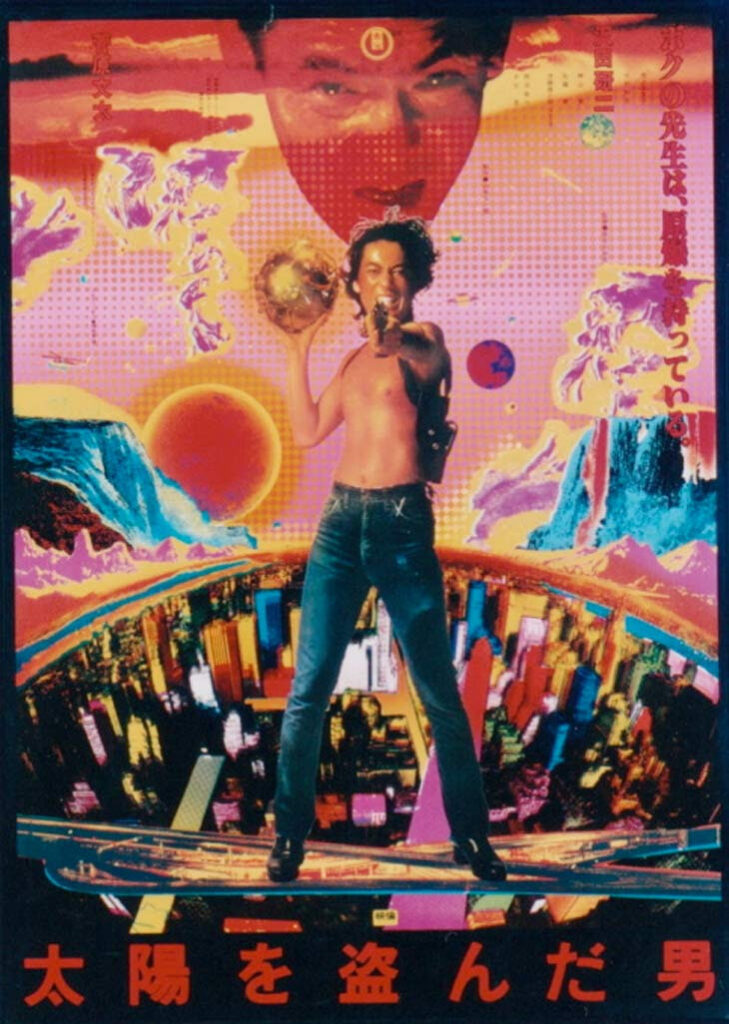
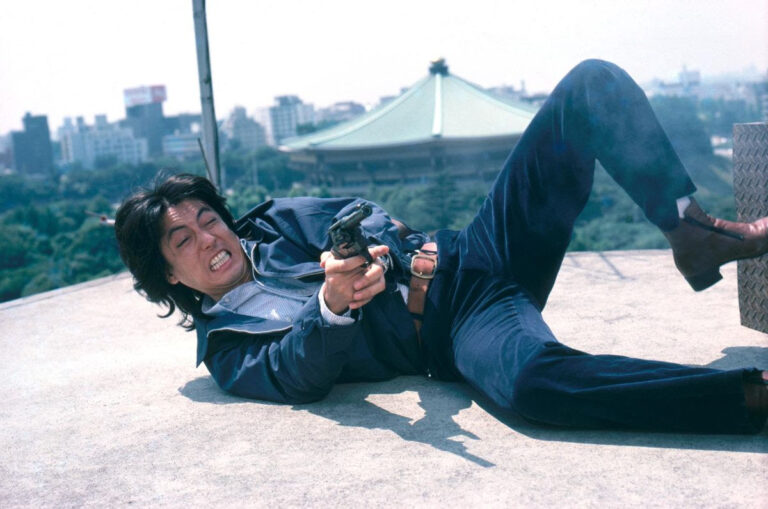
Imported 35mm Print. Initially titled The Laughing Atomic Bomb, Kazuhiko Hasegawa’s incendiary second feature—and what would amount to his final directorial work—is indisputably one of the great achievements of Japanese cinema. Born from an idea by Leonard Schrader and starring androgynous pop star Kenji Sawada, Hasegawa’s sprawling, anarchic masterpiece—featuring guerrilla-shot setpieces at the National Diet, Imperial Palace and Shibuya Tokyu Department Store—broaches his own personal history with the irradiating atom bomb. Makoto Kido (Sawada), a long-haired, gum-chewing science teacher, builds a homemade atomic bomb in his single-room Tokyo apartment, holding the country hostage by making exceedingly absurd demands. As he faces off with Bunta Sugawara’s straight-laced, flattop inspector, Kido becomes consumed by the power, with Hasegawa’s direction striking a radical balance between its weighty subject matter and breathtaking spectacle. Equal parts actioner, black comedy and momentous tragedy, The Man Who Stole the Sun suggest that we are all victims of the nuclear age.
Retreat Through The Wet Wasteland
『濡れた荒野を走れ』(Nureta koya o hashire)
Saturday, May 9 at 3:00 PM
Dir. Yukihiro Sawada, 1973, 73 min., DCP, color, in Japanese with English subtitles. With Takeo Chii, Yuri Yamashina, Maki Kawamura. Screenplay by Kazuhiko Hasegawa.
Far removed from Nikkatsu’s typical Roman Porno offerings, Yukihiro Sawada’s mordant critique of the police state—steeped in abuse, corruption and brutality—was at one point slated to be Hasegawa’s directorial debut. Opening with the raid of a church’s funds by a group of masked men who then sexually assault a young woman before reappearing at the crime scene as the very officers assigned to inspect the incident, Retreat Through the Wet Wasteland dispenses with any sense of moral code within its opening minutes. Coolly detached ringleader Harada (Takeo Chii), a ruthless inspector sporting dark lenses, is tasked with apprehending a former associate, now an escaped patient from a sanatorium. Despite Hasegawa’s apolitical stances, Nikkatsu’s labor union would declare that his “script represents the ideas of a Trotskyist who unnecessarily provokes authority.”
The Youth Killer
『青春の殺人者』(Seishun no satsujinsha)
Saturday, May 9 at 7:30 PM; Saturday, May 16 at 5:00 PM
Dir. Kazuhiko Hasegawa, 1976, 132 min., 16mm, color, in Japanese with English subtitles. With Yutaka Mizutani, Mieko Harada, Etsuko Ichihara. Screenplay by Tsutomu Tamura.
Imported 16mm. Polemical and provocative, The Youth Killer announced Kazuhiko Hasegawa as a striking new voice in Japanese cinema with its visceral adaptation of Kenji Nakagami’s short story Snakelust (which in turn was inspired by a 1974 incident of patricide). Initiated by a protracted double murder of a young man’s parents, Hasegawa’s debut follows the troubled path of young Jun (Yutaka Mizutani) who perpetrates the violent act after his parents oppose his relationship with local girl Keiko (Mieko Harada). Hasegawa’s complex psychological study, flickering back and forth through time and memory, exudes an alienated melancholia amid its rage, with the filmmaker approaching the incident as an everyday horror that befalls a seemingly ordinary man. Realized through a joint venture between mentor Shohei Imamura’s production company and ATG and soundtracked by Godiego’s Beatles-esque songs, The Youth Killer was a shocking arrival, an immediate triumph that led Kinema Junpo to declare it the best film of 1976.
SCREENING DATES
FRIDAY, MAY 8
7:00 PM The Man Who Stole the Sun
SATURDAY, MAY 9
3:00 PM Retreat Through The Wet Wasteland
5:00 PM Evening Primrose
7:30 PM The Youth Killer
FRIDAY, MAY 15
7:00 PM The Man Who Stole the Sun
SATURDAY, MAY 16
5:00 PM The Youth Killer
8:00 PM Bitterness of Youth