

©Courtesy of Apple TV+
There’s a unique kind of tonal development that very few modern shows manage to master: balancing uncanny comedy with eerie absurd humor. The new horror dramedy show, Widow’s Bay, not only commands it, but does so with a quiet confidence that makes the whole thing feel effortless.
The series hails from creator Katie Dippold. Emmy Award winner Hiro Murai directed and executive produced the dramedy through his banner Chum Films.
Emmy winner Matthew Rhys leads Widow’s Bay‘s ensemble cast. Kate O’Flynn, Stephen Root, Kingston Rumi Southwick, Kevin Carroll and Dale Dickey. The supporting cast includes K Callan and Jeff Hiller join Rhys on the dramedy.
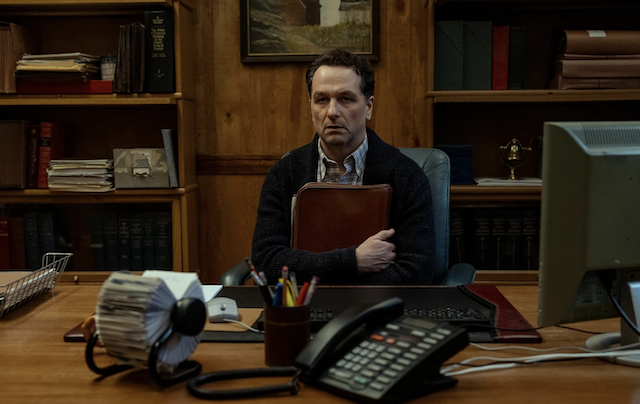
Widow’s Bay is a quaint island town 40 miles off the coast of New England. But something lurks beneath the surface. Mayor Tom Loftis (Rhys) is desperate to modernize his fading town. There’s no Wi-Fi, spotty cellular reception and a struggling local economy. Worst of all, superstitious locals who believe the island is cursed oppose him.
Loftis wasn’t born on the island. But even after all the years since he moved there, he’s still considered an outsider by the naive community.
 ©Courtesy of Apple TV+
So the mayor becomes determined to build a better future for his teenage son there. The government leader also hopes to revive the titular island by turning it into a tourist destination.
Miraculously, he succeeds, as tourists finally start visiting Widow’s Bay. Unfortunately, the locals were right: after decades of calm, the old stories that seemed too ludicrous to be true start happening again.
What might have easily fallen into gimmick territory instead became richly textured and unexpectedly immersive. The show knows exactly how to deploy every tool at its disposal – visually, performatively and tonally – to construct a world that is as unsettling as it is funny.
From a cinematography standpoint, Widow’s Bay strikes a remarkably assured tone. The dramedy leans into a visual language that borrows more from atmospheric horror than traditional comedy, favoring moody lighting, deliberate framing and a patient camera.
Director of Photography Christian Sprenger often shrouded his exterior shots of the coastal town in mist or washes them in muted grays and blues. The color grading sets a sense of isolation that feels almost mythic.
Interiors, by contrast, are frequently composed with tight framing and layered depth. That interweaving creates a sense that the characters are hemmed in by their surroundings hemmed in – or perhaps by something less visible.
The camera doesn’t rush to deliver a joke; it instead lingers, letting awkward pauses and visual incongruities do as much work as the dialogue. That restraint becomes one of the series’ greatest strengths, allowing humor to emerge organically from the frame itself.
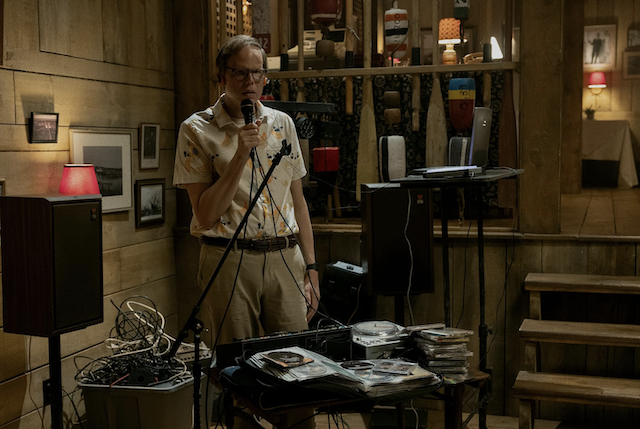
Equally impressive is the show’s production design from Steve Arnold, which turns Widow’s Bay into a fully realized, deeply idiosyncratic space. The town feels lived-in to the point of eccentricity – every room, storefront and public space is packed with detail that suggests years of quiet accumulation and local tradition.
The set decoration from Jennifer Engel is especially noteworthy. shelves are cluttered with peculiar objects, walls are lined with faded photographs and maritime relics, and there’s an overall aesthetic that hovers somewhere between quaint and quietly ominous. Nothing feels randomly placed. Instead, each visual element contributes to a larger sense of unease, as though the town is gently but persistently insisting that there’s more beneath the surface.
That interplay between the mundane and the bizarre is at the heart of the series’ absurd-horror comedy. Widow’s Bay doesn’t rely on big punchlines or overt parody; instead, it mines humor from tonal dissonance.
Characters treat strange, often inexplicable occurrences with a degree of normalcy that borders on denial, and it’s that gap – between what we see and how they respond – that creates the comedic spark.
The show understands that absurdity is funnier when it’s played straight. A lingering shot on an unsettling detail, followed by a completely deadpan reaction, often lands harder than any scripted gag. It’s a style of humor that rewards patience and attention.
Atmosphere is where all these elements converge, and Widow’s Bay excels at maintaining a consistent, almost hypnotic tone. There’s a constant sense that something isn’t quite right, but the show resists the urge to define or resolve that feeling too quickly.
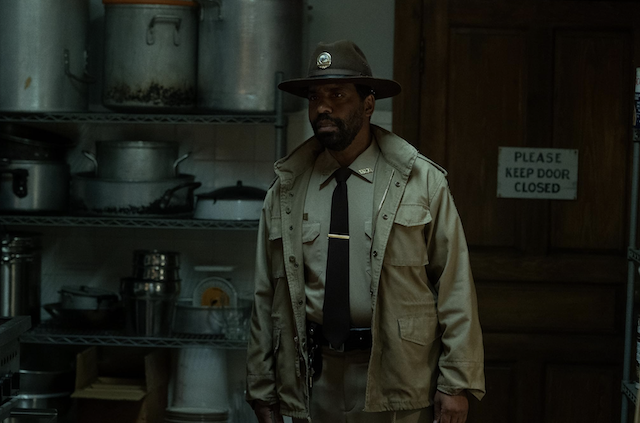
Sound design plays a crucial role in that development. Subtle ambient noises, distant echoes and the occasional intrusion of something unfamiliar all contribute to a low-level tension that hums beneath the surface.
 ©Courtesy of Apple TV+
The dramedy’s pacing is also deliberate, allowing moments of silence to carry weight. Rather than building toward obvious climaxes, the series sustains a steady mood, one that keeps the viewer slightly off-balance in the best possible way.
At the center of it all are three performances that anchor the series while also enhancing its offbeat sensibility. Rhys brings a grounded, almost understated presence that serves as an entry point into the town’s strangeness. He builds his performance on reaction – subtle shifts in expression, carefully timed pauses and a growing sense of disbelief that never quite tips into exaggeration. He plays the straight man without ever feeling dull, finding nuance in restraint.
Opposite him, O’Flynn injects the show with a sharp, unpredictable energy. There’s a slight edge to her performance that keeps scenes from settling into complacency. She seems entirely at home in the town’s peculiar logic, which makes her both compelling and faintly disconcerting. Her timing is impeccable, especially in moments where humor arises from contradiction or understatement.
Then there’s Root, whose presence elevates nearly every scene he’s in. Known for his mastery of deadpan delivery, he leans into the project’s tonal ambiguity with ease. He movies seamlessly between comedy and something more unsettling. He has an uncanny ability to make even the simplest line feel loaded with subtext.
What truly sets these performances apart, however, is their chemistry. There’s a natural, lived-in quality to the actors’ interactions that makes even the most bizarre scenarios feel believable. Conversations unfold with an easy rhythm, punctuated by pauses and glances that say as much as the dialogue itself. The trio feels like they inhabit the same strange reality. They each approach it from a slightly different angle but never breaking the dramedy’s internal logic.
Ultimately, Widow’s Bay is a show that trusts its audience. It doesn’t over-explain, doesn’t rush, and doesn’t feel the need to underline its humor.
Instead, the series builds a world that’s visually rich and tonally consistent. The show also anchors itself in performances from actors who understand exactly what kind of story they’re telling. The result is a comedy that lingers – not just for its laughs, but also for its atmosphere, textures and confidence.
Widow’s Bay will premiere tomorrow, April 29, 2026 on Apple TV+, with the first episodes dropping at launch. The streamer will then release new episodes weekly every Wednesday through June 17.
If you like the review, share your thoughts below!
Check out more of Karen Benardello’s articles.
Here’s the trailer of the series.