
@Courtesy of Focus Features
Q: This is one of those films that has plenty of fascinating layers to peel back. Why is it relevant to today, and why did it maybe resonate with you personally?
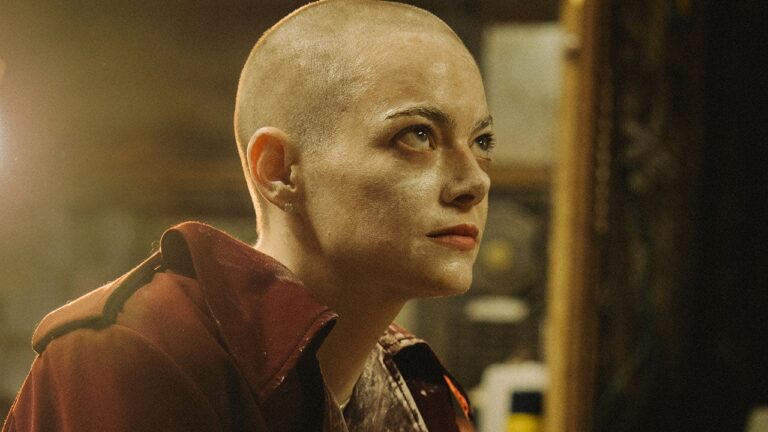
Will Tracy: It’s a remake of a Korean film called Save the Green Planet! I had lunch with Ari Aster in the East Village. He had told me about the film, which I’d never seen or indeed heard of. He didn’t tell me much about it, just said there might be something in the premise I’d find interesting and resonant. So I watched it and saw what he meant, and immediately started having ideas based on the premise. I felt you could make a very contemporary and American film out of that premise. I guess I didn’t approach it as a remake. I wrote it, it happened during the first wave of lockdown in New York, when it was really locked down. We had a newborn baby, so we were doubly locked down. I wrote it very quickly and was probably in a state of questioning myself, confused and unsure of what was going to happen next. That may have found its way into the script a little bit.
Yorgos Lanthimos: It was a very entertaining, exciting, interesting, complex read. It got me really excited imagining what it would be like as a film. I’m not very analytical in the beginning, when I read something I instinctively know that there’s much more to it than what’s on the surface, and I’m interested in it. I understand a lot more of its themes and how it feels relevant today, even more than when I read it three years ago. The state of the world, how it mirrors that through these characters in this situation. There’s a lot to unpack there. I think the film allows the space for the audience to do that according to who they are and how they feel.
Q:: Emma and Jesse, what about you as actors or as audience members for this movie?
Emma Stone: I loved this script from the first moment I read it. You always know within the first 20 or 30 pages, like you do with a book, if this is a voice or a feeling that speaks to you. I didn’t know how it was all going to unfold. I hadn’t seen Save the Green Planet! It was so interesting the way my mind went back and forth about if this is true or not, if she is what they say she is or not. It was twisty and surprising, emotional and funny. I was immediately in.
Jesse Plemons: We’re living in times that are disorienting and scary, full of paranoia and fear. There is an unconscious part of me that’s always searching for something, whether it’s music or art or film, that deals with it. A true, honest exploration without trying to take the position of giving you some obvious message or moral takeaway. In what Will Tracy wrote, he pulled off a magic trick with these characters that felt like perfect representatives of these two sides of the world, these archetypes.
Q: What was your first reaction upon reading the script? And how would you say it compared to the final product?
Emma Stone: Well, shooting it in VistaVision was really a great choice. Really a great choice.
Will Tracy: Yorgos pushed me towards. I’m at my best when I’m embracing the ambiguity of the story and the emotions of the characters, not being too on the nose with the theme. It’s essentially what I wrote, but he encouraged me to not think so literally. It can be a bit more abstract.
Jesse Plemons: Speaking about the flashback sequences, I remember Yorgos saying: “I’m going to mess with those. I’ve got some ideas.” It was very nonchalant. Then I opened it: my initial reaction to all was surreal and absurd and dark. There was something really emotionally evocative about them that it’s beside the point to intellectualize.
Q: How did you put this cast together with the casting director Jennifer Venditti?
Yorgos Lanthimos: The answer is pretty straightforward. I immediately sent the script to Emma as soon as I read it. I got excited and sent it to her to see if she felt the same way. She did. With Jesse, we had just worked on Kinds of Kindness, which was almost like making three films back to back because he had to play three different characters in three different stories. It was like an intense workshop, gathering experience and knowledge and gaining trust. Being inspired by how Don was written in the script, I felt I wanted to throw in a nonprofessional actor in the mix, which I do in all of my films.
But this was a major part. Reading the script and trying to understand how that character worked within that world, I thought that it would be interesting if he was neurodivergent, he had a different sensibility, and saw things differently. And so we went to Jennifer Venditti who has worked before with Emma on The Curse. Jennifer has great finding people that are not trained actors. She found Aidan quite early on in the process, we immediately loved him. We met him in person when we wanted to test a VistaVision camera. We were very nervous to meet him. He was great, very much himself. He’s very honest. Yt felt immediately the right choice to make him the soul of the film and the balance between this conflict of worlds.
Q: How did your previous relationship evolve in making this movie? Did you go into this with a shorthand? Or did the shorthand evolve and develop?
Jesse Plemons: It’s a benefit when you’ve worked together previously, it feels like you have a head start, there’s not this getting to know each other. There’s not the need to overexplain yourself or the way you’re looking at something. At the same time, each project is its own distinct creature that we’re all trying to figure out. If anything, it gives you more confidence to take the leap of faith along with everyone. It’s not just Emma and Yorgos and myself. It’s a lot of the crew members that are doing the same thing. It seems like everyone’s setting out on their own in the early days and gathering inspiration and bringing it back. It’s a constant process of following your instinct and intuition and what feels right because it’s its own thing.
Emma Stone: We usually rehearse quite a bit on Yorgos’ films. Here we didn’t really have that much time. We were promoting Kinds of Kindness at the same time as the prep for this film. That was also amazing because the three of us at least had been together a lot and had worked together before. It was really amazing having that comfort and that shorthand because there’s so much going on between Teddy and Michelle, between our characters. It was more about making sure that we had the lines down and then we could really find it much more quickly than we might have if we were just all new to each other. It’s like trust exercises with each other. Very silly stuff. Yorgos lets everybody set out on their creative and then he lets you know.
@Courtesy of Focus Features
Q: How does he get that, like level of trust from you? Is there anything you wouldn’t do for him in terms of crazy choices in a future project?
Emma Stone: It’s always such a hard question. Everything I’ve ever done in a Yorgos movie was in the script.
Q: How often does it happen during filming that you’re offering something that pivots the script like a moment or a tone?
Jesse Plemons: Speaking personally, I think that’s always the goal, to find something that’s unexpected. That’s the way I came to look at that rehearsal process: the trick as an actor is to prepare enough so you feel ready, but then not to get so tied to any of your preparation that you box yourself in in any way. As is the case with a lot of great directors, it’s an environment of exploration that is set, that benefits that type of exploration and discovery. I’m always hoping to be surprised.
Q: How did you find that balance between the drama of this very high stakes situation, and then this surreal comic tone?
Yorgos Lanthimos: That’s the process right there. You hope that you’ll figure out some kind of balance. That’s the interesting part of it. If you make something which is complex and has all these juxtapositions within it and layers, different people are going to perceive it slightly differently. So you can only go by how you feel it works and then hope that it works for other people too. It starts from the writing. It constantly changes, all these elements come in, it changes again in the editing, when you’re doing the sound or you’re adding music. It’s an evolving process. You have to look at the film as a whole and not just scene by scene. It’s complicated. You have to really work hard on it.
Q: What was the biggest specific challenge and how did you overcome it?
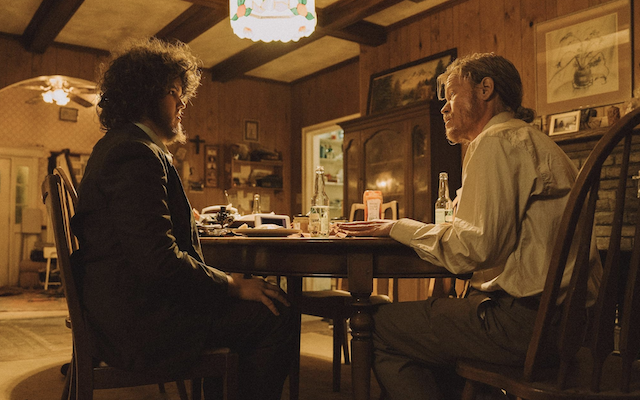
Jesse Plemons: One of the challenges was how much I immediately loved the script and the character. There was just an immediate like, wow, I don’t think an opportunity like this is going to come around again in this way. Meeting this character at this time in my life with the world the way that it is. There’s something that just felt really, really exciting. And so I had to work through all of that and let go of those personal attachments to it, be there for the actual scenes and throw all of that away. The thing that was both challenging and really exhilarating was the fact that Teddy wears every feeling and emotion on his sleeve, you never have any question of how he’s feeling or thinking about any situation. I really respected it, especially nowadays where it feels like so many of us, myself included, we’re trying to hang on to this attitude of like: I’m keeping it all together. I’m doing great. That was really exciting and challenging.
Emma Stone: For me, the biggest challenge was trying to thread what it would be when they watch it for the second time? That was a new experience for me. It was challenging to think about what that experience would be. After having read the script, what would I think of reading it from the beginning the second time?
Q: How did you nail that corporate culture and the language that Michelle uses?
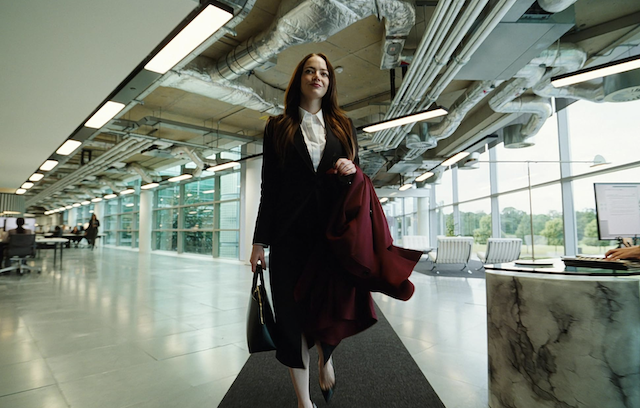
Will Tracy: I have to give some credit to all those years I spent on Succession, writing in that world. The challenge for both characters is that because they’re so assertive and have such conviction and their dug-in cultural attitudes, to make a movie that’s basically a tennis match, to make that not feel like this is a stereotype.
@Courtesy of Focus Features
If you liked the interview, share your thoughts below.
Check out more of Adriano’s articles.
Here’s the trailer for Bugonia: