


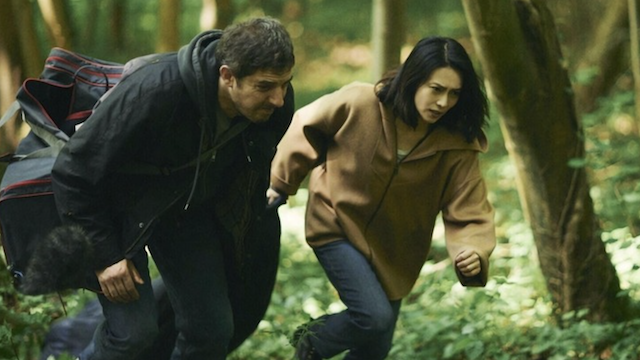
©Courtesy of Japan Society
Q : The original screenplay for the 1998 film ‘Serpent’s Path’ was written by Hiroshi Takahashi, who also wrote the screenplay for ‘Ring’. The cinematography was handled by Masaki Tamura, who worked on ‘Suzaku (Original Title ‘Moe no Suzaku’). The leading actors were Sho Aikawa and Teruyuki Kagawa. Could you elaborate on the decision to set the story in France and cast a woman as the main character? Your usual approach is to create the original work. Can you elaborate on why you decided to do a self-remake?
Kiyoshi Kurosawa: I never thought I would be able to remake my own film, but a French producer asked me if there were any of my works that I wanted to remake in France. I recall saying, ‘If it’s possible, I would like to remake ‘Serpent’s Path.’ I was not expecting it to happen, but when it did, I felt both happy and surprised.
As for why I wanted to do ‘Serpent’s Path,’ I haven’t really analyzed it myself, but one reason is that I think it’s a very interesting and well-crafted story that could work in any era or country. Takahashi Hiroshi is the creator of this story, but it could be effective in any setting. Although it has a straightforward theme of revenge, the work is not widely recognized.
When it comes to producing it, doing it in France is different from the original. Although I wanted to express the appeal of the story directly, I also wanted to fundamentally change something. The protagonist was becoming a Japanese woman due to that change.
Looking back, the desire to fundamentally change something stemmed from the fact that the original version is a very well-crafted story, and while I’m satisfied with it as an original work, it feels so strongly influenced by the Takahashi Hiroshi ‘s style was so strong that it didn’t feel like my own work at all.
It felt like a true Takahashi Hiroshi work, and while I was happy to be able to produce it, I might have wondered somewhere deep down, ‘What would happen if I brought it back as my own work?’ If I recreated it as my own work instead of Takahashi Hiroshi’s, what would transpire? To me, it was simply the idea of making it female
Q: I heard that you asked the director of photography and actress Shibasaki not to watch the original 1998 version, but the music for this film was composed by Nicolas Errèra, the cinematography by Alexis Kavyrchine, and the editing by Thomas Marchand—all French staff members who were also involved in the film “Daguerrotype.”(Which he also shot in France) Could you explain the reasoning behind insisting on French staff and the benefits or synergistic effects they brought to the film?
Kiyoshi Kurosawa: Well, rather than being particular about having French staff, I thought from the beginning that if I were to shoot in France, it would be something like that.
What I mean is that I shot my first movie in France for ‘Daguerreotype’ and it was a great experience. The actors and staff cooperated, respected the director’s vision, and gave their best.
I had thought that French people might be a bit more self-centered, but they were truly dedicated and committed to the film, so I had been telling the producer for a long time, “If there’s a chance, I’d love to do it again,” and we kept in touch via email and such.
Things like, “I made this movie,” or “What are you up to now?” The idea of working with them again was truly a dream come true. There are also some straightforward or mechanical aspects to it.
When you try to make a movie in France, you often receive a kind of subsidy, but one of the requirements for receiving that subsidy is that it must be a French movie. If it’s a co-production, that’s fine, but then the amount of the subsidy decreases.
If your film is produced in France, you may qualify for more funding, but the criteria are based on a point system. If the director, screenwriter, and lead actress are all Japanese, then the only other option is to have French staff for it to be considered a French film.
If the camera crew and other staff are all Japanese, the film will be considered a co-production and not a French one. The point system led to the decision to shoot with French staff from the start.
Q: In this film, Kô Shibasaki plays scenes where she stands up to men, but looking at her recent works, she tends to play calm roles, or even when she plays a police officer, she tends to play a calm character.
In a sense, this film may not be particularly unusual, but what attracted you to her and led to her casting? What aspects of her appeal led to her casting? Her acting range is well-known, but she didn’t originally speak French.
Kiyoshi Kurosawa: Well, I had always wanted to work with her, but you’re absolutely right. In my impression, she is a person with a strong core, but she is also modest. Even though she starred in the movie “Battle Royale,” I didn’t have the image of her doing intense action scenes. In recent years, she has mostly played quiet roles, so I had the impression that he was that kind of person. I thought that was fine. But it turned out to be a miscalculation. I imagined a film where a quiet, fragile Japanese woman living alone in Paris, surrounded by rough foreign men, gradually takes control despite her fragility.
I thought that would be quite different from the original 1998 version with Shô Aikawa, and I wondered if she would be okay. I initially thought that her vulnerability would be one of the central themes of this remake, but it turned out to be a miscalculation. Ms. Shibasaki is incredibly skilled at action scenes.
ven though she didn’t intentionally do it that way, it was written in the script, so naturally, her walking style and movements were incredibly confident. It might have been part of her character development, given that her character is living alone in France, but I think it’s probably her natural talent. So, this was a miscalculation.
When she actually did it, she was already Shô Aikawa from the start. She looks delicate, and physically weak, but from her gaze, her attitude, and her movements, it seemed like she was in control from the start. That was an unexpected turn of events. I had imagined someone more delicate for the role, but I was surprised. However, as we filmed, I thought it was interesting, so I decided it was fine, and we continued filming with surprise.
Q: In fact, Ms. Shibasaki herself has been intensively studying French for the past six months and lived in Paris for about two months, but the character Sayoko, portrayed by Kô Shibasaki in this work, is a psychiatrist with a partner, but other than that, there is not much information about her. She is a character who does not clearly answer patients’ questions about herself, leaving her somewhat elusive. When adapting the original script by Takahashi-san for this production, what aspects did you focus on when creating the character of Sayoko?
Kiyoshi Kurosawa: As I mentioned earlier, there were some miscalculations, but the most significant difference from the original was that I wanted to make this character somewhat mysterious, yet still have a certain realism and a proper background as a person living in France.
The original Shô Aikawa is completely mysterious, which is wonderful, but in this film, she is shown working, and there is a description that wasn’t in the original: she has a home. She buys groceries from Deli and returns home to live there. Additionally, there is his ex-husband, played by Aoki Munetaka, whom she occasionally contacts remotely.
It’s a setting that feels plausible for a woman living alone in France. This is a point that wasn’t in the original. However, to be honest, even though we did that, there was one episode where the script only mentioned that much. So, I thought it would somehow work out, but when she returned home and was in her room, I had no idea what she should be doing. Normally, of course, there are various aspects of real life, such as cooking, watching TV, reading books, or pursuing hobbies, but I couldn’t think of a single concrete thing she would do while living alone at home.
That’s how significant the concept of the story created by Takahashi Hiroshi was (in my mind). She said her daily life was completely unnecessary, and even if she said she wouldn’t do anything, I still had no idea what to do.
So I decided to made her go home and do nothing. I wondered what “doing nothing” meant, and finally came up with the idea of a Roomba(Roomba is the name of a robot vacuum cleaner manufactured and sold by iRobot Corporation. It is spelled “Roomba” in English, even though it pronounced Rumba in Japanese)., an automatic vacuum cleaner. She doesn’t do anything, but the Roomba, which is a brand name, cleans on its own. She doesn’t do anything. That was the final description I came up with.
Q: Damien Bonnard who plays Albert, who is taking on revenge alongside Sayoko in this film, Shibasaki naturally learned French on set, and I think they were able to communicate to a certain extent, but what kind of chemistry did the two of them have on set? How did they build their relationship?
Kiyoshi Kurosawa: I don’t know the details, but it’s still mysterious. Of course, Shibasaki underwent intense training, and perhaps that paid off. Actors are scary. She worked hard to speak French perfectly, lived in Paris for a while, and spoke normally with Damien. Damien probably didn’t say anything overly complicated, but he was considerate enough to help Shibasaki get accustomed to French.
Considering that, we made an effort to speak French together as much as possible, including French training. I have no idea what they were talking about, but I think Damien’s consideration played a big role. Before even creating the role, I think it naturally developed into a situation where French would just come out naturally, by spending time with Damien in French during breaks in filming.
Q: Mathieu Amalric, who appears in this film, plays Laval, who is putting into the confinement and tortured. It’s a pretty cruel scene, but I’m not sure if “comical” is the right word to describe it, but there are parts that make me laugh for some reason. Is that because of Mathieu’s acting skills and improvisational acting, or was it directed that way on set? Was it more of a hands-off approach, letting him take the lead, or did he simply perform the parts written in the script? Could you clarify that for me?
Kiyoshi Kurosawa: Basically, it was written in the script, but I left the acting up to him. To be honest, I don’t really understand when French people are acting in French. I’m not in a position to say, “Do this a little more, do that a little more,” so in that sense, I gave up on directing. They did something, and I watched it, and I kind of understood. I might say something like, “You’re overdoing it a bit” or “You could do a little more,” but I don’t know if they might be saying things that aren’t in the script. I don’t know. I’d say, “Wait a moment, cut,” and since everyone—the cameraman, the chief assistant director, and others—are people I know well, I’d say, “It’s okay, really okay, nothing’s wrong, right?” and they’d say, “It’s totally okay,” so we’d move forward.
Mathieu is someone I personally asked to appear in the film. As you know, he’s a pretty big deal in France, and he’s the kind of person who says, ‘Unless something extraordinary happens, I don’t want to appear in other people’s films as an actor.’
Q: I felt that very strongly while watching it. Wow, I felt like Mathieu was really enjoying himself. This will be the last question, but revenge, even if you defeat your hated enemy, doesn’t bring back what you’ve lost, but at least you achieve revenge itself. However, in this work, it doesn’t end there. What is your understanding of the word “revenge,” and what made you take on this work?
Kiyoshi Kurosawa: That’s a tough one. It’s a heavy question… Of course, I think it’s an important question. Of course, it was because of Hiroshi Takahashi’s original work that this film was made, but even when he was creating the original, back then, he was making a series of films called the “Revenge Series,” starring Sho Aikawa, with the theme of “revenge.”
From that time on, I felt that revenge was no longer about a happy ending. Even if revenge is achieved, the ending feels unsatisfying, hollow, and unclear about what to do next. Even if one chapter is closed, it leaves a lingering sense of unease. I believe all such films share this ending.
As I set out to remake it, that feeling has only grown stronger. The human desire for revenge is something that can’t be suppressed, but the various acts of revenge that are carried out under the pretext of revenge often lead to murder. While killing the other person is the ultimate goal of revenge, I feel that it’s not just hollow—it’s almost as if it never truly ends.
Revenge, as I need not say, gives rise to further revenge, which in turn gives rise to yet another revenge, creating an endless chain. Once a person is caught up in the system of revenge, even if the target in front of them is killed, it never ends. A new target emerges, and in some cases, one becomes the target oneself, leading to another cycle of revenge. This terrifying chain of violence is what I was aware of while making the film.
Well, this isn’t a movie rooted in such grand, deep ideas, so it’s ultimately a genre film, based on the action movie genre of revenge that’s been done countless times before. Takahashi Hiroshi made it that way too, so it was difficult to end the movie in a satisfying way, but I hope that while watching it, you won’t get too caught up in the theme of revenge, but instead enjoy it while wondering, “What will Shibasaki Kou do next?” and feel a sense of anticipation as you watch.
Q: It was a film that made me think a lot. But it also had entertainment value, and it was a very interesting film that combined both aspects. Thank you for taking the time to grant this interview.
Kiyoshi Kurosawa: Thank you as well.
I hope we can meet in person someday.
Q: I would also like to meet Mr. Kurosawa someday. Please take care of me then! Thank you very much.
If you like the interview, share your thoughts below.
Check out more of Nobuhiro’s articles.
Here’s the trailer fo the film.