

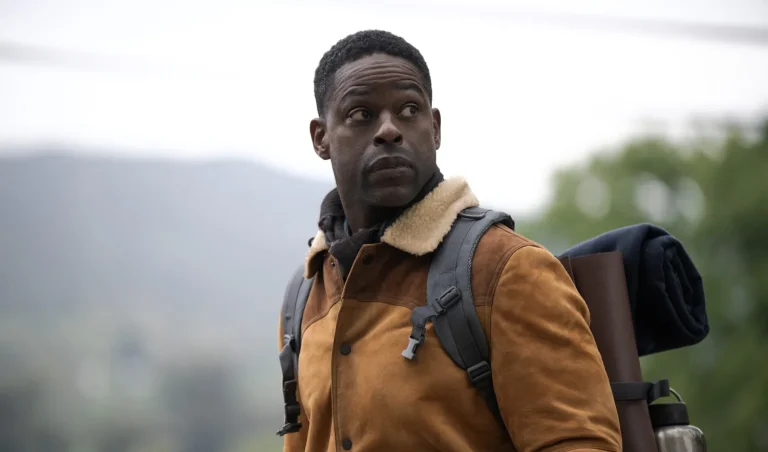
@Courtesy of Hulu
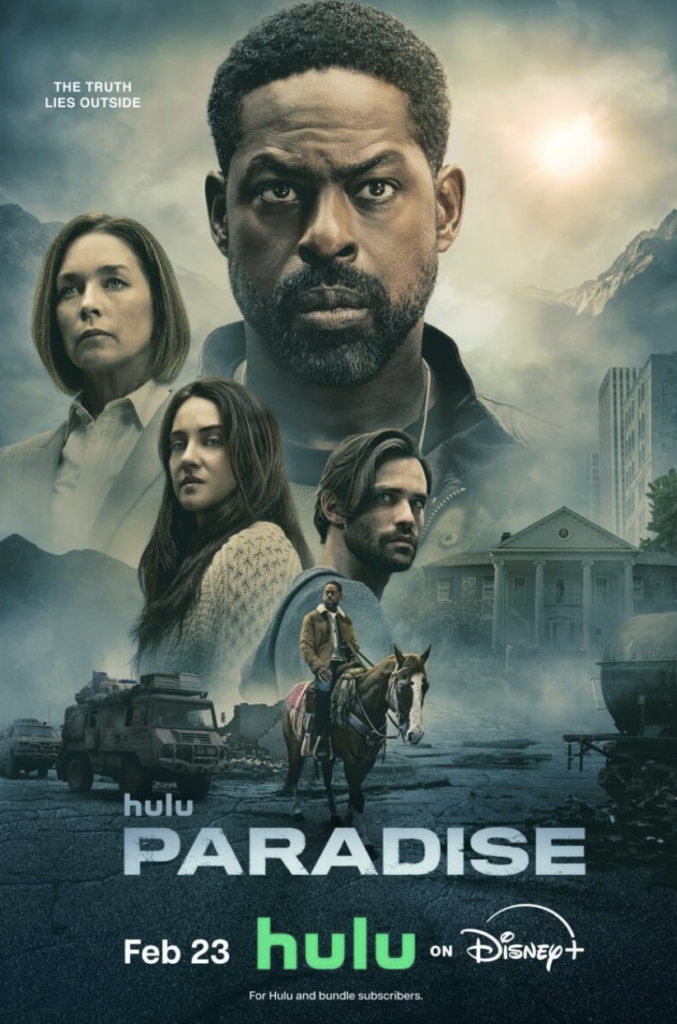
Q- What have you learned through this show in regards to how societies are built or civilizations are falling? And what do you think we could do better in the future?
Sterling K. Brown: We’re supposed to be in the community. We’re supposed to be in association with one another. People aren’t meant to be splintered and fractured and separated. We should all use our collective skills in such a way that would make the world a better place: I’m good at one thing, Julianne’s good at one thing, Shai’s good, Tom’s good, and together we use our skills to uplift everyone, not just ourselves but as a collective.
Julianne Nicholson: He makes a good point. Also just holding people at the top accountable. Paying attention. Looking out for those beneath you too, because what’s affecting them, affects all of us.
Shailene Woodley: The beautiful thing about the show is how it does highlight community. There’s this idea of the world being on fire and if you have to walk into the woods, who are you gonna walk into the woods with? We have a lot of division in our world at the moment, there’s a lot of judgment and there’s a lot of perception about the Other. I think the show is an invitation to debunk these ideas about what division actually means. When push comes to shove, what does it look like to look another human being in the eye and show up for them.
Thomas Doherty: When you’re in a post-apocalyptic situation, I assume that everyone does resort back to their kind of basic instinct. The beautiful thing about this show is that people are in that very primal state of survival. But you can still make a choice, you can still make a choice to connect to love, to do something good. In today’s world, the situation’s not quite as bad as in Paradise, but people are justifying evil behavior, essentially. That divides from what Sterling says, a sense of community.
Q: The character played by Shailene is locked up in Graceland. In real life, in which iconic place like Graceland do you want to be?
Sterling K. Brown: I would probably be somewhere like a community thing that has basketball courts and swimming pools and gymnasiums. A place where I could use my body and play games, that would probably be my favorite thing. Ping-pong tables, pool tables and dartboards, that kind of stuff.
Q: Great. What does it mean to get these leading roles that have such unusual gender portrayal? Usually guys get to portray these complex, contradictory characters. Sinatra gets to embody this in this. So what’s it like at this point in your career getting this kind of role?
Julianne Nicholson: It’s always exciting to get to do a role unlike that you’ve played before, to be the most powerful person in the room. As a woman it is a great feeling to have a great thing to put out into the world for people to see and normalize. Hopefully we’ll get more of that.
Q: Xavier faced many challenges in the first season. The last episode offers a sense of hope for him and for humanity. What can the audience expect from him in Season 2 and how have those events shaped the way he sees the world now?
Sterling K. Brown: He gets a chance to hear his wife’s voice in that tape that Sinatra plays for him. He thought that she’d been dead for three years. Now there’s renewed hope that she is alive. There’s renewed hope that there is life in the world. So he leaves his children behind with the hope of reunifying his family. There is a sense of hopefulness that he enters into the world in Season 2, believing that Teri is there, then he encounters all sorts of things. It is his first sort of entry into the world. We have all these ideas of what this post-apocalyptic world is gonna look like. Whether it’s The Road or some sort of zombie apocalypse, we just see people, right? We get a chance to see people either becoming the most selfish forms of themselves or the most selfless forms of themselves.
Q: Did working on this TV show change the way you live your present or you look at the future?
Thomas Doherty: Definitely. But not for the reasons you think. For me, embarking on this job, the main thing that I took away was a sense of gratitude. This is the first time I’ve really been in a space with this caliber of actors around me, to see how they all work was one thing. But to see how they all carry themselves in the world and the humility and the kindness that they have, that really had a huge effect on me. I ultimately concluded that my success and where I am today is a result of all these amazing people that I’ve had in my life. I can’t really take much personal credit for it. That’s a really beautiful, beautiful experience in my life.
Shailene Woodley: I just feel so grateful to be a part of this. I was such a fan of Season 1, to be a part of this family feels like an honor and a highlight in my career. It was just personally so fulfilling. Dan Fogelman and Sterling, the way that you guys have curated an environment from This Is Us into Paradise with the crew that you guys all work with, it was a very familial and comfortable environment, probably the most rare environment I’ve ever been in.
Sterling K. Brown: We get a chance to exercise choice in who we want to be in the world. Regardless of the circumstances that you find yourself in, even if they are dire circumstances, unwieldy and untenable and there’s no sort of options for you, you can still choose to access the highest part of yourself, and be generous. I encourage everyone to take a deep breath in these moments when they think that they have no options and recognize you always get a chance to choose how you respond to the world.
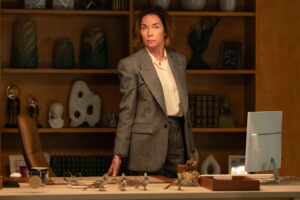 @Courtesy of Hulu
Q: Shows like this one, Silo, and Fallout parallels real-world bunkers being built. It’s a really blooming industry right now. Could you talk a little bit about how that inspired the show and how the show mirrors that world? Why do you think post-apocalyptic dramas have gone underground lately?
Sterling K. Brown: Dan had the idea for the show 10 years ago, before any of the other things were out, they all hit at the same time. We have a responsibility to the generations that come after us: what planet are we gonna pass along to them? It’s in the zeitgeist, like: “Well, maybe we go underground.” Maybe we do something, because something has to be done, otherwise, it doesn’t look great, right? I have a midcentury modern home, built in the 1950s right after World War II. It became a popular thing in California to have a bunker in your house. My wife won’t go into it because she says it’s dark.
Julianne Nicholson: I think it’s a real call to be paying attention to the people in power. Paying attention to technology and AI, which will reveal itself more as our Season 2 goes on. Paying attention to how we’re treating one another.
Sterling K. Brown: Those are all the underlying topics of the season. He is on a quest to find Teri and it’s probably the only thing that would’ve gotten him to leave the bunker in the first place. It’s nice to see him on the outside, going after what he wants while we get a chance to see the repercussions of what happened at the end of Season 1 inside of the bunker because it’s a fascinating world, both of them.
Q: How do you keep your writing on and keeping everybody so hooked onto your shows? And why Graceland?
Sterling K. Brown: I didn’t write the shows. Let me not take too much credit for the writing and the world-building. That said, maybe I inspired something, but Dan Fogelman, John Hoberg, our writers are second to none. They’re absolutely fantastic. What they did in a really interesting and provocative way is that they introduced us to a world in Season 1, and then we recognize that there’s a world outside of that world. So things don’t get stale. With Graceland, we get a chance to use a lot of the King’s music in a very similar, playful way where you use classics of his and remix them, it has a haunting tone to it, right? Graceland is an ultimate inspiration for me? I’m a Black man from St. Louis, Missouri, probably not. But I do like when you flip something on its head and you introduce it to an audience in a brand new way.
Julianne Nicholson: Sterling is the co-captain. Sterling very much sets the tone of every day, leading the charge with his generosity, his heart, his talents. We just fall in line, he’s a huge part of how the shows come together.
Shailene Woodley: Thomas and I met once before we had our first scene together, which actually was very helpful in a way, because these two people didn’t have a relationship with one another. I play someone who was in solitude for many years. The physical, emotional, spiritual, psychological intimacy that they chose to exchange with one another is one of the biggest offerings of vulnerability, an exchange of spirit that any of us could possibly go through. The fact that we didn’t really know each other really lent to this desire to just throw caution to the wind and look each other deeply in the eye, and choose to share all of what we had to share in those moments.
Q: Did you learn any survival skills you didn’t know and you want to share with us?
Julianne Nicholson: I wouldn’t do so well having to survive an apocalypse, I’m not gonna lie. My mother’s an herbalist and my stepfather’s a woodworker and they’re both wilderness guides and they would always take us camping. I would just go wherever they were and just take orders.
Q: Sinatra is such a unique character, we see that megalomania playing out almost every day in real life. How do you divorce yourself from that when you leave the set?
Julianne Nicholson: That’s so funny, because we have different feelings about the characters that we play than how the audience perceives them. When we were making this show, it was pre-Trump presidency. It was pre-having people in the Oval Office that weren’t elected to be there. The role of Sinatra took on a much deeper and even more sinister take when life was imitating art. Having been doing this now for a few years, the character never completely goes away but it’s easier for me to leave her on set. I don’t want to live in her world. I don’t want to live in her mind, her experience, so I try to leave her behind.
 @Courtesy of Hulu
Q: Your character operates in a space that feels both isolated and emotionally charged, and her presence has an outsized impact on the story. What drew you to that kind of concentrated, high-stakes role?
Shailene Woodley: I didn’t see it as necessarily a concentrated, high-stakes role. I saw her as just a human being doing the best she could in the situation that she was in. When you’re fortunate enough to have a screenwriter like Dan Fogelman and his team of writers that he has around him create and curate a character that’s so thoughtfully and meaningfully prescribed, my role was really professionally listen to everything that Annie was experiencing based on her environment, based on the situation around her. The thing that I loved most about her was that her mind worked in a very analytical and linear way, it actually allowed her to process her experience without allowing emotions to inhibit the way that she perceived survival. The way that she perceived her own willpower to forge forward. She’s a character that I actually learned a lot from. I feel like I’m a more still, patient version of myself after playing Annie.
Q: Will the series continue to focus on more recent events as everything is much more complicated than in the first season?
Sterling K. Brown: The show has its own mythology. It will continue along its own mythology, but hopefully there will be reverberations of things that are happening in society right now. With any good genre storytelling, you’re reflecting on the world in which you live while also giving them a degree of separation so that you can see it from a distance. It doesn’t feel so personal, but you’re actually able to say: “Hey, maybe we’re not so far off from this thing that we’re watching….” Paradise is entertaining and takes us outside of the world, but it’s also commenting on the thing that we’re going through now.” So it’s its own mythology.
If you like the press conference, share your thoughts below!
Check out more of Adriano’s articles.
Here’s the trailer for Paradise Season 2: