
@Courtesy of Neon
©Courtesy of Neon
Q: How did you work adapting the world of Stephen King’s short story and his idea that each one of us contains the whole world?
Mike Flanagan: Stephen once said at one point, when a person dies, a library burns down. Which is a similar idea andI think is beautiful. The idea that we contain multitudes: in the case of this story, he means it both literally and metaphorically. The universe inside of each of us, the universe we build as we make our way through life. It’s such a beautiful concept, I find it so comforting. Adapting Steve it’s just about tapping into that beating heart that he naturally has. To me, it is one of his most heartfelt stories ever.
Q: What was it about the tone of the story that you wanted to capture, and how was that reflected, not only in what you wrote, but how you approached directing it?
Mike Flanagan: There’s a tone that Steve achieves in a lot of his non-horror work. I’m thinking about The Body, which became Stand by Me. Or Rita Hayworth and Shawshank Redemption. The Green Mile to an extent, although that’s a little more supernatural. He creates the poles that you have to make sure you’re staying between when it comes to tone. Constant readers will recognize that Steve has that. He said there’s no horror in the world without love. His stories, even the scary ones, aren’t about the monsters. They’re about the people. IT isn’t about the clown, it’s about the kids. It’s about friendship. It’s about love. As long as you keep that in mind, it’s very easy to merge in on his tone.
Q: Tom, what percentage of those shooting days did you spend dancing?
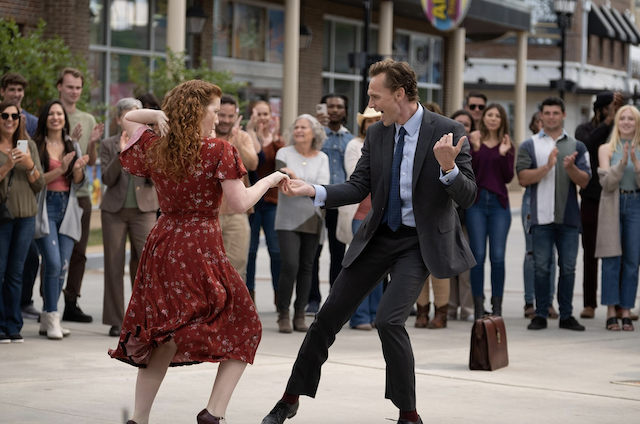
Tom Hiddleton: I think about 85 percent. I’m no math guy. I’m just the dancing guy. My filming days amounted to five, it was Monday to Friday and it was the first week of principal photography. So,we started out on the dance floor on a Monday morning. I had burned holes in my shoes and out on the asphalt in Alabama. On Friday, we did all the scenes where Chuck is with his wife Ginny and his son, in bed near the end. It was an extraordinarily compressed week. A life compressed, if you like, but we knew what we were doing.
Q: Did you have a reference on how the other young actor playing Chuck was gonna dance so that you could imitate him?
Tom Hiddleston: This is where I have to pay great credit to Benjamin. I got to do the dancing first. So, Benjamin now had to dance like me, but he does it better. He put these little signature moves in, which I had instinctively done unwittingly. When I saw the third act, or the first act, I realized that Benjamin had been watching me very, very closely indeed. And he put these extra things in.
Benjamin Pajak: All the credit to the choreographer Mandy Moore for that. I didn’t know if I was allowed to go to the set. Mandy was like: “ Yeah, let’s just go to the set. Watch Tom pick up some things!”
Mike Flanagan: I’ve got a great picture of you guys when you met. A great candid moment when you guys met. We were all excited to see it.
@Courtesy of Neon
Q: You know what’s gonna happen to your character. How much did you try to be conscious of that idea and how did it inform your performance?
Tom Hiddleston: What was crystallized for me when I read the script for the first time was that feeling that we all share, a knowledge none of us have. None of us know what the last day of our lives will be. None of us know the last date. None of us know how it’s gonna end. We all live, each of us every day in that uncertainty. We do the best we can with the life we have. That awareness is something that comes in and out of focus in our lives. Voltaire said: we all have two lives, the second begins when you realize you only have one. What Mike’s screenplay and what Stephen King’s story describes so beautifully is the magic of those small moments in our lives which will become the brightest stars in our memories in the last hours.
I had this awareness of the preciousness and the fragility of living, but also the magic and the majesty of connection in the everyday. And so, just getting to dance that out on the sidewalk on a Thursday afternoon is maybe a moment of an expression of the most intense freedom of his entire life. He’s completely free. He’s completely in the present moment. He’s completely alive. And in six months’ time, his life will be over. The thing that I was so moved by is that we contain multitudes. It’s true of all of us. None of us are one thing. None of us are the job that we do or the role that we play in our family or in our social circle. Inside the soul of every human being, is an internal world of infinite connections, memories, experiences, and possibilities.
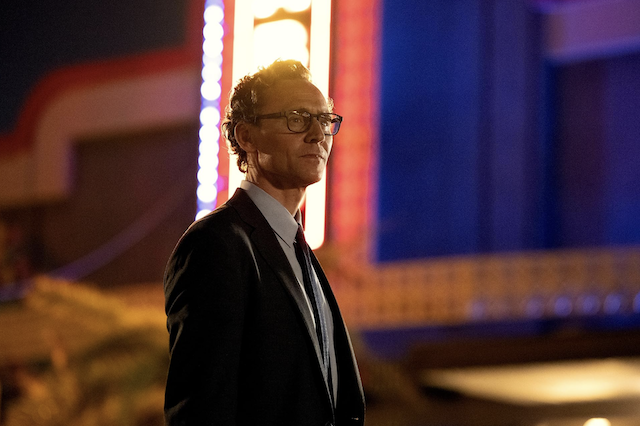
And we should never submit to the reduction that we’re just one thing. Yes, our lives are full of struggle and suffering and grief and pain and loss, that’s true as well. But they’re also magic. And there’s so much joy there. That’s the bit I found moving: Charles Krantz, to the external world, seems to be the gray man in the gray suit. He’s never gonna stop and listen to the music. But inside the soul of this accountant who loves his job and loves his wife and loves his son, is this dancer. And that might be true of anyone you see on the street: inside a human being there is greater breadth and depth and range than we could possibly imagine.
Q: Mark, you play a character who is a great sharer of wisdom, but the wisdom you’re sharing isn’t a hundred percent perfect…
Mark Hamill: It was relatable because I remember telling my parents what I wanted to do and they said, “You’re out of your mind. We don’t know anybody in showbusiness. Get your teacher’s degree.” That’s common advice, because the odds are against you. My father was in the Navy, so I went to the last two years in high school in Japan. And we had been living in Virginia, and I begged my father, and he took me on two trips to New York where I would see theater by myself. He wasn’t interested. It tickled me because my character is a very common man, he probably drinks a little too much, but the thing that turns him on is the glory of mathematics. I didn’t even meet Tom until the film wrapped at some press thing. Same with Karen and Chiwetel. I was completely isolated. It’s only when it all came together where I understood it in stages.
Q: This also is a film that has a lot to say about teachers. The world may be literally on the precipice, and people are still gonna be in the classrooms because that is their calling. Kate, could you talk a little bit about your character?
Kate Siegel: I think that many people are drawn to being teachers when they have a kindness in their heart and a desire to serve children. It’s not a well paying career. It’s not a career that comes with a lot of rewards, even though it probably should. I believe Miss Richards wanted to be a great teacher. She has a heart full of poetry, and it’s not quite going as well as she wants. There’s a humanity in that. There’s always one face that is looking to you for an answer, and if you can tap into that, there’s a real sense of making a difference in the world. To be able to make one difference in the world, I think is a part of what this movie is about. Each person is entirely insignificant, and that is the birth of compassion.
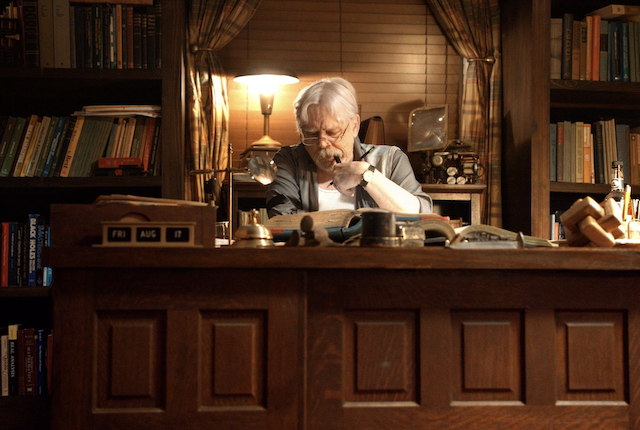
Q: There’s a shot where you put a wide angle lens on Benjamin when he is hearing what his teacher is saying. Can you talk about that scene, about working with Benjamin and that one shot?
Mike Flanagan: Working with Benjamin, you know, was a joy and a dream anyway. He intuitively understood the movie he was making and the character he was playing from the jump. The thing about that particular scene that was important to me was that we very much wanted this particular message to go directly into the heart of the viewer. In the edit, it was so clear that Chuck is the viewer. We become Chuck. It felt way more appropriate to only use that show of Benjamin and to be as close to behind his eyes as we could. It’s amazing because we are him at that moment. We’re hearing what he’s hearing. But he’s looking right into our eyes. It’s one of my favorite shots in the movie.
@Courtesy of Neon
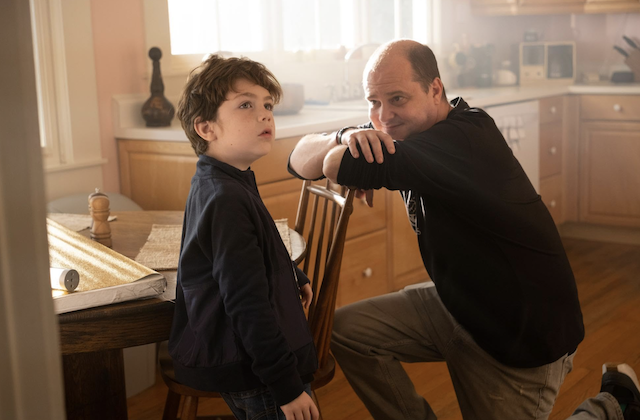
Q: You are playing the emotional soul and heart of the film, but you also have to do some pretty good dancing and you have to be part of a continuum of who this Chuck character is from a very young age to 39. Could you talk a little bit about how you prepared for this part?
Benjamin Pajak: Just going back to that scene, it was not hard to do it with Kate or Mike. Acting with Kate was so fun, she gave me so many things to play off of in that scene, and Mike was always there to direct me and guide me through it. The same throughout the whole filming process. There were just so many people there. It was my first really professional film opportunity, so I didn’t know much going into it. But Mike and Mark and everyone were really there to help me through it. About the dancing, Mandy was amazing at helping me through it. I don’t think I would have gotten through it if I didn’t have her. It was amazing to see Tom dance, there were just so many different factors that played into one and made it a really fun experience. Something that I’ll never forget.
Kate Siegel:: It’s worth saying that you brought such joy and professionalism to that set every day showing up. You ran your section and that set like someone who’s been doing this for way longer than you have. It raised the bar for everybody. It brought joy and a certain amount of wonder for those of us who might have been doing this for a while.
Q: We have seen movies where the world is about to end and people are behaving unusually. Your character is somebody who is going to keep at her job even as the world burns around her. Can you talk about how you got into that mindset?
Karen Gillan: My character is a nurse, she’s dealing with the end of everything. People all around her are essentially giving up, but she maintains the sense of positivity and optimism, she just has to keep going. I’ve just tried to look back at my life, think about times when I had to be that in somebody’s life, and draw on that. I had a baby six months ago, just going through the newborn period. I wish I had filmed this after that. Because I get it now. The sleep deprivation, but you have to keep on going because somebody’s relying on you. You can’t stop. I really admire the character. It’s amazing to see a caretaker get into that role and just keep everyone around her going.
Q: Chiwetel, can you talk about how you prepared for the opening scene and then the moving phone call with Karen?
Chiwetel Ejiofor: You were talking earlier about the tone: that was so rich in the script. You really immediately felt reading it, the sense of what it was talking to, emotionally and philosophically. The ease, the tone and the questions that it was asking just felt very effortless to me, very in control. I thought the opening was very great. With Karen, I just felt like the relationship felt very complete. There’s not much of it on paper, but there’s so much in the subtext of what they’re talking about. Just the way that they are together and the circumstance that they are together, they obviously had a real powerful connection.
Q: Mike, could you talk about that sequence and the role that music played in the scene?
Mike Flanagan: For what it’s worth, that sequence worked beautifully on the set. I got lost in it just listening to Chiwetel and Karen perform it. When you have that volume of words and something as visually undynamic as someone holding a phone, honestly there’s always a fear going into a scene like that. It might not work. The composers, the Newton Brothers, who I’ve worked with my entire career at this point, fell in love with the scene the same way I did. The tone of the score is incredibly respectful of the acting that’s happening. The score takes a real backseat throughout the entire film and adopts a very minimalist, unobtrusive quality. The emotional arc of the scene, the point of it, the wonder that’s being articulated about how small we are, how vast time is, that was already handled by the actors. Our score was really there just to help lift it that little bit and to help pull the audience through the edits more than anything else. I think the actors made the music and the composers got to sit back and accompany it.
@Courtesy of Neon
Q: I’m curious about how your character’s thinking as the stars literally vanish from the sky.
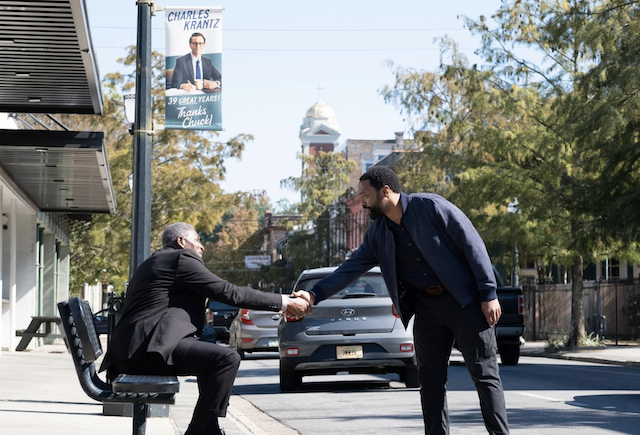
Chiwetel Ejiofor: It’s such an incredible moment in the film and incredible to play and to read. All of those beats felt very personal, they just felt very connected. It’s this kind of profound association with anything that we know to be our own spiritual self. That moment is filled with love. The whole Marty side of the story is filled with love. But it’s not romantic love. There’s a sense of understanding of his own place in the world. It felt truthful, very honest to me. And that’s what connected me to it.
Q: Stephen King is writing about the end of times, but he’s obsessed with the end of the Internet. That seems to be something that King is really driving at, that separation of human connection that the Internet gives us. King is writing about how technology is keeping us from human connection. Is that something that you responded to as a storyteller, something you felt you had to preserve in your adaptation?
Tom Hiddleston: Certainly. The thing in the story that hit me when I first read it, it is impossible for me to imagine a world without the Internet. And I grew up in a world without the Internet. It’s very strange to me. Steve hits on something incredible about how we now live in the most interconnected existence human beings have ever known. How we’ve used that connectivity can be a bit disappointing. And the loss of that connectivity is something that’s so hard to imagine. But we are dismantling and losing this incredible Internet, this incredible connectivity, this connected world that we’ve built with each other. We all lose it at the end.
Chiwetel Ejiofor: We have to be more committed. You know, we have to re-engage. We’re kind of exhausted sometimes and beaten up with it, but when it actually comes down to this, what’s truthful here is: there was more I could have done. There was more effort I could have put into this.
Q: Karen, your character and Chiwetel’s character realized that, yes, we could have done more, but the thing that matters the most is how we connect to each other. Is that what you hope people will take away from this particular part of the story in your film?
Karen Gillan: It’s interesting to think about what you would do in your own life if it really was the end of everything. We all get so obsessed with things in our lives, whether it’s material possessions or accolades or money. All of that will probably just fall away, and we will reach out to the person that matters the most to us in that type of situation. That’s valuable to remember.
Tom Hiddleston: This movie’s raising an interesting question about the quality of our connections as they stand. And as things start to break down, you’ll have the immediacy of, to Chiwetel’s point, I don’t need this. I have two legs. I’m gonna walk over there, and we’re gonna have a real conversation. Maybe Stephen is pointing out that perhaps we don’t do that enough. We have the resources we need, but we lean on our technologies, which are simulating real connection, but they’re not actually the substance of human connection.
Mike Flanagan: What strikes me about the story Steve constructed is as Marty takes that walk, every stranger he encounters engages in conversation, meaningful conversation, open conversation. As connected as we all are technologically, that kind of connection is increasingly rare.
Q: Last question, Mike. Did the movie you made look like the thing you imagined you were gonna make? And if it differed, where did it differ?
Mike Flanagan: This movie’s so much better than the one I imagined. I’m so much happier. I read the story in April 2020, and it felt like the world was ending in a major way. I was locked in my house in Glendale. For the first few pages, I didn’t think I could continue reading it. It hit that close to home. The movie that came to life in my imagination while I read it was going to be so dark at the beginning. All I wanted was to take that imaginary movie and try to put it on a screen. But I was utterly unprepared for what these tremendous actors would do as they brought it to life. This is my favorite thing I’ve ever worked on.
It means the world to me. It’s the thing that I’m the happiest to leave in the world for my kids, who I think are gonna need this someday, need a message like this. The movie that I’ve been lucky enough to see and was lucky enough to play a part in was lifted and amplified and elevated by incredible artists and beautiful human beings who were all in it, not for the glory or the money, because we didn’t have any of that. The first conversation we had about it was about joy and about legacy and about what you wanted your son to see. We all had very, very meaningful conversations about what it means to be a human being in this world and what it means for that world to end. I was lucky to make something with people who were there for the right reason. We were making something that we hoped would outlive us, and I hope it does.
If you like the interview, share your thoughts below!
Check out more of Adriano’s articles.
Here’s the trailer for The Life of Chuck: