
@Courtesy of HBO MAX
@Courtesy of HBO MAX
Press Conference With Star/Director/Writer/Executive Producer Noah Wyle, Creator Scott Gemmill, Executive Producer John Wells
Q: Did you feel any kind of pressure after the success of the first season?
Noah Wyle: No. Of course we felt that the proverbial sophomore slump is real. When you have something that’s as impactful and as successful as our first season, it is inevitable that you’re gonna be combating expectations. John alleviated us from a lot of pressure early on by saying: “You don’t have to do it bigger, better, faster, stronger, you just have to do it again. Remember what you did the first time and stay true to the characters, be honest and go from there.”
Q: How did you balance telling the story you wanted to tell and fanservice? Do you ask the writers to stay away from the discourse online?
Scott Gemmill: I have no online presence, but I hear it from the room, though. They’ll tell me what’s going on. We picked 10 months because that’s long enough for Langdon to come out of rehab, that’s why we picked that. That’s part of the fun of the show, is catching up with these people and you only have 15 hours to do it.
John Wells: You want to be careful. We really appreciate the most vocal and engaged. At the same time, they’re not necessarily representing every viewer. So you want to be careful to just follow the stories. What we hear from extensive research with medical professionals, that’s where their stories live.
Q: With this second season, there was on-location filming in the Pittsburgh area. Can you talk about starting the season in the actual setting of the show and the energy and the narrative advantages of that environment?
Noah Wyle: Intentionally this is a claustrophobic, immersive experience that keeps you in the emergency department as much as we can. Occasionally we go up to the helicopter pad when a patient arrives. Occasionally we follow Robby into work and follow him home, but that’s pretty specific. What it gives us is an opportunity to break the monotony of production in Los Angeles to take a field trip, to have everybody get to go and bond as a cast on location. It’s great ambassadorship to the city of Pittsburgh, which has opened its arms to us, and Allegheny General Hospital, to allow us to shoot there, so we try to be really good, and responsible stewards of that. And then aside from that, we tend to get back to the soundstage where we control as many variables as possible.
Q: How do you feel that the show is relevant to the time we’re living in and the situation of healthcare workers in the US? In what ways does the series de-mystify the American healthcare system?
Scott Gemmill: One of the things we do at the beginning of the season is we will sit down multiple times a day and talk to healthcare experts in the field in various aspects, whether it’s anesthesiology or cardiologists or specialists in mental health therapy. We ask them: what’s going on in your world? What stories aren’t being told? What stories do you think should be told? That’s how we craft some of the medical stories that we do. Ultimately, the stories are told through our characters and what’s going on with them. We’re trying to keep our fingers on the pulse of what’s going on in medicine as up to date as we can be.
John Wells: It’s important not to follow the headlines, but to actually hear what the concerns are of the people who do it. Sadly, there’s lot of stories to talk about. American healthcare is in a crisis, not getting better by pushing eight to 10 million people off of the insurance rolls, which means that they’re not gonna be getting the primary care which keeps them from showing up in the emergency room with far more significant problems. So, sadly, there are a lot of stories to tell.
Q: Is there anything you learned about making the first season that’s helped you make the second season?
Noah Wyle: About the physical production, once we realized that certain things were working and that was validated by the viewers, it gave us a little confidence to come back and put a little bit more emphasis on certain things and less on others. We learned that it’s a really delicate balance between the cases and the characters: a lot of people responded to the medicine but a lot of people responded more to the internal journey of our characters. Coming back, it was less about coming up with sexy cases and more about being really faithful to the interior architecture of the characters, where they were and how these cases that they are working on reflects on them even to a greater degree.
John Wells: The main thing we learned was that it worked, to be honest. When it went on the air, we were shooting just the last few days. The narrative storytelling is very different because it’s in a single day, we had no idea whether that actually works, so the confidence that came from seeing that the premise work was very helpful in the second year in the writers’ room.
Noah Wyle: We’re almost too smooth. In fact, that was John’s big note to us: things are starting to look too polished, too choreographed, you look too efficient, and the composition is too perfect. Don’t be so good at your jobs.
John Wells: Our actors, they didn’t know what they were doing at the beginning, literally physically didn’t know what they were doing. Then doing it for seven months, you get better at it, but the character is one or two hours farther along in their training, not seven months farther along. Continuing to keep the discipline of what you actually know in the amount of time that you’ve spent as a physician in this setting, there’s nothing easy about what Noah does, but his character has been there for a long time. Others started to get too good. Our camera crew started to get too good. Part of the rawness is bumping into things and not knowing exactly where you are, trying to keep up because we’re trying with the camera to say you are someone who’s trailing behind these physicians, so you’re gonna be in the way, it’s not gonna be a perfect view, you’re not gonna see everything all the time.
@Courtesy of HBO MAX
Q: When the show started airing and you were just working on sort of the final episodes: what did you notice the response immediately?
Noah Wyle: It felt like the medical community embraced it first and embraced it loudly. We were really aiming at and hoping to get the stamp of approval from, that was extremely gratifying. That gave other people the confidence to watch it, then word began to spread from there.
Q: Do you ever get doctors who go up to you?
Noah Wyle: I used to joke that back in the ER days, my mother, who was a nurse, would call me and say: “You never touch your face with bloody gloves, you never do this and that. I have to go to work tomorrow and I’m gonna have to answer that!” Now thanks to the internet, I’ve got like eight million mothers to call me and tell me, “I think your stethoscope was backwards, jackass.”
Q: Did you go to emergency rooms to check on the body language of these doctors? Is it your intention to show the dynamics of the relationship between doctors and patients?.
Noah Wyle: Absolutely. One of the things that we were all really gratified about back in the ER days was that if we said it on television, you could believe that it was true: if we said this was a medical fact, you could take that to your doctor and have that verified. Medical shows have played fast and loose with that over the years, the culture has changed a lot. That relationship between patient and doctor that used to be pretty sacred now has a lot in between it. Misinformation and cynicism and distrust and all sorts of things that makes it difficult to have that engaged conversation with your practitioner. We, again, try to be faithful to the medicine and the accuracy.
John Wells: That’s what the physicians and the nurses that we talk to all the time tell us. That’s actually something that a physician would say to a patient and it’s very realistic to how they actually communicate.
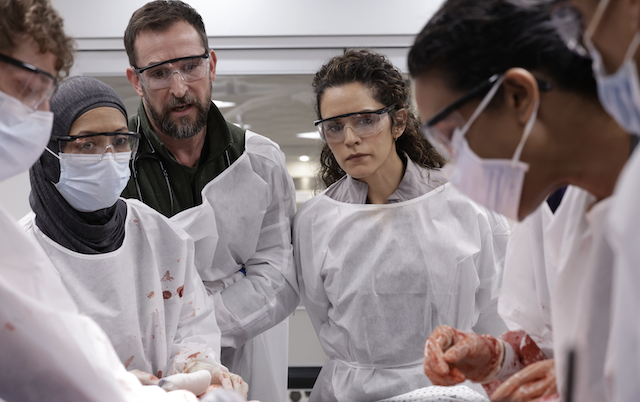
Noah Wyle: We have a lot of tremendous relationships with people that practice medicine still in this city, which treats a population that’s pretty similar to the one that we depict on the show. The performers all went through various exercises, a boot camp. We all tried to stay on our feet for 15 hours and just note where we were holding tension, which got tired first, when did you feel hungry, when did you feel like you had to go to the bathroom. Write those things in your scripts and as those hours in the shift come up, you’ll have your appropriate body language. It was a good exercise to let everybody know that this wears itself physically as well as emotionally.
@Courtesy of HBO MAX
Q: Is it ever hard on you? Do you take that home at night or are you the kind of person who’s learned to walk away from it at the end of the day?
Noah Wyle: It is so weird because we’re shooting Episode 13 right now out of 15, so we are in the championship rounds of this season where the emotional volatility of the character is extremely raw. It’s very odd to come out and speak objectively about something that I’m so intensely in at the moment. When we get to this part of the season for the second time, I find it’s harder to come out than it is to stay in, because the demands are such. The body doesn’t really differentiate between the real or symbolic act, so there’s a lot of unwinding and releasing and flushing that needs to happen at the end of the season for all of us. That’s the masochistic aspect of what we do for a living. We invite these things and we play with them. That’s what we do.
Q: This second season addresses the advantages and disadvantages of using AI. How do you feel about that?
Noah Wyle: One of the experts we met with was an AI expert and it’s incredible. We are on the cusp of so many amazing breakthroughs because of this computational data programming. Whether it’s identifying cancer, disease earlier than ever thought before. The way that we talk about it, which is just the use of it in your charting and in your dictation, to allow you to be hands-free and to look in the eyes of your patient and not have to type everything into a screen, really creates more of a sense of intimacy and a sense of presence in the room. It’s pretty accurate. It’s not totally accurate as we depict, but it’s getting closer and closer. The question is whether or not, like most of these technological advancements, it’s going to increase efficiency, but will it come at the cost of redundancy? Does this just mean that fewer people will have jobs? Is that really an advancement? If this technology’s replacing people, as we see in our own industry, I’m not sure that’s a breakthrough.
John Wells: With the additional time that the physicians will get back from being able to use this technology, will they be able to use that to spend more time with patients? Or is it simply going to be accelerating how many patients you’re supposed to see? Is the expectation that the technology allows you to be a better practitioner or that it actually accelerates how you have to practice? That’s the real fear of the medical community.
Q: What is the biggest difference in storytelling in the medical drama genre since the ER days? Are there issues that are more prevalent in today’s healthcare system that you wanted to address or have medical and technical progress affected the storylines in big ways?
Noah Wyle: We had a huge dry erase board where we wrote all the things that we never did on ER that could be talked about today. We were amazed at how fast we filled up that board, whether it was talking about Fentanyl or talking about trans rights or talking about gun violence, talking about nursing shortages or boarding crisis. It went on and on and on, there’s a lot here that we could get into that feels extremely relevant.
Scott Gemmill: COVID obviously had a huge impact on healthcare, we wanted to address that. It had and has long-term repercussions to healthcare professionals as well as the general public. Also the amount of disinformation that’s out there was something we never had to deal with before, something that we’ve tried to address as well.
Q: The first season ended at the highest possible level of tension with the mass shooting, so when you approached the writing of this season, what was more important for you, raising the stakes and the tension even higher or taking the show in a different direction?
Scott Gemmill: Either one. I don’t think we took the show in a different direction, basically the show is a different shift in all these doctors and nurses’ lives and the lives of their patients. We didn’t want to change it because it seemed to be working, and to be honest, we’d only been in these people’s lives for 15 hours, so we still had a lot of story to tell.
Q: Noah, you’re an executive producer, writer, director, actor. What’s something you’re bad at?
Noah Wyle: Saying no. Setting limits. Ask my wife, she’s got the list.
If you liked the interview, share your thoughts below.
Check out more of Adriano’s articles.
Here’s the trailer for The Pitt Season 2: