
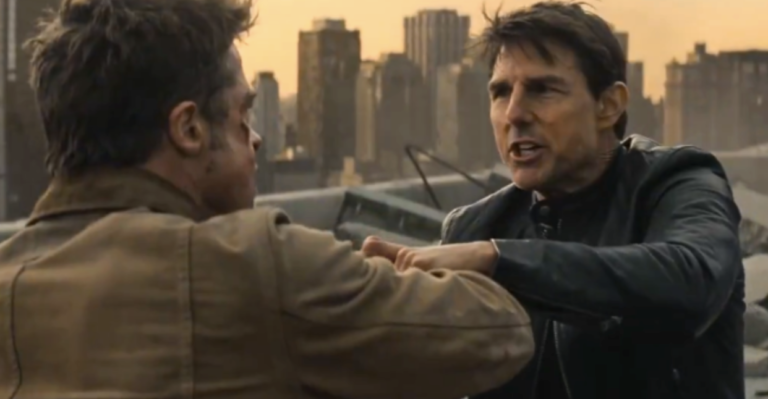
©Courtesy of Tom Cruise vs Brad Pitt deepfake video from Seedance 2.0
The panic arrived, as it often does in Hollywood, via a viral clip. In a matter of hours, a hyper-realistic AI-generated video depicting lookalikes of Tom Cruise and Brad Pitt fighting on a rooftop circulated across social media. The tool behind it, Seedance 2.0, had been released only days earlier by ByteDance, the parent company of TikTok. The message to Hollywood was unmistakable: generative video had crossed a psychological threshold.
Within a week, The Walt Disney Company sent ByteDance cease-and-desist letters. The movie studio accused the internet technology company of deploying a pirated library of characters from Marvel and Star Wars.
Netflix also sent the Chinese company cease-and-desist letters. The streaming service described ByteDance as a high-speed piracy engine. Netflix alleged that ByteDance generated derivative works featuring Stranger Things, Bridgerton, Squid Game and KPop Demon Hunters.
The Motion Picture Association (MPA) called the infringement systemic, not incidental. SAG-AFTRA denounced the tool as blatant infringement.
ByteDance responded with a familiar formula. The company stated that it “respects intellectual property rights and is“taking steps to strengthen current safeguards.
But the industry’s reaction suggests that this moment is not merely about one product. It is about the future architecture of filmmaking itself.
For over a century, cinema has been defined by scarcity. Cameras were expensive. Film stock was finite. Post-production required specialized labor. Distribution depended on theater chains and television deals. Even in the streaming era, the ability to mount a blockbuster remains a capital-intensive endeavor.
Seedance 2.0 threatens that scarcity model. It can generate cohesive video and audio sequences from a few lines of text.
Rhett Reese, who co-write Deadpool & Wolverine, watched the Cruise-Pitt clip and declared, “It’s likely over for us.” He imagined a near future in which a single person, armed with taste and talent comparable to Christopher Nolan, could produce a film indistinguishable from a studio release.
Reese’s concern emphasizes a broader fear: that the barriers to cinematic creation are collapsing. If anyone can prompt a system to create superheroes, space operas or Regency romances, the studio system may face collapse. The idea that scale equals quality may become endangered within Hollywood.
However, history suggests that the democratization of tools rarely destroys art; it transforms it. The invention of digital cameras didn’t end filmmaking – they instead created new aesthetics and voices. The iPhone also didn’t end cinema – it enabled an entirely new grammar of visual storytelling.
The film industry must move past the debate over whether AI will be used in movies in the future, as many filmmakers are already using such tools in their projects. Instead, the industry must consider who will control the technological tool, and under what terms.
As a result, the immediate clash between filmmakers and AI has turned to the legal system. Studios argue that Seedance was trained on copyrighted works without consent. Filmmakers are stating that the company now produces output that replicates protected characters, costumes and visual styles.
Netflix has preemptively challenged the idea that such usage constitutes fair use, especially when the output resembles a competing commercial product. The MPA, meanwhile, states that infringement is a feature, not a bug, a claim that responds to the core of the generative AI debate.
As a result, the definition of authorship in the age of machine learning is now at stake. If an AI model ingests thousands of hours of studio content to learn cinematic grammar, lighting styles, character designs and narrative beats, its output raises the question if it’s analysis or appropriation. The courts will eventually decide, but the industry is already sketching the outlines of a licensing future.
In the discussion over the ethics and legality of AI, an apparent contradiction has arisen. Disney has threatened ByteDance while also investing heavily in AI partnerships. The technology company announced a $1 billion equity stake in OpenAI. It also revealed its licensing agreement that allows the Sora video generator to use some of Disney’s characters.
As a result, Disney has objected to the unauthorized replication. But the studio does monetize authorized AI access to its IP. So Disney executives have subtly confirmed that AI is acceptable to them when it makes them a profit.
This duality suggests that the future of AI in film will be negotiated. Studios may build proprietary models trained exclusively on licensed libraries. Actors may license digital likenesses under strict conditions. Writers may bargain for compensation when their scripts become training data. Rather than dismantling Hollywood, AI may entrench its power by centralizing the most valuable datasets behind paywalls.
Lost amid the legal volleys is a more basic issue: AI video is still imperfect. Recent showcases, including entries at the Chroma Awards, exposed the limitations. Dialogue lacks nuance, while visuals possess a flattened, synthetic brightness that becomes glaring on a cinema screen. Even standout shorts like The Twin Earth or The Cinema That Never Was succeeded partly because they worked around AI’s weaknesses rather than improving them.
For now, the technology is better suited to concept art, previsualization or short-form spectacle than to emotionally complex features. On the big screen, minor distortions become uncanny distractions.
But generative systems are improving at a startling pace. AI creators note that a model producing mediocre results today may improve in the future. Seedance 2.0’s rapid evolution over its predecessor illustrates this dynamic. The aesthetic shortcomings that reassure traditional filmmakers may be temporary.
When those technical hurdles improve, the debate will shift from whether AI can make a good movie to who is using it the best?
If copyright is the first source of contention with AI, labor is the second. Actors’ unions like SAG-AFTRA are acutely aware that digital doubles and AI-generated performances could erode bargaining power. The idea that a studio or an external company could synthesize an actor’s likeness without consent strikes at the heart of performance as labor.
The Cruise-Pitt rooftop clip may have been unofficial, but it dramatized a world in which celebrity likeness is infinitely replicable. Contracts will need to specify how digital scans are used, how long they persist and how compensation scales will change. The distinction between parody, homage and exploitation will blur.
At the same time, AI could expand opportunities for performers. De-aging, dubbing and language localization may become seamless. Actors could license virtual versions of themselves to appear in international markets or experimental projects they could never physically shoot. While the threat of AI is displacement, the technology also offers opportunities of multiplication.
The fact that this confrontation centers on ByteDance is significant. TikTok has already reshaped music marketing, celebrity culture and audience attention spans. If its parent company controls a widely accessible video generator capable of producing studio-grade clips, the locus of creative power could lean further toward platforms.
Studios are not merely defending their IP; they’re also defending distribution ecosystems. If audiences can generate personalized spinoffs of their favorite films and television shows at home, the future of the studios’ carefully managed release cycle will be disrupted and altered. If viral AI clips eclipse official trailers, studios will lose control of their projects’ narratives.
Platforms thrive on user engagement. Studios succeed through controlled scarcity. AI interrupts that distinction by enabling users to become micro-studios. The tension between centralized IP ownership and decentralized creation will define the next decade of media law.
It is tempting to frame Seedance 2.0 as either the cause of the complete collapse of Hollywood, as seen by the current wave of cease-and-desist letters from Disney, Netflix, Paramount, Warner Bros. and the MPA. The letters signal that the industry will not passively accept unlicensed AI replication. As a result, legal frameworks will emerge to help licensing markets mature.
But Generative video will never truly disappear. They’ll become cheaper, faster and more convincing as technology improve. Independent creators will continue to experiment. Some of their projects will fail , while others will surprise skeptics. Over time, many audiences grow more comfortable with AI-infused storytelling, just as they did with CGI.
The future of AI in the film industry is unlikely to be a binary of replacement or rejection. It will be a negotiation over legal, aesthetic and cultural concerns. Studios will defend their franchises while quietly building their own AI models. Creators will decry infringement while exploring new tools. Unions will demand protections while adapting contracts to new realities.
In the future, a filmmaker of exceptional talent may sit at a computer, type a prompt and produce a film that will rival today’s blockbusters. When that happens, the achievement will not belong solely to the algorithm; the resulting project will belong to the human who knows what to ask for.
What began with a brawl between AI-generated facsimiles of the former Interview with the Vampire co-stars may ultimately be remembered as the moment Hollywood realized that its most valuable asset may be encoded in data. The clash between The Walt Disney Company, Netflix and ByteDance is not simply a dispute over piracy; it’s a struggle over who owns the rules and rights of modern storytelling. In that sense, the lawsuits are less about stopping AI than about setting the price of admission.
Hollywood has survived the arrival of sound, television, home video and streaming. It will survive generative video as well.
But survival doesn’t mean balance. As legal standards form and labor contracts evolve, AI will likely become another instrument in filmmakers’ skill sets. The enduring advantage won’t lie in access to algorithms alone, but also in judgment, taste and narrative instinct. The future blockbuster may begin with a prompt, yet it will still depend on the oldest element in cinema: a human deciding what story is worth telling and why.
If you liked this article, please share your comment below.