
@Courtesy of Paramount+
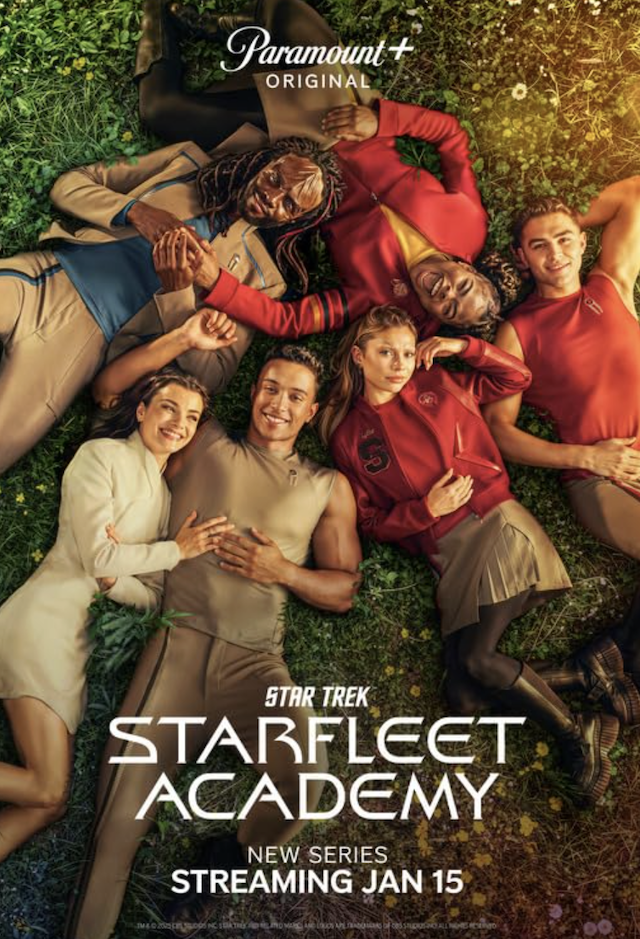
Press Conference With Actors Paul Giamatti and Holly Hunter
Q: There is a wonderful conversation in the first episode between your character, Nahla, and Oded Fehr who of course is a familiar face from Star Trek: Discovery, where you both talk about kids inheriting a broken world and about building a future. How much does this resonate for the series and for you both?
Holly Hunter: Stories are always about conflict. The world is always in flux. Often, we write stories about broken worlds and how we are going to evolve from that, because we’re always in a state of change. Starfleet Academy, but also Star Trek, is constantly examining that flux. The Federation in Starfleet Academy is in a real state of transition, a rough one. They’ve got to evolve to this new world, so this is the beginning of that exploration of that story, of that conflict.
Paul Giamatti: I agree. Science fiction in general is about change and growth and inheriting the future. It’s always gonna be about trying to make things better. Star Trek is very much about. As Holly said, the Federation is in a transitional state here, which is exciting and different and new. And troubling. The Federation’s not supposed to be in trouble, is the vanguard that’s making sure everything’s okay. Starfleet Academy is all about the future generations, building character so that they can move forward and help out. Change things.
Q: Which values of Star Trek do you cherish most?
Paul Giamatti: Empathy. Openness to everybody. Other cultures. That seems to me to feel like a bedrock value that is instilled in people. Empathy to me feels like a really basic value.
Holly Hunter: Yeah, I agree. Also discussion. Star Trek is about communication across the galaxy. There’s difficulties from different languages to different political beliefs. Star Trek is all about conversation and people continuing to discuss. Be open with each other to get to negotiations, to get to solutions for the community.
Q: How did you approach honoring the Star Trek legacy while at the same time bringing a new take on the iconic TV series?
Paul Giamatti: That was built into the scripts, actually. They were already building in stuff that honored a lot of the traditional values. It’s a great callback for people. Starfleet Academy is already the bedrock for all the myths. Everything comes out of Starfleet Academy. But it feels very much its own show, and very new. But that’s all in the writing. I was just acting out what they gave me to do. I’m a Star Trek fan, so I unconsciously brought a lot of adoration for it.
Holly Hunter: It’s so cool because this is the first Star Trek iteration that has focused exclusively on the Academy. That’s just a fresh, new thing for the entirety of the legacy of the series. Then you bring in all these fresh new actors into the mix. It’s chaotic and spontaneous and joyful and relaxed and tragic. They bring their own drama to the show. It’s a big playground.
Q: What did Alex Kurtzman have to do with that?
Holly Hunter: He knows Star Trek so well. He’s been experienced with Star Trek for years. Has written the movie with J.J. Abrams starring Chris Pine. He’s really been involved. I have incredible trust in him for his knowledge.
Paul Giamatti: He’s got the foundation. He knows it so well. He’s been involved with it for so long, but he’s wanting to take it to new places, try out new things. It’s great. It’s the best of both worlds. He’s the whole thing right now.
Q: How was it for you to join this extraordinary franchise?
Holly Hunter: Exquisite. It started when I showed up to Toronto, where we’re shooting it, and I looked at the sets. Because the sets alone, from the beginning of Star Trek, have been thrilling. When I watched it as a kid, the sets were thrilling. The mid-century furniture, the way that William Shatner’s office was outfitted. He’d show up with his, not gun shirts, but occasionally he’d take off his jacket and it was like, “Oh my god!” It was just like a shot of excitement for me. A little bit like being a kid. I’m not a Star Trek aficionado, but it still makes me feel like a child. That’s one of the reasons why a lot of people will watch Star Trek, because it gives you a sense of wonder.
Paul Giamatti: I can’t lay claim to being some kind of encyclopedic expert, but I love it, and I’ve grown up with it. I’ve watched several of the iterations in total, but I’m not one of these guys that can quote things chapter and verse. I get scared of those people when I have to deal with them ’cause I know I’m gonna say something wrong. But I love science fiction, it’s a youthful genre, it keeps you young. That’s how I grew up, reading it. There’s a nostalgic thing that takes you back to remind you of being young. It’s always about new ideas, new perspectives. Imaginative worlds. What really makes sense about this show is it’s literally about young people who are embarking on this whole adventure. The youthfulness of it is appropriate to the genre.
 @Courtesy of Paramount+
Q: What does Star Trek allow you to explore dramatically that a non-genre series wouldn’t, especially within its long moral and political continuity?
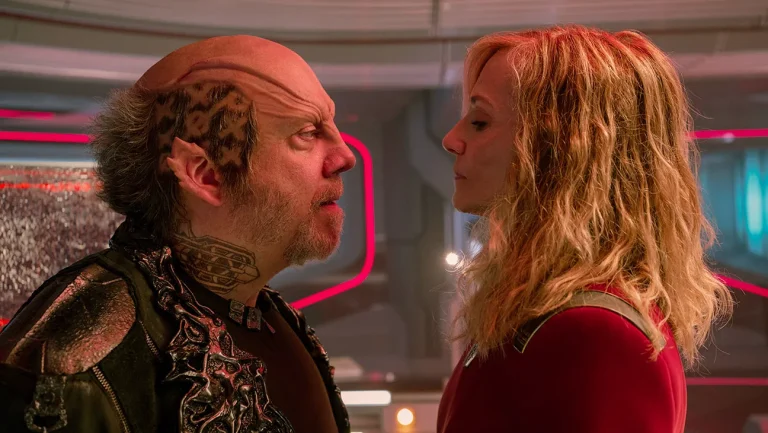
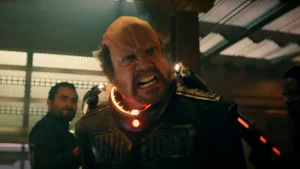
Paul Giamatti: There’s all of that. But I’m a pirate, a space pirate. I’m a half-Klingon, half-Tellarite space pirate. I’ve been all over the galaxy. I probably time-traveled. Who knows? It’s a huge open door to your imagination, that’s fantastic. And then within that, you’re dealing with these very human things. The character has a very human dilemma, it goes along and you figure out why he’s as ticked off at the world as he is. He’s got very human dimensions, he’s complicated. He’s a deeply troubled child inside, there’s all wonderful real dimensions to him. While still being a space pirate. And a Klingon. It’s wonderful.
Q: Star Trek has given us countless memorable heroes and villains for the past 60 years. Were you inspired by any of them in particular as you ventured into this universe yourself?
Holly Hunter: It’s about all these people coming from places truly unknown. From millions of light years away. A real character to character, granular intimacy. Even between Paul and me, there were lives there on screen. What is this between them? Unspoken mystery. That’s the cool thing about Star Trek: these incredible opposites, the largeness and the granular intimacy of the show, of these characters.
Paul Giamatti: There’s some great characters and performances that make the characters really great, that I just love. A Deep Space Nine fan in particular, some of the bad guys on that, Dukat and Garak, it’s wonderful. And the Ferengi guys, Brunt, all these really hilarious, wonderful, funny, strange, scary characters. you know. I’m sure it was in my head in some way. I wasn’t consciously drawing on it, but I’m sure it’s in there.
Q: What does the term Star Trek mean to you?
Holly Hunter: Star Trek does begin in a place of nostalgia for so many people, and it can start at the beginning of your life. Where you were drinking lemonade or, in my case, grape juice, Welch’s grape juice is what I had when I was watching Star Trek with my father, with crushed ice that he crushed for me.
Paul Giamatti: There’s a definite kind of American childhood thing that comes back to you. In the sense of decent, healthy adventuring out into the world. A lot of it is rooted in that. Oftentimes a father introduced their children to it, that seems appropriate to this show, to this particular show, of parents handing things on, adults handing things on.
 @Courtesy of Paramount+
Q: How was the fight with Sandro Rosta choreographed? How much did he want to do himself?
Paul Giamatti: It was in the script, it was nothing, really. It was like we pushed each other around, that was it. And Alex said, “Now, that fight is gonna have to be like a real fight. We’re gonna have to have a really crazy, violent fight.” And I was like, “Okay.” I’m almost 60, I haven’t done much like that in a long time, but I was game for it. I loved doing it with Sandro because I trusted him entirely. It was wonderful. It was all very choreographed and very worked out. It came out great. There’s one shot where it isn’t me and it isn’t him, only because it was too dangerous for us to do it, so they wouldn’t let us do it. But other than that, it’s me and him. He split his lip and I broke my finger, and it was fantastic. I loved doing it. But they did say to me, “We have plans for another fight.” And I said, “No, no.” That was it for me. A Star Trek fight, big, classic Star Trek fight. Like the original series, they always had these great fights.
Q: Although the story is set in the 32nd century, it deals with rivalry, ambition, and fear of failure. Why do you think these themes feel especially relevant right now?
Paul Giamatti: Those themes are always gonna feel relevant. Conflict and failure. Failure is a theme. That’s very interesting. People are afraid of failing, isn’t it? They’re students. This guy that I play is really, in a sense, a failure in his way. I don’t believe that there was ever a golden age in humanity when everything was actually fine, you know? It’s always been in flux, the world and people.
Q: What is the earliest recollection you have of the Star Trek universe, and how was it entering this world?
Holly Hunter: I started with my father watching it during the first season with Shatner and Nimoy. I had an appetite for having this filmed conversation about what’s going on. What’s going on with us as human beings? How do human beings navigate all the complexities of our lives in a moral universe? That’s why people keep coming back to it, why it is evergreen. It gives us conflict, but it also gives us solutions. I was very attracted to that, in particular.
Paul Giamatti: I started watching with my father. I was probably seven or something like that. It made a big impact on me, particularly the character of Spock. I’m not entirely sure why. Something about Leonard Nimoy’s appearance is extraordinary in that part. He puts it across in an amazing way. There’s an episode where there’s a creature that’s been killing people in a mine, and they don’t know why. Spock has this ability to mind meld with the creature, he reads its mind, and it’s a traumatized creature. It’s lost, young and scared. That really stayed with me. This hyperrational man is the one you call upon to read the heart of the other creature. It’s still moving to me, what an extraordinary character. So, Spock, for me, was a big thing.
Q: Your character teaches at a Fleet Academy, where there is even more diversity and a greater range of challenges. How would you describe the character you play and what challenges does your character face?
Holly Hunter: One of the things that has been interesting and fun to navigate through the series is it’s a real active acceptance. Acceptance of how they feel, what they’re thinking, what’s motivating them. Understand it and have empathy for it. On this show, in this story, I give the students a lot of freedom. Because I want to and because they want it. They deserve it.
Q: Do you believe in aliens or have you ever seen a UFO?
Holly Hunter: I can’t say that I don’t believe in them. But I’ve never seen one. I believe that there’s a possibility it could exist.
Paul Giamatti: I’ve never seen a UFO. I’ve never seen anything that I could say I thought was extra-terrestrial. I think it seems crazy that there isn’t some other life form. It’s gigantic, the universe. Maybe so far away that no, we haven’t encountered them.
Q: Can you please describe the scene on the ship where you and Paul Giamatti had the argument? It was fantastic and it feels like you and Paul Giamatti were playing on stage. Can you please share with us when you first read the script?
Holly Hunter: Paul and I have talked about that. the scene on the bridge, it’s just by nature, it’s theater. The bridge is a theater. Both of us came from the stage. Somehow we felt right at home. It’s almost a theater. It’s not quite naturalism, Star Trek can also not be quite naturalistic. We were goosed by that. That was just a pleasure, slightly erotic, slightly co-conspirators.
 @Courtesy of Paramount+
Q: Your characters represent two opposing sides of the story, yet both are strong and fearless in their convictions. What specifically drew you to want to bring these characters to life?
Paul Giamatti: His unpredictability. He plays the clown for people. I find that an interesting quality in a psychopath. I find it menacing and strange. That was interesting to explore, playing a guy who is so violently opposed to all of these values. But for sad, traumatic reasons underneath it all. He hates the Starfleet Academy but I think underneath it he’s jealous of and envies and wishes he had in his life. At the end of the show, you hear a lot about what he thinks about it, there’s a childish admiration of The Federation inside of him that gets thwarted.
Holly Hunter: I wanted to bring something very approachable to Nahla. There’s a camaraderie with the students, I want it to feel like they can come to her with anything. I wanted to be a safe place for them. I also wanted the captain to also have that kind of approachability while also being the leader. That was something that I was intrigued to see, I wanted to explore that intersection.
Q: What interactions have you had with the Star Trek community, and how do you anticipate that relationship building?
Paul Giamatti: I haven’t had any real encounters yet. I’m a little afraid. I’m a little afraid of this overselling that I know all about Star Trek that’s going on, ‘cause I know I’m gonna get challenged by people who are gonna have issues with what I did. But I look forward to it, actually. I look forward to going to a Star Trek convention. I can go to one of those now, legitimately. So, I’m interested to engage more, see what people think.
If you like the press conference, share your thoughts below!
Check out more of Adriano’s articles.
Here’s the trailer for Dead Man’s Wire: