
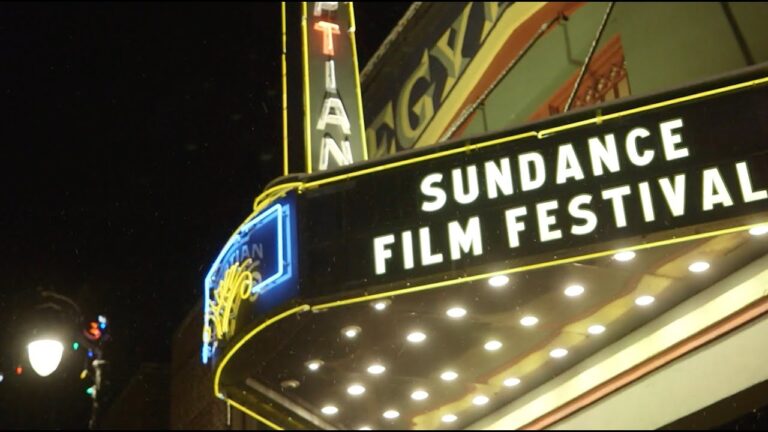
Nobody ever considered Robert Redford a “horror icon,” but neither the Saw or V/H/S franchises would be what they are today without the buzz they generated at the Sundance Film Festival, famously founded by Redford. From its inception, the festival quickly emerged as launching pad for important films and talented filmmakers, of all genres.
The actor-director was a Westerner through-and-through (he was both Jermiah Johnson and the Sundance Kid) so naturally he founded the festival and the institute that manages it in the Rocky Mountains of Utah. Next year will be the first year the festival moves from Park City (and several surrounding Utah cities), to Boulder, Colorado. As it happens, Redford attended the University of Colorado-Boulder for over a year (before politely agreeing to leave), so the festival’s relocation could have been a full circle moment. Regardless, a Sundance without Redford definitely constitutes the end of an era, so it makes sense to take stock of his life and Sundance legacy during the final festival that he advised during the planning stages.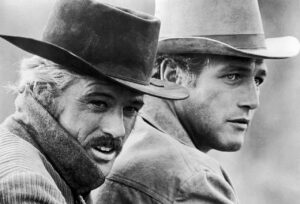 Of course, Redford did not hand select every film that screened at Sundance, but he was an active presence at each festival (at least during the ten years I attended as credentialed press, 2011-2020). Every festival opened with the founder’s press conference that were part hype sessions and partly just an opportunity to gawk in amazement at Redford. Celebrities constantly trudged up and down hilly Main Street (which is quite steep, especially if you are not yet accustomed to the altitude), but whenever the crowds spotted Redford, you could hear the whispered excitement.
Redford had presence, right from the start. That is why young Redford was so perfect for one of his most enduring television performances, as Harold Beldon, a.k.a. Death, on The Twilight Zone episode “Nothing in the Dark,” who was literally frighteningly handsome. Yet, Redford projected the perfect sensitivity to reassure elderly Wanda Dunn that he would give her the peaceful rest she truly needs. 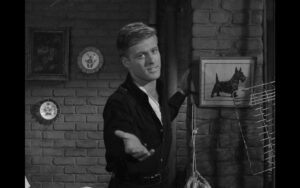 Ironically, Redford portrayed a very different agent of death fifty-two years later in Charlie McDowell’s 2017 Sundance premiere, The Discovery. Announcing he has proved the existence of the afterlife, Redford’s Dr. Thomas Harber inadvertently induces waves of suicides by people desperate for a fresh start. (Even though it was produced by Netflix, The Discovery remains an unjustly overlooked example of vintage late-career Redford.)
In the early days of the festival (originally known as the U.S. Film and Video Festival, until it adopted the Sundance name in 1991), the chance to hit Park City’s slopes at the peak of ski season helped bolster its appeal. Until recently, official screenings were also held at the Sundance Mountain Resort, which Redford owned until 2020. However, requesting Sundance Mountain press tickets was a rookie mistake, because the resort was a 45-minute drive from Park City, without a regular bus connection. Regardless, linking the festival to ski culture made sense for Redford, the avid sportsman and the star of Michael Ritchie’s Downhill Racer, in which he portrayed a cocky young Olympic hopeful (sort of like a Days of Thunder on skis).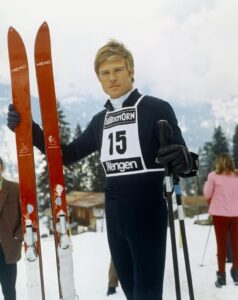 The Festival really hit its stride in the late 1980’s and early 1990s, thanks to programming either the world or American premieres of breakout independent films and documentaries, including Stephen Soderbergh’s Sex, Lies, and Videotape (1989), Whit Stillman’s Metropolitan (1990), Robert Rodriguez’s El Mariachi (1992), Quentin Tarantino’s Reservoir Dogs (1994), Steve James’ Hoop Dreams (1994), and Kevin Smith’s Clerks (1994).
Thanks to Redford and Sundance, “independent film” gained cool cachet in the 1990s. Instead of a liability, a film’s origins outside the Hollywood establishment became a marketing draw and a badge of honor. Yet, Redford, the godfather of independent film, demonstrated his own independence by playing secret bad guy Alexander Pierce in the Marvel behemoths, Captain America: The Winter Soldier and Avengers: Endgame, at the height of the MCU’s popularity.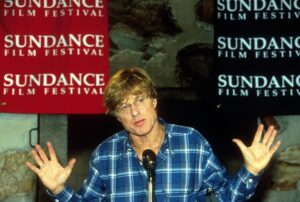 Logically, given the Rocky Mountain setting, Sundance often reflected Redford’s passion for nature and the outdoors, with selections like Lucy Walker’s The Crash Reel (profiling snowboarder Kevin Pearce), Jimmy Chin & Elizabeth Chai Vasahelyi’s Audience Award-winning mountaineering doc Meru, Luc Jacquet’s hit nature documentary March of the Penguins, and Otto Bell’s visually stunning The Eagle Huntress.
Although Redford’s classic ode to fly fishing, A River Runs Through It was technically never an official Sundance selection, it screened as a special fundraiser for the Sundance Institute, so maybe it warrants an asterisk. However, Ken Kwapis’s adaptation of Bill Bryson’s autobiographical A Walk in the Woods premiered at the Festival, notably starring Redford as the Appalachian Trail-hiking Bryson.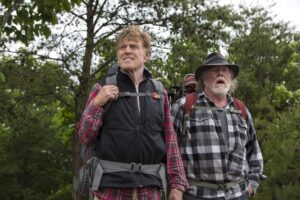 Not surprisingly, Redford’s concern for nature often manifested in environmental activism, which was also reflected in many green-themed Sundance selections. Perhaps the most notable (or infamous) would be Davis Guggenheim’s An Inconvenient Truth, which punched-up Al Gore’s global warming lectures. Yet, in 2013, the Festival resisted dogmatism, by screening Robert Stone’s Pandora’s Promise, which made a cogent case for nuclear power as the only truly safe, reliable, and cost-effective form of green energy.
Indeed, Sundance represented a full-service festival during the 2010’s, programming films from across a relatively broad ideological spectrum. For instance, Lee Tamahori’s The Devil’s Double depicted the insanity and brutality of Saddam Hussein and his sons, through the eyes of Latif Yahia, the unfortunate man forced to serve as Uday Hussein’s body-double. Like an Iraqi Scarface, Tamahori’s film is a kinetic, drug-fueled thriller that in no way excuses, justifies, or minimizes the crimes of the Husseins (leaving most of the audience speechless at the 2011 press & industry screening I attended).
Even more timely, Sundance programmed Anabel Rodriguez Rio’s documentary Once Upon a Time in Venezuela, which exposed the poverty Venezuelans endure due to the rampant corruption of the Chavist regime. Frustratingly, it has yet to receive a proper theatrical release, despite overwhelmingly positive reviews.
Likewise, several Sundance selections provide useful context for understanding the recent protests in Iran and the regime’s violent crackdown. In fact, Ali Samadi Ahadi’s partially animated documentary The Green Wave chronicling the 2009 street demonstration should remind us of the Iranian people have long rejected their oppressive government’s dubious claims to legitimacy.
Sundance narrative dramas also explored the current regime’s homophobia in narrative dramas, like Iranian-born Maryam Keshavarz’s Circumstance and Algerian filmmaker Amor Hakkar’s A Few Days of Respite. Both films seem even more relevant today than when they screened at the 2011 Sundance Film Festival. Consequently, it is a shame Hakkar’s quiet but deeply humanistic film never really scored proper American theatrical release.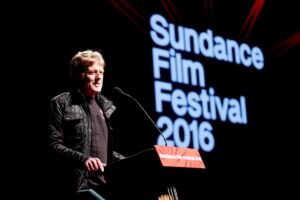 Throughout its existence, Sundance has generated sensational buzz for films that opportunely tapped into the cultural zeitgeist. The timing was perfect for Jordan Peele’s Get Out (a 2017 Sundance premiere), because of the way it satirized white liberal racism through a horror prism. Arguably, The Blair Witch Project became the first film to “go viral” at the 1999 Festival, launching the found footage genre as we now know it, on the way to claiming the title of the top-grossing indie film of all time, with a $248 million gross.
Yet, Redford could identify with the phenomenon. At the youthful age of 56, he became a media sensation all over again, due to his role in Adrian Lyne’s provocative Indecent Proposal. For weeks, late night talk show viewers had to sit through jokes that essentially restated the contention that a lot of women would need much less than one million dollars to convince them to spend a night with the superstar.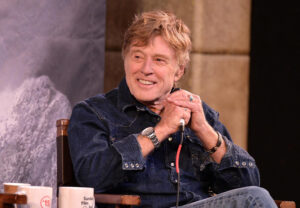 Arguably, Redford’s IMDb page is somewhat misleading. Admittedly, he has extensive producer and “thanks” credits. Yet, there is no listing for him on many films that largely owe their cultural footprints to the momentum they built at Sundance, such as Jared Hess’s Napoleon Dynamite and Jason Ritman’s Juno. Plus, there are the legion of films that received early incubator support from the Sundance Institute, such as this year’s Academy Award nominee Train Dreams.
Yet, it is Redford’s star presence that will be most missed. He was the president and founder of Sundance, but he carried himself like the chairman of the board. Redford couldn’t possibly micromanage every aspect of such a large enterprise, but he clearly took an active interest, especially during festival time. He was the guiding light of independent film, yet Redford was also one of the last true movie stars. He will be missed, particularly in Park City.
If you like the article, share your thoughts below.