

©Courtesy of Well go USA Entertainment
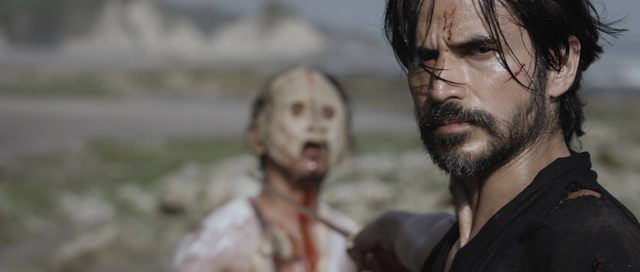
Thanks to their success repelling the Mongol invasions of 1274 and 1281, China’s Ming Dynasty decided against any further military aggression directed towards Japan throughout its reign. Samurai like Riku were one of the major factors contributing to Japan’s victories. Frankly, Riku assumes his fighting days have finished when he washes ashore on a remote Pacific island, but a tribe of cannibals has different ideas in Josh C. Waller’s Lone Samurai, which opens in theaters this Friday.
Riku’s mission was simple in conception—board a Mongol war ship to kill as much crew as possible—but skillfully executed. However, when the invaders’ vessel sinks, the samurai awakens wounded and disoriented on the beach of a tiny island, the kind of which the outside world never took much notice of until the WWII island-hopping battles. Initially, Riku starts healing himself and building a Shinto shrine, just to facilitate a worthy seppuku ceremony. However, a cannibal hunting party from a neighboring isle rudely interrupts his private ritual.
Any Chanbara fan knows that if your rival wants to commit hara-kiri, just let them do it. Boar lacks that insight and maturity. Having just succeeded his father as chief, Boar feels a need to exercise his authority and demonstrate bravado. Consequently, when Riku escapes back to his former island sanctuary, Boar forms a war party to hunt him down. Of course, that plays exactly into Riku’s hands. Disgusted by Boar’s treatment of other prisoners, Riku pledges to punish his cruelty. Specifically, he vows to decapitate 50 of his warriors.
Indeed, Waller turns the mood of the film on a dime, downshifting from a solemn meditation on isolation and mortality into a spectacular battle royale. In terms of themes and vibe, the first half plays like a Chanbara Robinson Crusoe, while the second half is more akin to a desert island version of The Raid: Redemption.
In fact, the comparison to The Raid franchise is rather apt, considering the involvement of the Uwais Team, founded by its star, Iko Uwais, as both producers (represented by his partner Ryan Santoro, who served as an executive producer) and coordinating the fantastic stunt work. Although Uwais does not appear in the film, his fans get the next best thing: his frequent on-screen nemesis, Yayan “Mad Dog” Ruhian, who portrays Riku’s worthiest opponent, Witch, the cannibals’ former champion, whose reputation for wisdom Boar clearly resents.
 ©Courtesy of Well go USA Entertainment
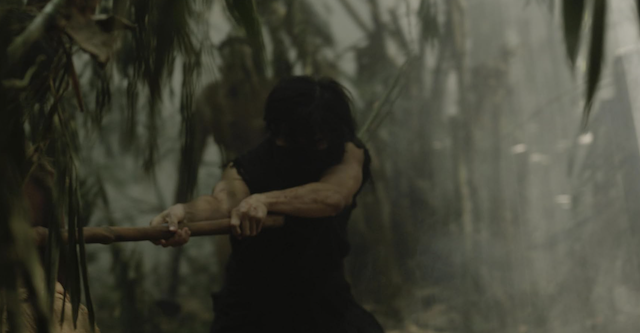
Happily, Riku’s face-off with Witch does not disappoint. Nor do any of the throwdowns that come before or after. The Uwais Team knows their stuff and they have the chops to execute the incredibly cinematic moves. Waller might be new to Chanbara, but his previous work always featured plenty of action, especially his collaborations with Zoe Bell (such as Camino). To his credit, Waller understands how to really show off the cast and stunt performers’ chops, often framing wide shots to encompass full bodies as they circle and lunge.
The mononymously-billed Shogen (who is indeed Japanese, but of Okinawan descent) delivers a remarkably quiet performance throughout Lone Samurai, especially by the standards of action movie leading men. Yet, he broods convincingly in the first half and displays appropriate steeliness during the second section. Even when silent, he has undeniably magnetic screen presence.
As usual, Ruhian alone justifies the price of admission (or VOD rental) with his eye-popping skills and super-charged energy. However, in Lone Samurai, his performance takes on surprisingly tragic dimensions. In contrast, Rama Ramadhan leans into Boar’s villainous savagery and his imposing physicality, which makes the conclusion satisfyingly cathartic.
Admittedly, Lone Samurai’s two respective halves somewhat clash tonally, but they arguably signify the opposing sides of the Bushido way. The first part emphasizes the nobility and sacrifice demanded of Samurai, while the second half represents courage and martial discipline. Logically, Waller necessarily structured the film this way, so it ends on a crescendo.
If patrons understand the history of the Samurai and the Bushido code (in this case, during the late Kamakura Era), they should equally appreciate both the meditative moments and the blood-splattering slicing-and-dicing. However, even the most attention-challenged viewer will be enthralled by the swordplay and butt-kicking. Highly recommended for Chanbara fans, Lone Samurai releases this Friday (12/12) in theaters.
Grade: A
If you like the review, share your thoughts below.
Check out more of Joe’s articles.
Here’s the trailer of the film.