


©Courtesy of Netflix
Taiza Kujo annoys other lawyers because they think he makes them look bad—and perhaps he does, but maybe not in the way that they think. He accepts the worst of the worst as his clients and negotiates deals his colleagues consider potentially unethical. However, he takes the time to better understand his clients’ psychology and motivations. Somehow, he often counterintuitively reaches something like justice, or the closest approximation available under the law. Be that as it may, his luck might run out in the ten-episode live-action series Sins of Kujo, based on Shohei Manabe’s manga Kujo no Taizai (not widely available on North America), which is now streaming on Netflix.
Many attorneys say everyone deserves competent representation for the legal system to work, but Kujo really means it. If you simply ask to retain him, he will automatically say yes, like Morgan Spurlock super-sizing at McDonald’s. His new associate, Shinji Karasuma sort of gets it, but not really. Regardless, Karasuma knows he can learn much from Kujo, as long as he avoids guilt by association.
The two lawyers also share a childhood bond. They both observed the same criminal trial, in which Kujo’s father, a stern prosecutor, secured the death penalty for the man who murdered Karasua’s father, even though the guilty party was clearly mentality unhinged. Intuitively, both boys understood the story didn’t end with the conviction—a common theme for Kujo’s cases. ©Courtesy of Netflix
Nevertheless, Kujo really picks some difficult clients—or rather they pick him. In the first episode, he represents the criminal lowlife whose criminal negligence costs an innocent boy his leg. Kujo and Karasuma next represent the sympathetic Sota Sogabe, a slow-witted ex-con bullied into serving as a drug mule, in in the two-part “Thee Dignity of the Vulnerable,” but Kujo is perversely determined for him to plead guilty for his boss’s crimes. Initially, his defense angers Karasuma and Hitome Yakushimae, the social worker they often collaborate with. Yet, both come to grudgingly accept the wisdom of his strategy.
Indeed, Sins of Kujo often plays out like the legal version of Freakonomics. Through a superior understanding of his clients’ incentives and the ironic intricacies of the law, Kujo produces results that are more truly in their interests than if he had pursued the preferences of polite society.
Similarly, Kujo genuinely listens to Shizuku Kisaga, a client on trial for murder. In contrast, “public interest” attorney Reiko Kameoka, simply used Kisaga to score a quick PR victory over the adult video industry (and a payday for her ostensive client’s abusive “step father”), leaving her worse than when she found the confused girl. ©Courtesy of Netflix
Kujo is not always on the “wrong” side. During the two-parter “Family Ties” he represents the heir trying to reclaim the inheritance swindled away by her late father’s abusive Yakuza-controlled nursing home. Of course, in Kujo’s world, no good deed goes unpunished. In this instance, he turns brutish Yakuza Ryoma Sugawara into a dangerous foe.
How do all these sketchy clients find Kujo? Often, they are referred by the series’ most intriguing character, his “friend,” Kengu Mibo, a dodgy body-shop owner, whose remains much more active in Yakuza business than he lets on. Eventually, as the saying goes, with friends like Mibo’s associates, Kujo doesn’t need enemies.
Frankly, Sins of Kujo could indeed be considered an economist’s legal drama, because it constantly invites viewers to take into account incentives, unintended consequences, and opportunity costs. In some ways, Kujo is a heroic figure of almost Sisyphean dimensions. Yet, lawyers might resent the way he undercuts many of their self-serving assumptions.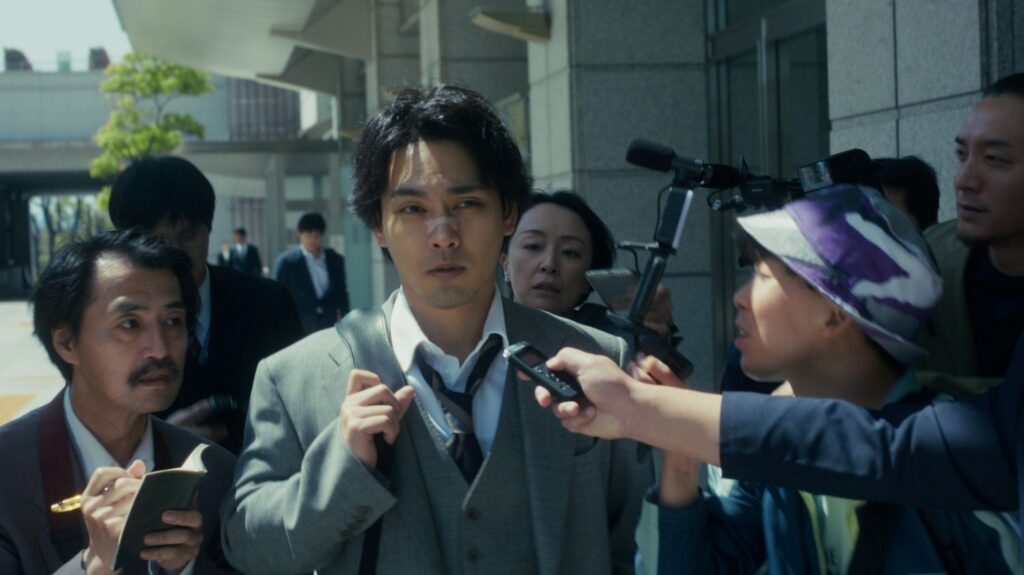 ©Courtesy of Netflix
Indeed, Nonji Nemoto’s adaptation of Manabe’s manga often takes quite surprising turns. Yet, it still delivers as an old school Yakuza crime drama. Yuya Yagira (who has a strong track record of manga adaptations, including the Gintama and Gannibal franchises) raises world-weary cynicism to a high art form with his portrayal of Kujo. However, Hokuto Matsumura and Elaiza Ikeda nicely counterbalance him as the still somewhat idealistic Karasuma and Yakushimae, whose verbal sparring sessions with Kujo are pleasantly meaty.
Keita Machida intriguingly humanizes the cunning Mido. Somehow, his performance is always simultaneously creepy and charismatic. Yuu Kashii also stands out as the driven but somewhat hypocritical Kameoka. Plus, Tsuyoshi Muro, Takenori Goto, and Shinobu Hasegawa all make seriously despicable villains as the Yakuza bosses Kyogoku and Sugawara as well as the Yakuza-aligned adult video tycoon, Koyama.
Without question, Sins of Kujo represents the best legal drama of recent years, due to the way it slices and dices through cliches and conventions. It is smart, in ways that cut in multiple directions. Very highly recommended, Sins of Kujo now streams on Netflix.
Grade: A
If you like the review, share your thoughts below!
Check out more of Joe’s articles.
Here’s the trailer of the film.