

Japanese cinema has a long and very important tradition of period drama movies. The legendary Akira Kurosawa was an absolute master in this specific kind of movies, realizing masterpieces like Rashomon (1950), Seven Samurai (1954) and Ran (1985), for which he obtained an Academy Award nomination as best director.
Samurai Fury (Muromachi Outsiders) clearly belongs to this tradition through the scale of the mise en scene, the depiction of the main character and the epic behind all of this. At the same time though the director Yu Irie had in mind a fresh take on the genre, something capable of making his movie more contemporary and appealing to the nowadays viewers.
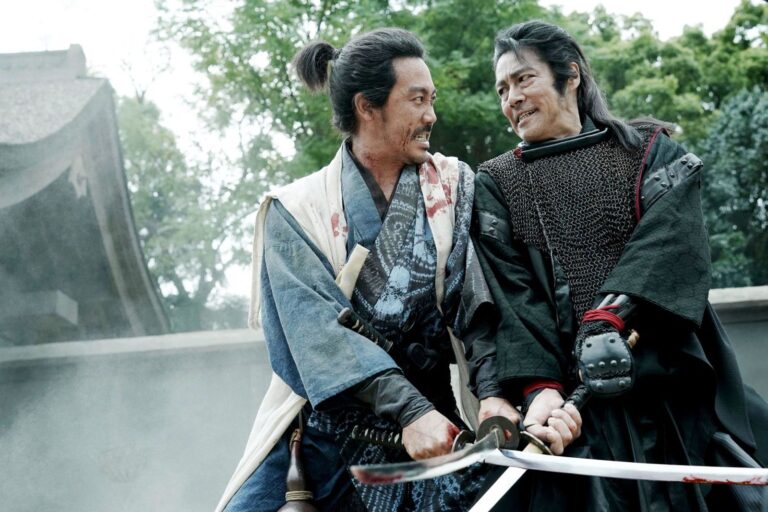
Set in 1461 near Kyoto, Samurai Fury (Muromachi Outsiders) shows the struggle of those times without any kind of embellishment, actually quite the contrary. The great number of villages around Kyoto ruined by plague and famine become since the very first scene a dark, realistic theater for the characters to inhabit. Here we have the epic and thrilling duel between the two ronin Honekawa Doken (Shin’ichi Tsutsumi) and Hasuda Hyoe (Yô Ôizumi): the first one has been named head of security of the Kyoto Shogun, while the other has been instructed by Doken to wander the area and discover who wants to raise a rebellion against the rulers.
While doing this, Hyoe decides to bring with him the young and wild-tempered Saizo (Kento Nagao), because he has decided the boy can be trained to become a skilled samurai. The reason Hyoe wants to try to avoid the conflict is that he cares for the common people and their primal necessities, but the situation is getting worse and worse, and the clash between poor and rich seems inevitable…
 @Courtesy of NYAFF
Since the very first sequences of Samurai Fury (Muromachi Outsiders) you can tell Yu Irie knows really well the rules of Japanese period drama: the settings are magnificent (even when harsh) to watch, and the characters represent the quest for righteousness and honor of the classics. But the director also uses the camera movement and the editing to make his movie something more contemporary. Some action sequences respond to the known style of such a genre. In other moments on the other hand we can experience a different and exhilarating vision, like for example during the scene of Saizo’s training with the twenty swords.
That single moment in the movie is something visually both elegant and powerful, which elevates the aesthetic of the entire product. Another fun moment of Samurai Fury (Muromachi Outsiders) is when the director pays his personal homage to “Spaghetti Western” inserting a jingle that is clearly inspired from Ennio Morricone’s legendary scores for A Fistful of Dollars (1964) directed by Sergio Leone. Which makes total sense, because that masterpiece was an unofficial remake of Yojimbo (1961) by Akira Kurosawa.
The best part of Samurai Fury (Muromachi Outsiders) is the last ten, fifteen minutes, after the glamorous showdown is over and the love/hate relationship between Hyoe and Doken must come to an end. Here the characters, good or bad, show their inner soul in a scene of recognition that becomes utterly moving. As a period drama based on true events, the work of Yu Irie is surely entertaining and provides the right amount of depth in the main characters in order to feel for them.
Rate: B
If you liked the review, share your thoughts below.
Check out more of Adriano’s articles.
Here’s the trailer for Samurai Fury (Muromachi Outsiders):