

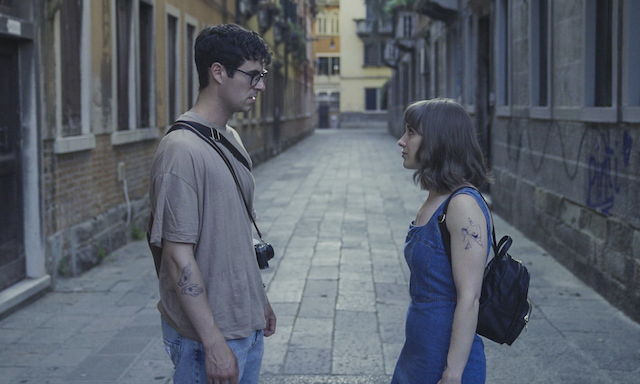
There are some fantastical, romanticized love stories that burn fast and bright. There are other love stories, notably the new dramedy Nate and Moriah in Venice, that are instead textured and imperfect.
Nate and Moriah in Venice follows Nate (Michael Ridley), a failed filmmaker as he hunts for inspiration. Moriah (Corrinne Mica) is an aspiring influencer who’s focused on her mental health. In order to find the peace they’re boh longing for, they take a spontaneous day trip to Venice. But as their day meanders through long, winding corridors and canals, past tensions and betrayals begin to resurface.
The movie emphasizes its intimate and observational nature with its small crew of four filmmakers. Ridley and Mica were the only actors who joined them in front of the camera. Principal photography lasted just ten days in the streets of the eponymous Italian city.
Nate and Moriah in Venice explores the changing nature of interpersonal relationships in modern hyper-connected society. Those interaction between the two titular protagonists emphasize the altered versions of themselves that they present to the world. As a result, the duo’s arc delves into the difficulty many couples face when their perfectly crafted image is built on an unsteady foundation.
Ridley and Mica’s effortless chemistry as Nate and Moriah is palpable but never overplayed. There’s a restraint to their interactions that makes their emotional connection realistic and relatable. The performers therefore bring Balke’s writing, which is driven by both honesty and a sense of whimsical humor, to the screen.
Throughout the dramedy, Ridley delivers a quietly compelling performance as Nate, whose career masks a deep personal stagnation. The actor brings a soulful vulnerability to the character.
Mica’s performance is equally compelling. The actress plays Moriah as a woman shaped by ambition, solitude and the fear of becoming emotionally vulnerable again. The performer emphasizes how the character is grappling with the success she’s achieved and the emotional price she paid to get there. Overall, when their characters spend the day in Venus, the actors emphasize the struggle of accepting who they were and who they’ve become.
As a filmmaker, Balke thrives in infusing Nate and Moriah’s quiet moment with unspoken looks, unfinished conversations and long silences that say more than words. The movie’s strength lies in the filmmaker’s restraint in resolving the past with a grand gesture. Instead, the two protagonists lean into the emotional complexity of an ambiguous future.
Balke worked with the movie’s cinematographer, Francis Dillon, to capture Venice in an honest, more lived-in way. The duo used the city’s golden light, fogged windows and endless bridges as metaphors for connection, separation and the spaces people try to cross in order to reclaim their love.
The filmmakers present the eponymous city’s authenticity in every frame, from shadowed alleys to water-stained walls. Those shots mirror the fragility of Nate and Moriah’s human connection. Dillon’s use of natural light and long, deliberate takes adds to the dramedy’s contemplative mood.
Balke and Dillon use Venice’s faded grandeur to mirror the characters’ emotional landscape. The film lingers inside such locations as candlelit cafés to create an atmosphere thick with memory and longing.
With Nate and Moriah in Venice, Balke crafted a tender, emotionally intelligent dramedy that ponders whether love deserves a second chance. The protagonists also question if time and memory can ever align again to make it possible.
Balke’s movie is as much about atmosphere as it is about romance. The film is a slow-burning exploration of what happens when two people, who once meant everything to each other, collide again after they try to forget their painful experiences.
As Moriah tells Nate in one scene in the movie, “We only ever saw each other clearly when we stopped trying to.” Nate and Moriah in Venice is a meditative, emotionally layered feature that explores that idea. Balke’s filmmaking, and Mica and Riley’s performances, also explore how regret and the complicated nature of timing ultimately dictates how textured and imperfect love can become.
Nate and Moriah in Venice played at last month’s Rhode Island International Film Festival. The screening at the Providence-based festival will be followed by a screening at the Glendale International Film Festival in Los Angeles on Saturday, September 27.
Overall: B+
If you like the review, share your thoughts below!