
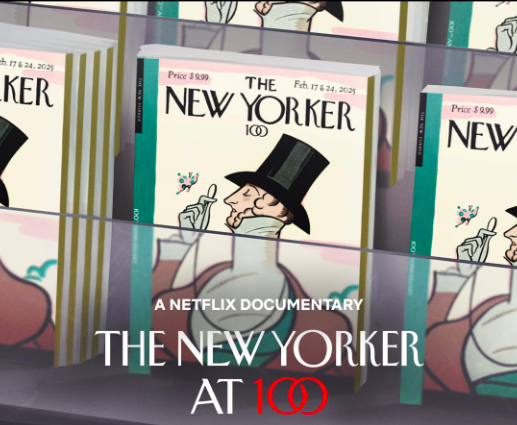
The Netflix documentary directed and produced by Academy Award-winning Marshall Curry, allows unprecedented access into The New Yorker’s newsroom while retracing its history that began at the beginning of the previous century.
The New Yorker At 100 premiered at the 52nd Telluride Film Festival and it features interviews with the former and current team of the prestigious magazine, blending them with old footage, as the narration is voiced out by Julianne Moore.
The readers of this media have always been associated to an erudite crowd. Still today, The New Yorker’s mission remains committed to the deontological values of journalism, providing accurate information and adhering to ethical codes.

The New Yorker saw the light of day during the roaring twenties, when the jazz age in the City That Never Sleeps was populated by financiers, flappers and speakeasies. Harold Ross and Jane Grant, founded it at the Algonquin Hotel in 1925. Ross remained the editor until his death in 1951, shaping the magazine’s editorial tone and its famously meticulous fact-checking department. The emblem for those first years was the dandy character that made its first appearance on the very first cover: Eustace Tilley, a caricature of Alfred d’Orsay.
Throughout its entire history and various editors, The New Yorker has thrived in being a model of intrepid journalism, characterised by the presence of ingeniously satirical cartoons. The New Yorker At 100 explains how the years following World War II, transformed the magazine. The government banned showing images of children suffering and at that time John Hersey’s essay Hiroshima filled an entire issue. It is still remembered as a revolutionary piece of non fiction, utilising the fictional style. When that issue was released Albert Einstein requested a thousand copies, it was read on radio broadcasts and was the talk of town. At this point in history, The New Yorker shifted from a whimsical read to a platform of serious journalism. Some defined it as an institution as iconic as The Statue of Liberty.
The New Yorker became a voice for the voiceless, under the creed of its writers who claimed: “we cannot shape reality, we can only reflect it.” This is very well represented by the article James Baldwin wrote during the time of the emergence of the Civil Rights Movement, that changed the conversation on the question of race. This was happening when William Shawn was at the helm and was nicknamed the “Iron Mouse” for the way he included stories that confronted the powerful.
When the magazine was acquired in 1985 by Advance Publications — the media company owned by Samuel Irving Newhouse Jr — morphed again its identity. Robert Gottlieb was at the helm, until the arrival of Tina Brown in 1992 who came from Vanity Fair. The New Yorker — that would punctiliously check its umlauts and diaeresis — started to confront the clashes between past and present, with the introduction of flashy parties and glamorous photoshoots with Richard Avedon. Tina Brown allowed young mothers to be hired at the magazine and wanted to “make the serious sexy and the sexy serious,” but was overwhelmed by the criticism which led her to quit and embark on a new media project with Harvey Weinstein. No one could foresee that the very magazine she had abandoned would later allow Ronan Farrow to complete his investigative reportage against the American film producer and convicted sex offender.

Once Tina Brown left The New Yorker in haste, a new editor-in-chief was to be appointed. The choice fell on the in-house journalist and editor who had also won a Pulitzer Prize: David Remnick who is still leading the magazine today.
The highbrow reputation of this media platform has enabled the publication of short stories by many of the most respected writers and thinkers of the 20th and 21st centuries, including Truman Capote, Vladimir Nabokov, Rachel Carson and Dorothy Parker to mention a few. Whatever topic was covered by The New Yorker, the best writer in the discussed field would be summoned, from film critic Pauline Kael to chef Anthony Bourdain. Each one would show great care towards their area of expertise. For instance, Richard Brody in the documentary, reiterates the importance of reviewing films conscientiously, because “it takes 2 years to make a film, 2 hours to watch it and 2 minutes to demolish it.”
Throughout its centenary life, The New Yorker has been celebrated in pop culture: in animated series such as Family Guy, live action ones like Sex and the City and Mad Men, and an incommensurable number of films. The most blatant homage is Wes Anderson’s The French Dispatch, where Bill Murray’s character is shaped to emulate Harold Ross.
Marshall Curry — who won the 2020 Academy Award for Best Live Action Short Film with his drama The Neighbors’ Window — returns to his documentarian origins to etch in reel the intellectual heritage sown by The New Yorker. A truly exemplary legacy to behold.
Final Grade: B+
Photos credits: Courtesy of Netflix