

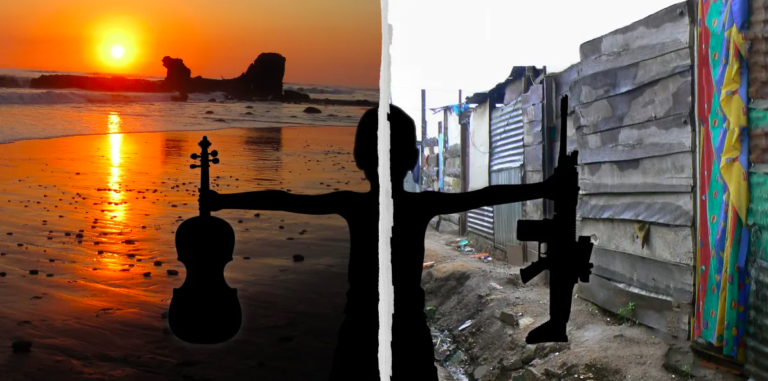
Simon & Garfunkel sung “Hello, darkness, my old friend, I’ve come to talk with you again, Because a vision softly creeping, Left its seeds while I was sleeping, And the vision that was planted in my brain, Still remains, Within the sound of silence.” This was the first verse of their famous song The Sound of Silence, where this paradoxical symbolism denounces how silence can grow like a cancer in society. This idea very well relates with the documentary The Sound of Hope, that shows how keeping crime hushed can be detrimental. On the other hand, music can become the elixir to survive in a corrupted and deathly society like the one in El Salvador.
The film, directed by Emanuele Michetti, highlights a groundbreaking initiative in El Salvador aimed at reducing gang violence through classical music education. The pygmalion-narrators of this initiative, called El Sistema, are diplomat Mauricio Mena, Music teacher Renato Portillo and MusAid Director Kevin Shaffter. This trio of adults is championing music as a redemption tool, to prevent youngsters to give into the pressure of joining gangs in the country or being forced to flee to the US to avoid this misfortunate destiny.
The social problem of this nation is described in statistics: an average of 15 people are killed in El Salvador every day. The homicide rate in the country has plummeted drastically since 2015. The crackdown has also resulted in El Salvador having the highest incarceration rate in the world, at 1,086 people per 100,000 in 2023. That same year an estimated 1.6% of El Salvador’s population was incarcerated.
El Sistema arrived in El Salvador, after the programme with the same name had been fruitfully established in Venezuela, as a social intervention that would offer educational opportunities in another Latin American country plagued by gang violence. This initiative has given positive results, since a report showed a 34% reduction in violence among participating youth.
The children who are students benefitting from the programme express — during the film’s interviews — their enthusiasm in being sheltered by this musical initiative. Thus, the unorthodox weapon to fight against crime becomes classical music education. Maurice Ravel’s Bolero or Gershwin’s Rhapsody in Blue, are just a few of the classical pieces that will draw audiences in this enthralling asylum that protects new generations from an wretched future of corruption.
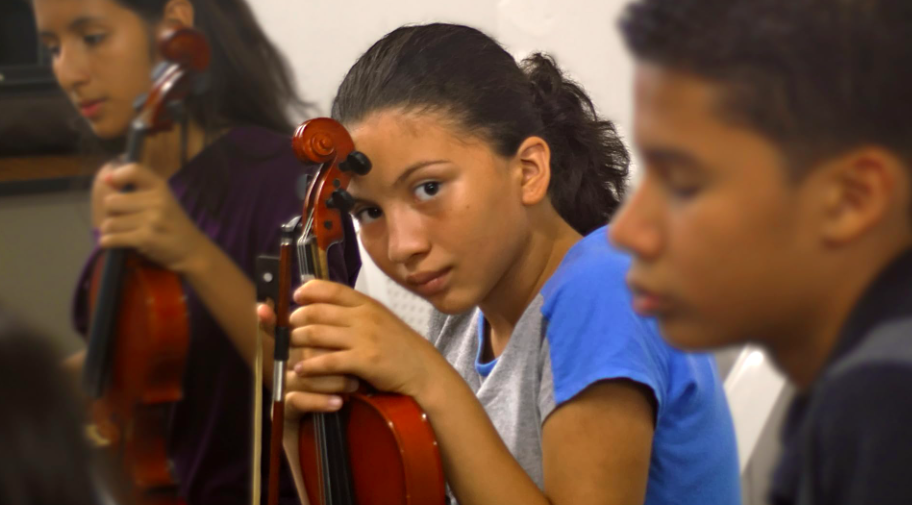
The film director was struck by the way a country with the potential of El Salvador could be annihilated by the gang crackdown. In his own words he expressed: “I saw how violence eclipses the beauty of this country, which is surrounded by stunning landscapes and is mostly populated by generous and harmless citizens.” The silver lining in this desolate scenario is how forging the new generations through music can contrast this ghastly phenomenon.
The Sound of Hope focuses on the personal stories of both the students and the teachers who are part of El Sistema in El Salvador. The documentary serves as a testament to the extraordinary work propelled by an underrepresented community, but also as a dissemination tool to promote this programme, so that more young students may embrace art to break the cycle of poverty and crime. This intent goes full circle with the first words of the film that we see on the screen, that quote the great music conductor Claudio Abbado: “We should not teach music to children with the purpose of making them great musicians, but rather so that they learn to listen and, as a result, to be heard.”
Final Grade: B+
Photos credits: IMDb