
@Courtesy of Peacock
Press Conference With Actor Domhnall Gleeson and Creators Greg Daniels and Michael Koman
Q: You helped shape The Office and now you’re returning with The Paper. What inspired you to turn the camera on a struggling local newsroom and why did this feel like the right story to tell now?
Greg Daniels: It was a long journey. There were a lot of people saying, “You’ve got to do more out of this world,” and I was always very reluctant to water down the show while it was happening. The Office has been off the air for quite a long time. They’re super supportive of this, it isn’t going to hurt the original show at this point. So I had this early idea, the connection being paper, since they sold paper (Dunder Mifflin). At each stage, it felt more and more interesting and viable. When I had the opportunity to pitch it to Michael, whose work I loved and respected, he started to respond that maybe this is a good idea.
Q: How did you go about researching and developing your character? Did you talk to journalists to get a feel for their daily routines?
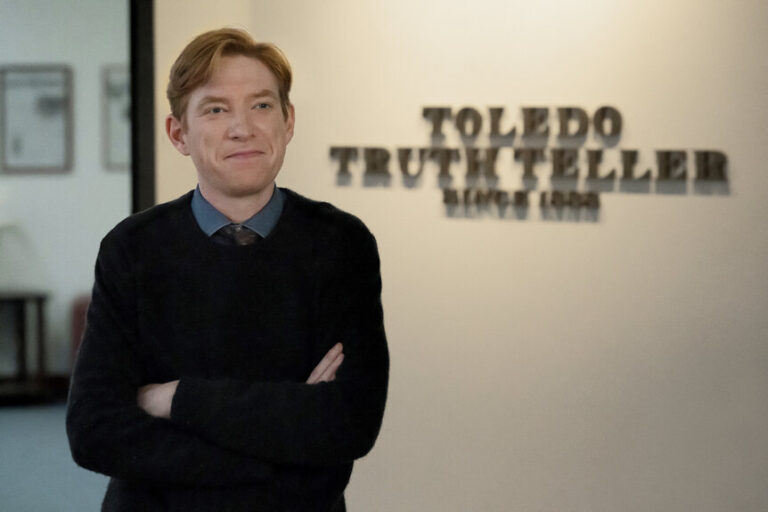
Domhnall Gleeson: I did. It was more for my own head than for anything that was hugely useful in the show. I went to Ohio because I hadn’t been around that part of the country before. I went to Cincinnati, Columbus, Toledo, and chatted to loads of journalists from different newspapers, about what being a journalist and being an editor is like these days.
Greg Daniels: I have my personal experiences—high school and college newspaper— and observing my kids do the newspaper at their schools. I also worked for the Voice of America, as a young person. I did pieces into the tape recorder and plugged them into a phone with alligator clips and everything. There’s still, fortunately, a lot of papers around the country that you can read online and get a sense of their individual personalities.
Q: In which way is this like an ode to the press? Did you have a relationship that you felt you had to give an homage to the media?
Domhnall Gleeson: I’ve always understood the importance of journalism. Maybe I’ve not always understood what it takes to do it well, but always had a huge amount of respect for this profession. I’ve always been quite romantic about it. Speaking truth to power is incredibly important
Greg Daniels: Sure. People have a huge reservoir of positive feelings about the great newspaper stories of the past and hopefully that will inspire a renewal or more interest. But even if it doesn’t have an effect on journalism, it’s good for inspiring emotions in the viewer of a TV show.
Michael Koman: Those sentiments that Ned expresses, I think those are the characters’ sentiments. He does feel a deep connection to the history of journalism and he sees it as almost like a way of life. He’d love to put himself in those black and white pictures that people put over their desks of a busy newsroom. I certainly share his sentiments. I just absolutely do romanticize a certain kind of idea of the press.
Greg Daniels: I have a high school-aged daughter who works on her school newspaper. It’s so inspiring to see the school newspaper take on subjects at the school, their passionate belief that by exposing things they can change things, the joy in expressing themselves well in the copy. They’re learning all the basics and I just think that’s something to be encouraged and an exciting thing.
Q: The Paper dives into the struggles of a small newsroom. Did working on it make you think differently about your own relationship to news? Is there a local newspaper that you read?
Domhnall Gleeson: I subscribe to three newspapers in Dublin. I live very close to the center of Dublin, the reason local newspapers are so important is to pay attention to the places that are not at the center of the news all the time. A lot of Irish journalism is based around Dublin. They do a good job of paying attention to the whole country, but there are more local newspapers in the suburbs of Dublin or outside in County Dublin, as opposed to the city. Anywhere you go, reading the local newspaper is always super-interesting.
Q: The documentary camera style feels like a character itself. Did that change the way you performed?
Domhnall Gleeson: Definitely. Everybody knows the tropes that go along with it that the original show in the UK and US set. More sitcoms then did that. You’re aware of that, but then making it feel real, making it work for these characters in these environments was the new challenge. It definitely makes you behave differently because you’re being observed. It’s not just one person observing you, it’s you being aware that you’re being recorded.
Q: Comedy and mockumentary works because it feels so real. How did you approach shaping The Paper’s tone? Keeping it funny but also grounded in something audiences can recognize in their own lives?
Michael Koman: One of the very helpful things about doing something in a documentary style is that you’re already committed to naturalism and people behaving the way they would in real life.
Greg Daniels: The mockumentary shooting style has been used on a lot of shows. When you do something in the same world you should be as rigorous as The Office is. So it’s not a stylistic thing, it’s not like The Bernie Mac Show where he just addresses the camera. You have to be incredibly specific that there’s a person with a video camera in the room or shooting through a window. The characters are aware of that.
 @Courtesy of Peacock
Q: About the mockumentary format, did you enjoy watching those shows yourself and why do you think audiences love it so much in general?
Domhnall Gleeson: I don’t know why audiences love it so much in general. I just know that the UK Office, the US Office, Parks and Rec they’re great comedies. If there wasn’t a camera in the room, those would still be wonderful stories because of the relationships between the characters. I also love all the Christopher Guest films. Love all those, the feeling of the camera being in the room with them. They’re actually all really good comedies even if they weren’t mockumentary. The scripts are great, the improv in the Christopher Guest movies is great and the story foundations are super-solid. Then you get good performers, and that elevates everything.
Q: The cast mixes big names with fresh faces. How did you balance that dynamic?
Michael Koman: There wasn’t a conscious decision. We cast people that we thought were great. They’re trying to figure out, is this new editor in chief for real? Is he gonna do it? Sometimes his optimism isn’t truthful, but we needed a person who could be very much a leader and capable of taking beaten-down office workers and inspiring them to turn themselves into citizen journalists. But also somebody who was super-funny. You want somebody who can project both idealism and be a goofball at the same time.
Q: Going back to your trip to the Midwest, what did you learn from the people and visiting the newsrooms? Did you get to see the whole printing press? Is there anything that you picked up that really inspired you and your role?
Domhnall Gleeson: I didn’t go to the printing press because now they send it away, there’ll be one printing press somewhere else in the state where all of the papers send their stuff to get printed. It is not the way it used to be. I found out you have earlier and earlier deadlines during the day because it’s further away now, you have to send it away earlier in the day. There’s this huge pressure to try to be up-to-date. And that’s why the online news is just such a different beast. It’s a whole different version of journalism in terms of what’s happening right now. The younger people I met with, they got into an industry that they’re being told is dying. And they’re still committing to it hard, they’re putting their life, their hopes, their dreams, their financial future in it. That was absolutely amazing.
Q: This show actually is about how work enriches your life. How does your work enrich your life?
Domhnall Gleeson: I didn’t want to be an actor necessarily. I fell into it and I was very lucky to fall into it. I’m a way better person than I would have been. The people I’ve met through acting, the things I’ve had to think about, the situations I’ve had to think about, the people who I’ve had to put myself in the shoes of to try to imagine what their motivation is, I think has made me a more empathetic person. I’ve been very lucky to keep working, it has just made my life so much richer.
 @Courtesy of Peacock
Q: What are the upsides and the downsides of using the mockumentary format compared to a regular sitcom? And why do you think audiences and also show creators love it so much?
Greg Daniels: There’s something about the amount of scripted content that’s available at all times. I feel like it’s more inspirational to be taking your cues from something out in real life. What’s great about this format for comedy is that it allows for a casualness to the making of the show in terms of lighting and all of the nuts and bolts. We’re constantly going, “Oh, the boom’s in the shot. Whatever. Boom’s in the shot.” And so we don’t slow down for that. For every hour of time on set, at least 45 minutes is acting. It changes everything about the procedure because you’re not under a time gun so much. If somebody has an idea, you’re like, “Yeah, try it. You know, we’ve got time for that. Try it.” We shoot a lot more than we could ever possibly use. When we get in the editing room, we have a lot of choices and that makes it also feel more real because real documentaries are like that. They always have hundreds of hours of footage to try and build something out of it.
Michael Koman: When you have a really good cast, it’s nice that this is just a different performance than they would give in other projects because it’s happening in real life. You just get to see a different side of performers.
Greg Daniels: For smart actors, they like that there’s an extra layer. They can do what traditional acting is, which is to relate to the person in the scene. But then they also have this back of their head: if they want, they can look at the camera and relate to the imagined future viewers of the documentary.
Q: What makes Ned, your character, a good journalist?
Domhnall Gleeson: He’s aspirational. He aspires to what he thinks the newspaper is going to be, and then you show the reality of what it actually is. The difference between those two things is where the comedy lies. It’s a subtly complicated part because he always has to seem hopeful, but there has to be enough about him to keep a crackle in the room. The possibility of failure at every point. Keeping those two things alive was where you’re trying to keep the comedy.
Q: How political did you allow yourself to become with this show?
Greg Daniels: Our aim is not to be specifically political because it takes a long time to make these shows. We were writing this a year ago and we’re not attempting to be like a late-night talk show.
Michael Koman: I do think that this style of show is really geared toward character comedy. The way politics should figure into it would have to be through a character wanting to explore that. I don’t think that really happened in the first season, they’re just learning how to be journalists.
Greg Daniels: Character comedies are great. That’s the genre I’ve spent my career in. They have something to say about everything that happens in the world without having to know what it’s going to be because it’s about human beings. And The Paper is about an optimistic human being.
Michael Koman: It’s important for the world to find its way into the show, always, for something to feel like, “Yes, that’s the world I live in too. And it feels that way.” So I really just think it’s our job to continue to do that.
If you like the interview, share your thoughts below!
Check out more of Adriano’s articles.
Here’s the trailer for The Paper: