


©Courtesy of IFC Films
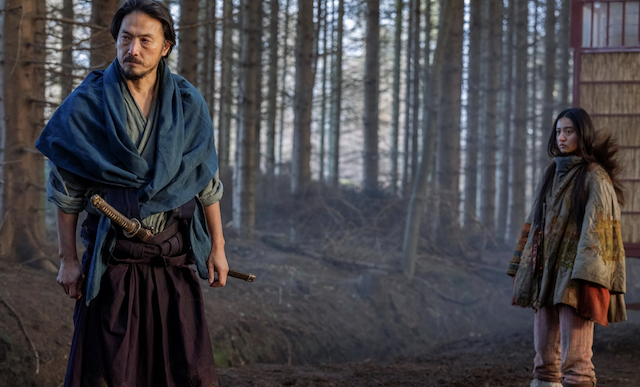
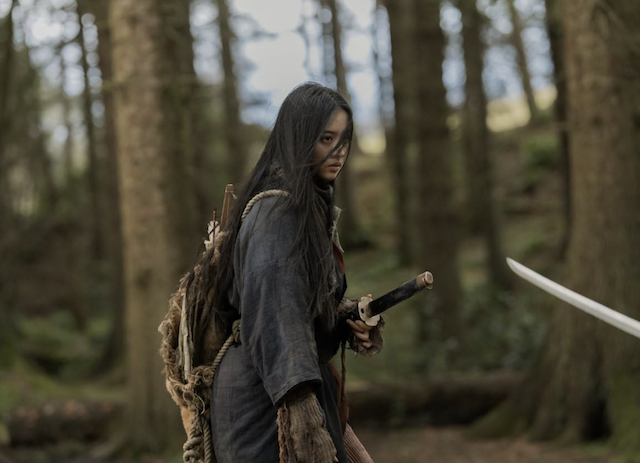
Touring has always been hard on performers, but it is particularly tough for “Tornado” traveling through the 1790s Scottish Highlands. She and her exiled Samurai father stage Japanese-themed Punch-and-Judy-like puppet shows that incorporate real-life martial arts demonstrations. Unfortunately, she will need all the combat skills her father taught her to avoid getting killed like an archetypal “Judy” by a gang of cutthroats in John Maclean’s Tornado, which opens Friday in theaters.
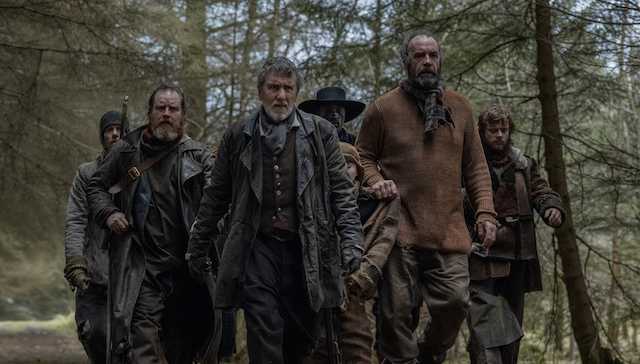
As Tornado and her father Fujin finish their final puppet show before moving on for the winter, a nameless mute boy steals the gold Sugarman’s gang looted from a church. Rather ill-advisedly, Tornado lets him stowaway aboard their creaky wagon. Despite the henchmen’s negligence, the gang’s cunning leader, Sugarman, quickly connects the dots to the boy and the Japanese puppeteers.
The film starts with Sugarman and company in full pursuit of Tornado and the boy. Maclean then flashes back, showing us their earlier encounters with Fujin and his daughter. What unfolds could be described as a story of ronin versus highwaymen (a much grittier and far more serious conflict than any prior Samurai “vs.” mash-up).
©Courtesy of IFC Films
In fact, Maclean conceived Tornado as a sort of British-Scottish Western, in which Sugarman’s highwaymen operate much like the Hole-in-the-Wall Gang. In many ways, it serves as a close thematic companion to his previous film, Slow West, from “way back” in 2015. Maclean unleashes the action against a backdrop of wide-open spaces, which does not allow Tornado many hiding places. However, Sugarman’s unhesitating willingness to chase her into a stately (but admittedly somewhat ill-kept) manor house, in defiance of the era’s rigid class-consciousness, offers the setting for a tense cat-and-mouse game.
Regardless, Tornado admittedly boils down to a chase film, but somehow it never feels repetitive or formulaic. Partly, it is because Sugarman is such a great villain—and a perfect role for Tim Roth (returning to the kind of sword-wielding historical villainy that earned him an Oscar nomination for Rob Roy). In this case, Sugarman’s greater age and accumulated bitterness arguably make him unusually human (and surprisingly sad), as measured against typical movie bad guys.
Yet, Kôki (a.k.a. the musician-model Mitsuki Kimura) consistently holds her own opposite Roth, as the quietly rebellious title character. She is also a genuine force during her action scenes. While Takehiro Hira has comparatively less screen time as her father, Fujin, his performance truly embodies the bushido spirit and his complicated paternal chemistry with Tornado really gives the film its poignant heft.
©Courtesy of IFC Films
Maclean’s film also boasts a wealth of supporting villains, nearly of all whom have their own unique persona and distinctive look, notably including Jack Morris, Rory McCann, and Dennis Okwera (whose characters have colorful names like Squid Lips, Kitten, and Psycho). Jack Lowden might even be more sinister than Roth portraying his duplicitous and unstable son, Little Sugar. On the other hand, Joanne Whaley (now longer “Kilmer”) contributes dignified gravitas as Crawford, a sort of den mother to a traveling circus that finds itself caught in the crossfire, during her brief but resonant appearances.
Plus, the puppets credited to “Mattes and Miniatures” are strikingly cinematic in their own right. Considering the artistry of lead puppeteer-coordinator Colin Purves and puppeteers Kim Bergsagel and Symon Macintyre, viewers can understand how Sugarman’s gang lost sight of the loot—even if he is not so forgiving.
Maclean’s narrative is admittedly simple and straightforward, but brutally effective. In its own way, it is a revisionist Western for the United Kingdom, deconstructing the romantic image of the highwaymen and other supposedly picaresque bandits. The resulting film captures a time when the moors and highlands were wild like the American frontier. Yet, it is defined and elevated by the Fujin’s fatalistic honor and Tornado’s sense of filial duty. Altogether, it is quite a potent brew. Highly recommended for fans of both the Western and Chanbara genres. Tornado opens this Friday (5/30) in theaters.
©Courtesy of IFC Films
Grade: A
If you like the review, share your thoughts below!
Check out more of Joe’s articles.
Here’s the trailer for the film.