


© RYUYA SUZUKI
Jinsei : 無名の人生 「Mumei no Jinsei」(Japanese Title)
Release Date: May 16th, 2025 in Japan
Duration: 93 mins
Director: Ryuya Suzuki
Writer: Ryuya Suzuki (Screenplay/Original Creator),
Starring: ACE COOL (Protagonist), Ayumu Nakajima (Kuzu), Eri Kamataki (Yoko), Kanji Tsuda (Shiratori), Katsuya Maiguma (Yamato), Shohei Uno (Hiroshi)
Animation Production: A-1 Pictures
“Jinsei” : This is the debut feature film from independent director Ryuya Suzuki, who worked for a year and a half to create it. His roles also included animation director, art director, compositing director of photography, character designer, editor, and music composer. This was produced by Kenji Iwaisawa, an indie animation director responsible for “ON-GAKU: Our Sound.”
© RYUYA SUZUKI
Exclusive Interview with Editor/Writer/Director Ryuya Suzuki
Q : This anime had a profound impact on me. I saw this anime as one of the top three anime I saw this year. I was as astonished just like the movie ‘Flow’, which earned the Academy Award this year. After you graduated from an art university, you initially had aspirations of becoming a live-action film director, but at one point, you worked as a bar manager to support yourself. What motivated you to begin creating short animated films before making this feature?
Ryuya Suzuki : During my time at that bar, the Covid pandemic hit the world, and restaurants had to shut down. At that time, the bar had iPads for electronic payments, so I took one home without asking. I downloaded an app called Procreate, which I also used for this project, and started creating something (an animated short film) on a whim. Since then, I have been fully absorbed in the process and have been doing it continuously.
Q: After completing the short films ‘MAHOROBA’ and ‘Lawless Love,’ how did you develop the concept for your most recent film, ‘Jinsei’? I understood that you made it at home, but how did it progress to a feature-length film? From what I understand, it was a very time-consuming process, could you provide us with a brief description of it?
Ryuya Suzuki: Initially, I produced two short films. Initially, I was a film lover who preferred live-action movies, so when it came to movies, I naturally considered feature-length films. Until then, I had worked as a bar manager and made anime as a hobby. However, I wanted to dedicate my entire life to filmmaking, so I quit my job and launched crowdfunding.
The production itself was completed in a year and a half, but this was the case even during the short film era. However, I did not prepare storyboards or scripts in advance. I opted to write each scene on the spot as I went along, which I found to be an exciting artistic process, so I carried on with that approach. I followed that process.
Q: When creating with no script, like in storyboards, how do you flesh out the characters to convey the acting to the voice actors? What was your method for getting the voice actors to vocalize and imagine their roles?
Ryuya Suzuki : Since the character lacks facial expressions, we had a meeting, but I only suggested looking closely at the artwork and its description. The actors naturally portrayed their roles with a slightly subdued feel, which was appropriate for the roles. Up to that point, I had never voiced anyone in short films in a studio before, so I was curious how it would go. Upon entering the voice acting studio, I realized a significant distinction, and I guess I had the correct answer in my head all along.
Q: The concept of being given different nicknames throughout life seemed to be a setting that would capture every moment while also being easy to structure, which made me think of it as a very intriguing idea. What was the motivation behind this?
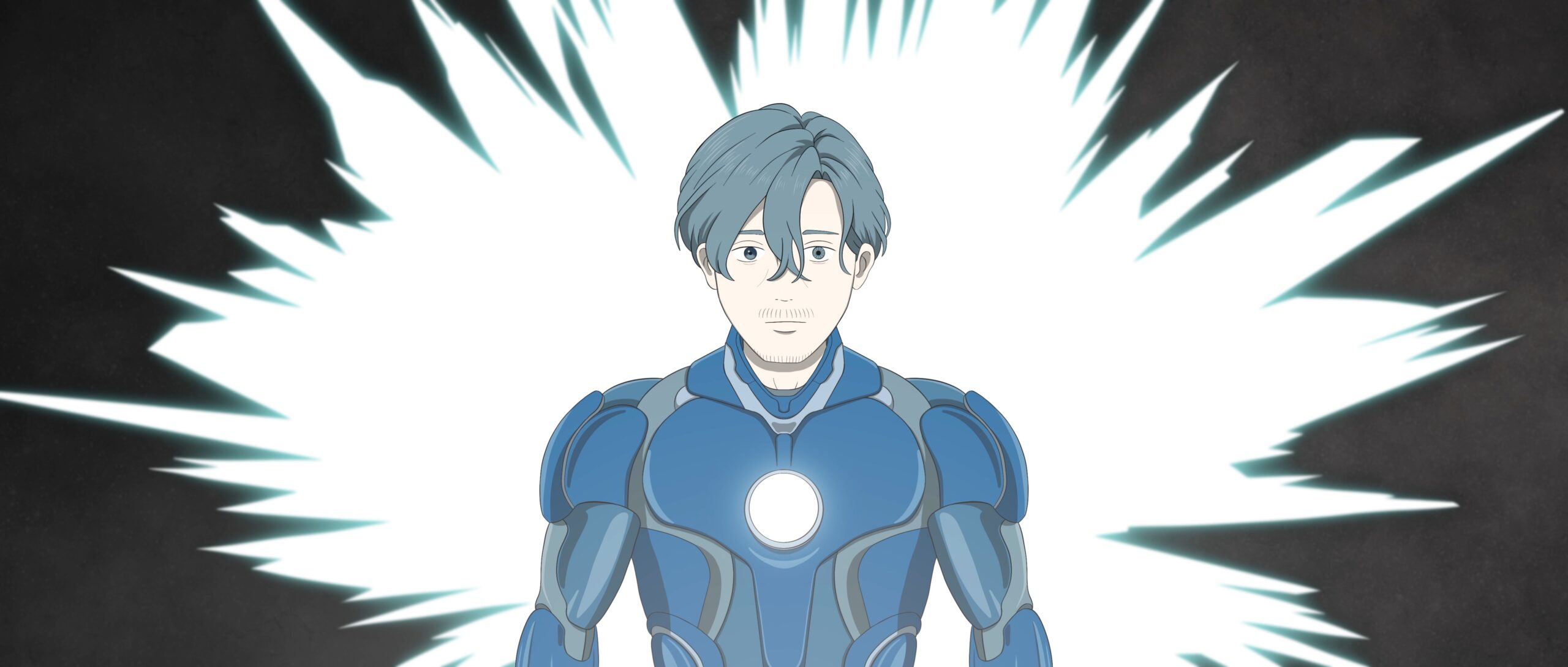
Ryuya Suzuki: I initially intended to talk about names, but instead of discussing the content, I had a rough idea of a 10-chapter structure and decided to connect them like a short film. I began with the titles of every chapter, in fact, I’ve had nicknames since I was a child. During my time at the bar, I was known as ‘Master’. I believed that nicknames and names are like labels that fit you, and that could be a fitting theme for a movie being produced in this day and age, and that many people may relate to that theme. I believed that the protagonist’s nickname (nickname) would influence their personality, and I wanted to create it myself, and that’s how it came to be.
© RYUYA SUZUKI
Q: From the start, the car’s background is almost silent until the movie title appears and the story begins. I find this idea very intriguing. Although the story doesn’t have any dialogue, I think it’s a challenge to come up with images that can be comprehended simply by examining them, and it’s also a challenge to make the audience comprehend it. Where did the inspiration for this idea come from?
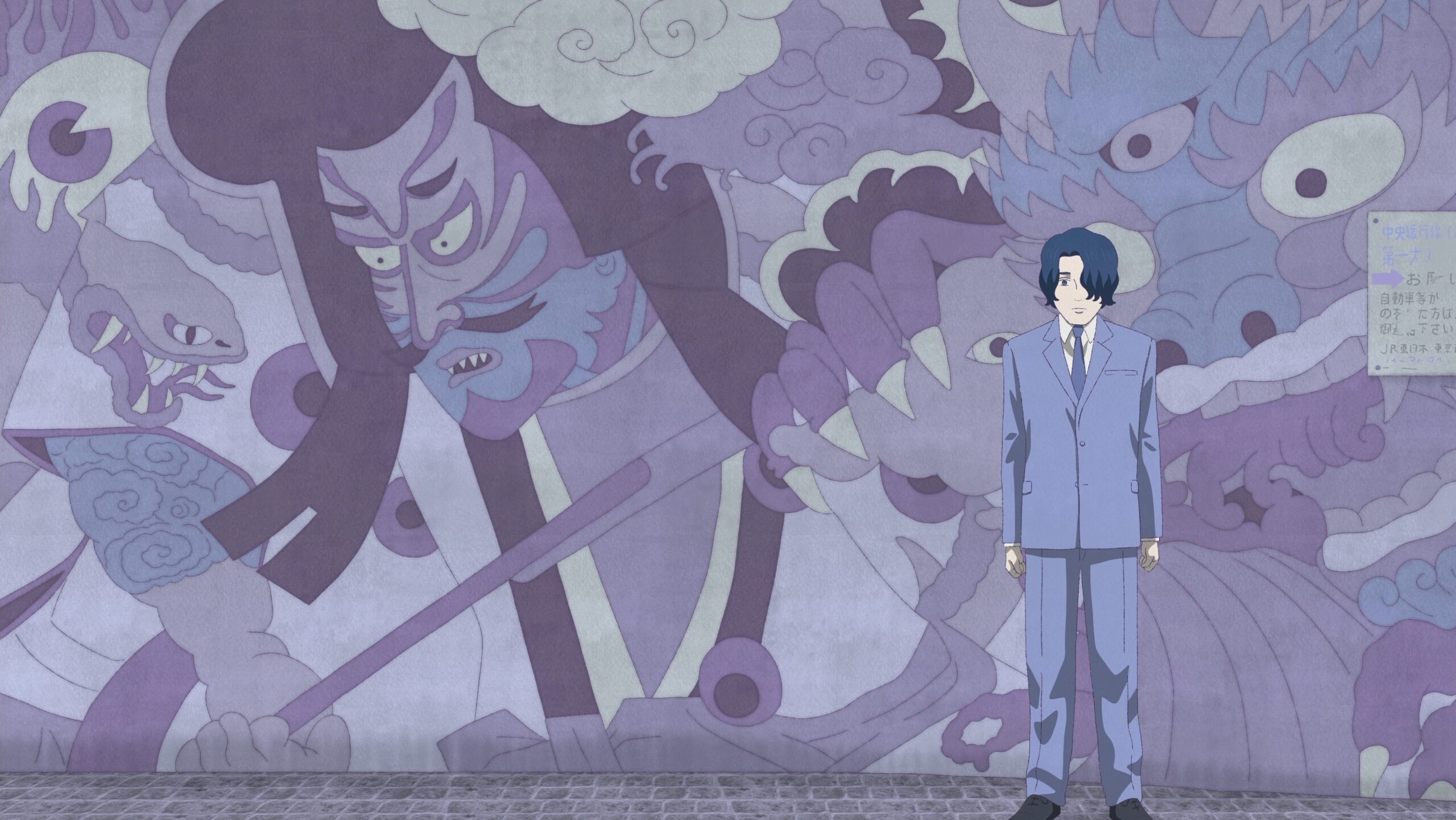
Ryuya Suzuki: I’m pleased that you brought that up. Ultimately, when it comes to this work, I took everything and turned it on its head. Considering that I have only been making anime for about five years, and most of the anime that is currently popular in Japan is technically outstanding, with smooth and fluid animation. I determined that despite the images not moving much, I would concentrate on keeping a sense of tension and suspense through the direction.
Despite the lack of significant movement in the opening sequence, the background still moves. Through portraying the movie’s overall movement, I was able to create a direction that even someone like me, with limited technical expertise, was capable of.
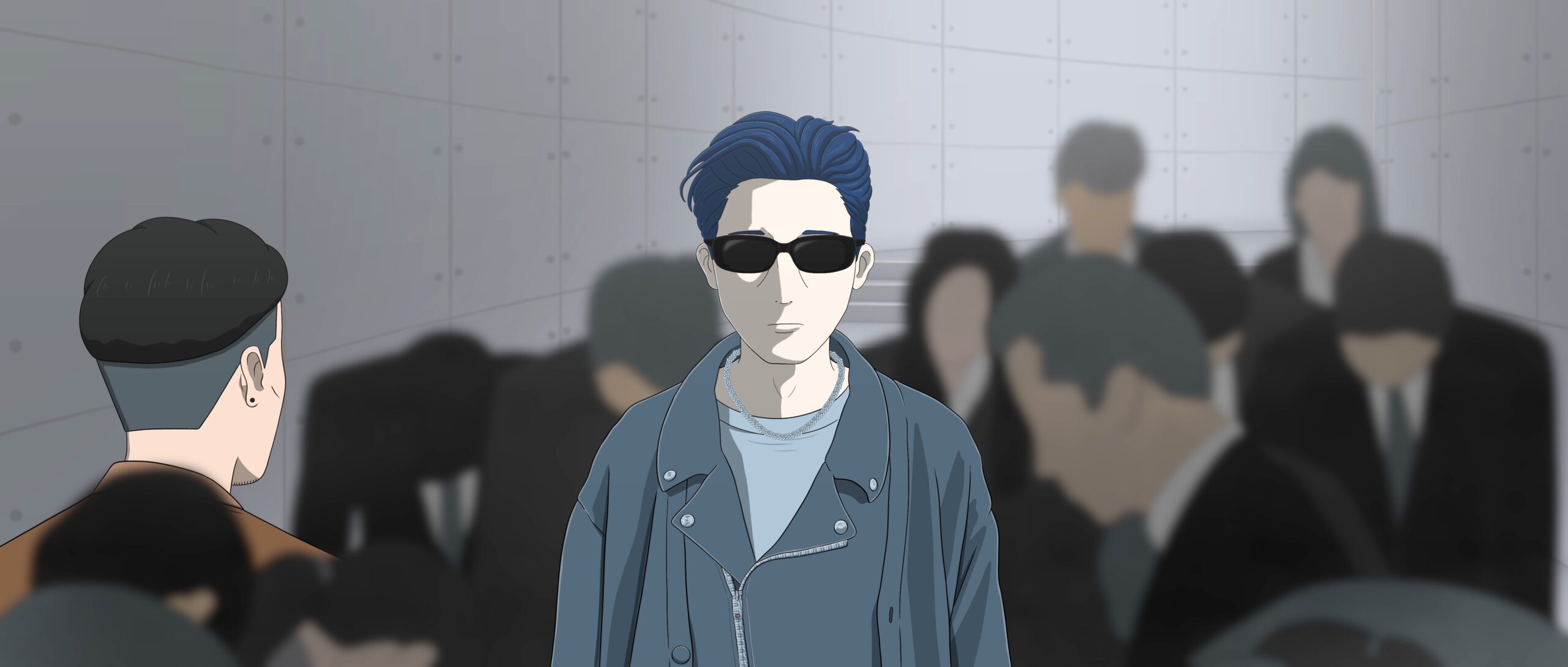
Q : The protagonist of this work, Se-chan, has a limited vocabulary and reflects the transformation of a man who is difficult to comprehend. Can you share with us the process of casting ACE COOL, a leading rapper from Japan, as the voice actor for this role? The casting idea is intriguing, and the fact that he is not a typical voice actor adds a particular flavor that I like.
Ryuya Suzuki: At first, I had the idea to ask a regular actor, but I didn’t want someone who had expertise or experience as a voice actor. I desired someone who was unique, someone who felt out of place.
I was pondering what to do while listening to an album and had a hunch that asking a rapper to play a role without any lines might be a good idea. I had the thought that it would create a good chemical reaction, so I asked him(ACE COOL) spontaneously.
Q : I believed that rappers possess some improvisational skills, and I pondered whether they also possess a quick-thinking ability. What was their performance like on the recording room?
Ryuya Suzuki: In truth, he is a quiet, polite, and kind like older brother. When we initially got to know each other, we talked about our shared love for Takeshi Kitano’s movies.
Q: What kind of movies do you like? Among Kitano’s works…
Ryuya Suzuki: Violent movies from the 80s and 90s…
Q: Like “Violent Cop” or “Sonatine”?
Ryuya Suzuki: The scene where Se-Chan and Kin-Chan first meet in this film is a tribute to Kitano’s ‘Brother.’ My own work is also influenced by the thought of how Kitano’s films would be animated.
I used their low number of lines and limited movement as a reference point. At a later time, the actor (ACE COOL) recalled having imagined Kitano’s film ‘Brother’ while playing the role.
Q: Mr. Suzuki, you are involved in more than just drawing. You are also involved in music and editing. What led you to become so passionate about music and editing? What motivates your desire to be a part of these processes as well as drawing?
Ryusei Suzuki: I believe that the timing of animation, editing, and music is where my individuality shines through, and therefore I was attentive to the rhythm and tempo of the work. During my work, I would think, “This scene is a bit long” or, “Let’s move this part along quickly.” Although it’s inevitable that I work alone, I made a conscious decision to be meticulous in every detail to create a work that is my own.
© RYUYA SUZUKI
Q: You are from Tohoku region, right? The early part of the movie is set in Sendai. Are there parts that faithfully recreate real places?
Ryuya Suzuki: While working on this work, I returned to my parents’ house in Sendai and shut myself in to work on it. As the background for the elementary school and junior high school scenes, I mostly utilized local scenery. Due to the lack of backgrounds from my house, I would walk about five minutes away from my house and observe the scenery as it was.
Q: What kind of places actually exist in reality?
Ryuya Suzuki: First, there was the apartment complex and the Sendai Mediatheque building, which served as the audition venue. I also searched around the rooftop parking lot of Sendai Station and used those locations as backgrounds. I also went to Kabukicho once and used photos I took there.
Q: In the movie, the protagonist aims to become an idol like his father. Did you research any reference materials or actual idols when depicting the process of forming a male idol group?
Ryuya Suzuki: I’ve always been a big fan of TV, and I think I was pretty knowledgeable about celebrities, so even without doing any research, I felt like I had a general idea about idols. So when it came to the group Zenroku that appears in the movie, I tried to create my ideal team, with a youngest member, an older brother character, and so on, incorporating a lot of real-life and ideal elements. Of course, I also drew a lot of inspiration from the idols of the former Johnny’s agency.
Q: In the movie, there is a great line where Kin-chan, the protagonist Se-chan’s friend, says to Se-chan’s father (who is not his real father), “Blood is just a liquid, no different from Pocari Sweat!(popular soft drink in Japan)” Every word spoken by the protagonist Se-chan feels very meaningful, but since there are few lines like that, was there anything you were conscious of when directing the voice actors during the recording?
Ryusei Suzuki: I think that by condensing the lines myself, the intensity of each line increased significantly. I carefully selected the lines until the very end, making sure not to include any unnecessary ones. I think the lines were the most difficult part. The actors also picked up on that, and they delivered each line with care, so surprisingly, there was a sense of understanding without much back-and-forth, and everyone seemed to get it.
So, during the voice recording sessions, there wasn’t much need to emphasize things strongly, but everyone was really fun to work with. Tsuda-san, who played the Shiratori, was perfect from the start, and Nakajima-san, who played the Kuzu, even added some playful touches on his own. ACE-san and Ohashi-san, who were also new to this, approached it with a “let’s create this together” attitude, so I feel like we were able to explore various performance styles.
Q: I thought the ending song would be sung by ACE COOL, but why did you decide to use an idol song in the end? That song was written and composed by you, right?
Ryuya Suzuki: Yes, that’s right. I really like how sometimes in sophisticated Japanese commercial films, even though the content is completely dark, the music has a completely different tone. I also like how Thai art films sometimes play J-Pop-style music at the end. I’m a little proud that this film is not simply a cheerful work, so I wanted to confuse the audience a little more, and that’s why I created such a silly song with that kind of tone.
Q: I think your individuality really shines through in your lyrics and compositions, which is wonderful. Earlier, you mentioned that you were influenced by Takeshi Kitano’s work. Are there any American films that have influenced you?
Ryuya Suzuki: When I was in high school, I was really into gangster movies, I like director Scorsese and actors like Al Pacino and Robert De Niro. I also like Woody Allen’s films and American comic book movies, so I feel like I really grew up on American cinema. But I think the film that really influenced me the most was “Taxi Driver.”
Q: Would you say that your work is influenced by films from the 1970s?
Ryuya Suzuki: I think that’s when I started to like a slightly darker style of filmmaking.
Q: This is my last question. Your film was screened at the New York Asian Film Festival and has also been recognized at the Annecy Film Festival. What aspects of your film would you like American audiences to focus on?
Ryuya Suzuki: Since I made it with Japanese audiences in mind, I guess I’d like them to laugh a lot. I want them to see that there are other kinds of anime out there, that Japan isn’t just about Hayao Miyazaki. I hope they’ll lower their expectations a bit.
If you like the interview, share your thoughts below!
Check out more of Nobuhiro’s articles.
Here’s the trailer of the film.