

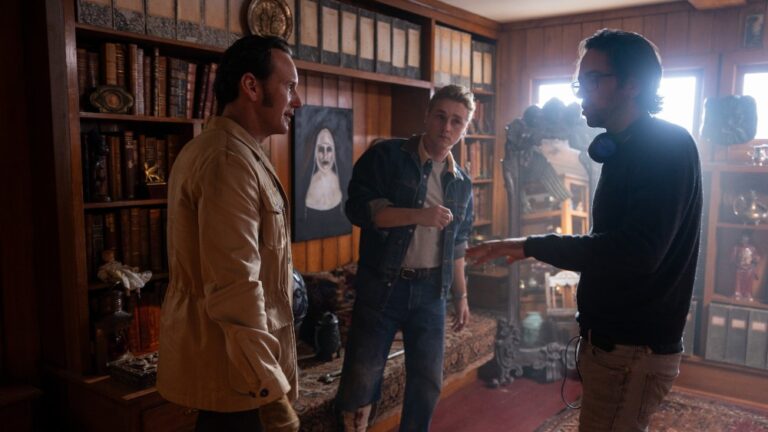
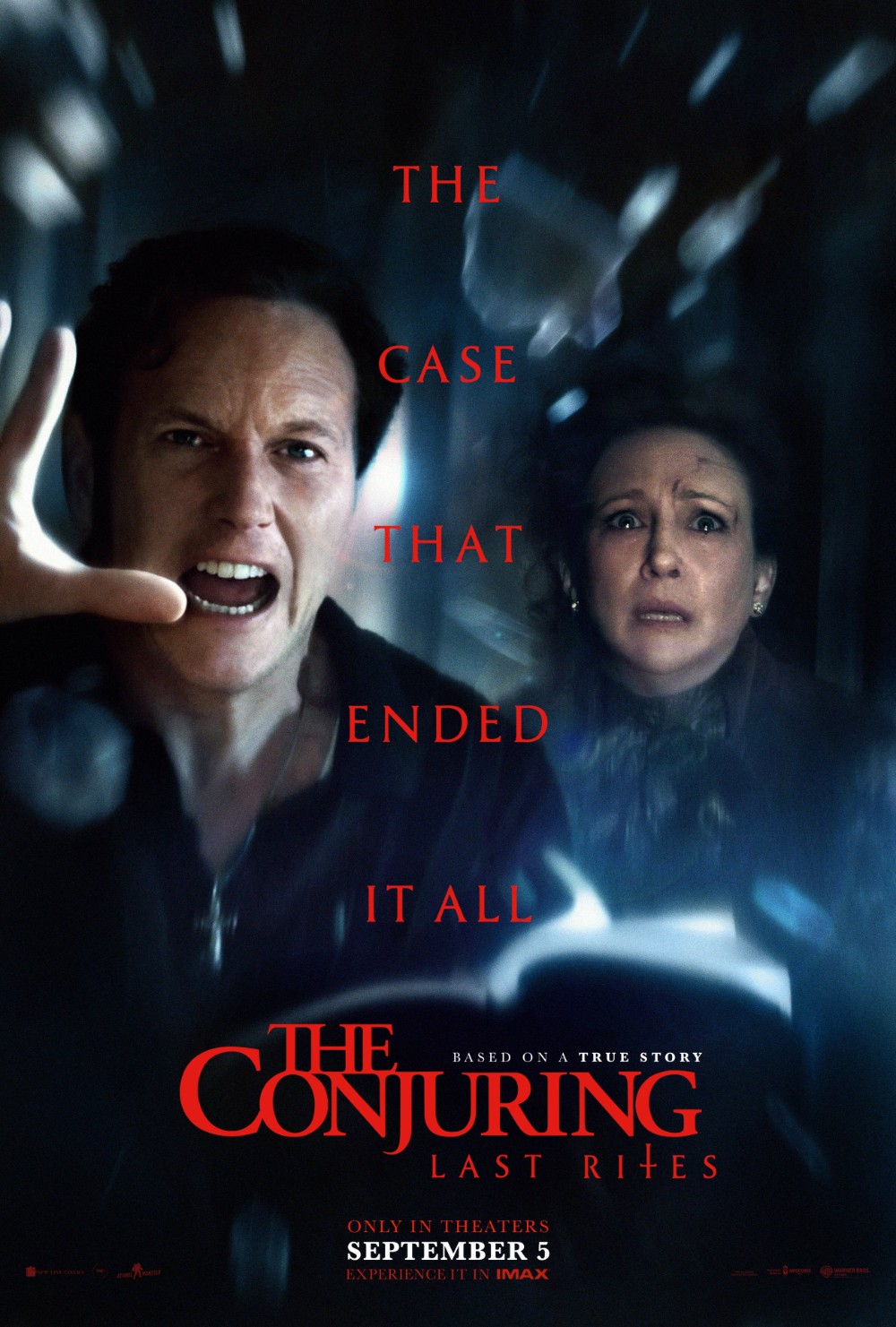
Director Michael Chaves and producer James Wan have now worked together on three (official) movies in “The Conjuring” franchise, beginning with 2021’s The Conjuring: The Devil Made Me Do It, then continuing with Chaves directing the spin-off sequel The Nun II in 2023. Now, they’re reuniting with Patrick Wilson and Vera Farmiga for The Conjuring: Last Rites, which is being set-up as a send-off for Wilson and Farmiga’s real-life supernatural experts, Ed and Lorraine Warren.
This fourth movie in the main franchise – not including the spin-offs and the Chaves’ earlier-directed The Curse of La Llorona – is centered around the real-life Smerl Haunting in Pennsylvania, where a family is haunted by spirits associated with a lavish mirror brought into their home. This installment also includes the Warrens’ daughter, Judy, played by Mia Tomlinson, who is now graduated from college and dating Tony (Ben Hardy), who wants to pop the question.
Chaves has upped his game for this super-scary and surprisingly emotional final journey with the Warrens. Recently,Cinema Daily US had a chance to take part in a couple virtual roundtable interviews for the movie with Chaves and Wan, who directed the first two movies.
[Note: The following interviews have been edited for length and clarity.]
Q: Did you feel any pressure knowing you were helming the end game of “The Conjuring” universe with this movie? What was that like for you, and what lessons did you take from the previous movies you directed?
Michael Chaves: Obviously, a lot of pressure. This is a series I love so much and the fans love so much. I think that the biggest thing with it is, ultimately, this is a journey we’ve been on with Ed and Lorraine Warren and trying to tell a final chapter to their family story. So much of the experience of the movie is that we’re saying goodbye to Ed and Lorraine, to Patrick and Vera. We’re saying goodbye to this incredible series that we’ve been a part of for 12 years. I was there with all of you guys when I saw that first one and just fell in love with this series and fell in love with those characters and the world. It is hard to say goodbye, and I think that’s always hard when you’re kind of coming to these final chapter movies. That’s really why we leaned into the story of parents and children, and just their relationship with Judy as they’re saying goodbye to their daughter and giving her away. It felt like a great metaphor and a great parallel that they’re going on this journey of saying goodbye to her and saying goodbye to the Warrens. It just felt like that was the through line we leaned into.
Q: The Smerl Haunting case is very famous and well-documented. It was obviously sensationalized in media, including a terrifying made-for-TV movie. That has to be challenging for you to approach it where you give the touchstones of familiarity, but really surprise audiences when it comes to the scares. So what was your approach to the horror side of it?
Chaves: With the Smerl case, we actually worked with the Smerl sisters. They came on early, as we were developing the script into pre-production through production, and there was a movie called The Haunted based on a book. That was actually James’s introduction to the Warrens, and that was actually a movie that [the Smerls] really didn’t like; they had a lot of issues with it. I was like, “What can I do in telling your story?” And they said, “Don’t make that movie again.” They just didn’t feel like it was true to their story, and they felt it didn’t listen to what they experienced. That was the big thing with this. In every way possible, we really tried to ground it in their experience and based on things that they had gone through. That really fueled so much of the story. Obviously, we’re also telling the Warrens’ story, but also, the mirror was real. It just was not in the Smerl house. That was another case of [the Warrens], and if you stay to the very end, that mirror is real. We kind of had to weave that in and then weave in the Warren story, so it was a juggling act of all those things.
Q: I wanted to ask about all these great little character moments like the Warren cookout. Can you talk about getting this extra creative time to focus on these other character moments?
Chaves: I’m so glad you liked that. We actually had some people in our test screenings who said, “I am the biggest horror fan ever, but my favorite scene was Ed’s birthday party.” We were a little nervous going into our first screening, because that felt likea very long period of time, and when you watch a movie before you share it with an audience, you don’t have a good perspective. You’re like, “Are we spending too much time here? Are people are gonna wanna get into a scare, wanna get into something else?” I thinkwhat’s so great about it is that people love spending time with these characters. The more time you spend with these people, the more you get scared later on, because you’ve made an emotional investment. That actually does contribute to the impact of scares later on. I was expecting that we were gonna have to cut that [cookout] up or cut away from it. I’m really glad that it worked as well as it did, because it actually is a big chunk of the movie, and I think it’s a tribute to the actors. Honestly, everyone in there is so watchable that you could just keep on watching them.
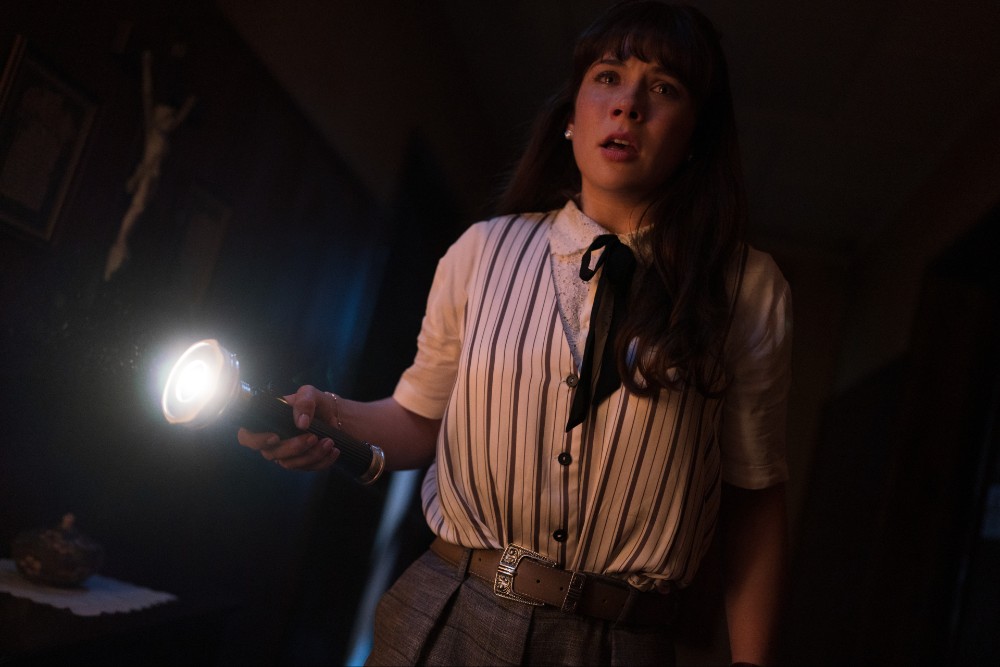
Q: You have two new members of your cast in Mia Tomlinson and Ben Hardy, so what was it like to guide them into the world of the Warrens and The Conjuring?
Chaves: Those actors are so amazing, and I think with both of them, it was such a great opportunity for us to see the world of the Warrens through a different lens. And with Judy, we’re seeing it in this, the perspective of like, what’s it like to be the daughter of the heroes? What’s it like to be the daughter of the superstars? Like, what’s it like to kind of grow up where you have demons coming in and out of the house and these like demonic entities and all this stuff. And like, what baggage does that give someone? And then what is the price that you have to pay later on? So that felt like a great opportunity with that character. Mia did a great job with her incredible vulnerability and nuance in that. With Ben, I thought Tony is such a great way of just bringing in a fresh pair of eyes. I think that one of the things with any series when you’re around this long is – to get [a little] inside baseball – it’s dangerous to get to a place where you’re so deep in the weeds that you don’t have anyone who can give you a fresh perspective. Tony was a blessing and a gift to be able to have someone who comes in and says, “Why do you have a room filled with demonic antiques? Is that normal? Is that like what’s going on with that?” And to be able to kind of get reintroduced into these things that fans have accepted as being normal. But again, we had a lot of test screenings, we showed it to a lot of people. I think there were actually people who’ve never seen a “Conjuring” movie. I know it sounds impossible, but we had them come in and it was amazing ’cause when they would see the movie, they were like, “Oh, I totally got it.” I think Tony was the one that had guided them through and helped them understand the movie, so they were great, and those actors are just awesome. I think they’re incredible additions to that world, and they really held their own against Patrick and Vera.
Q: This being the tenth Conjuring movie and third you directed yourself, how do you find new ways to scare people?
Chaves: it’s tricky. We actually had a limited number of ways, and then, we just used them all up on this one. It’s always a trick, because the “Conjuring” movies also have a certain language and a certain style. I think there is something in the scares that is very playful, I think by its nature. The DNA of the movie goes back to the clap game [in The Conjuring]. I think thatwith everything in the series, it is rooted in that sense of play and that these entities and these darker forces are trying to kind of lure us in with games and they’re luring us in with toys, like Annabelle being a doll. It’s always when you’re doing the scares,you’re always trying to push the boundaries a little bit. There’s obviously a lot more blood in this movie than there was in previous “Conjuring” movies. I think there’s also a part of the language of that. So much of the first film is rooted in the horror movies of the ’70s, like The Changeling and The Exorcist. And obviously, we wanted a return to that and keeping that DNA. But I also wanted a little bit of the flavor of the ’80s. We actually shot on C-series anamorphic lenses, these great vintage lenses that they used on Poltergeist and on Alien. Even the “bloody sink,” which was a bit of an ode to The Shining and Nightmare on Elm Street. These movies are always referencing other horror movies of the period that they live in. That was always the basis for how we built these scares. I really do think this is why it’s the last one. We ran out of scares.
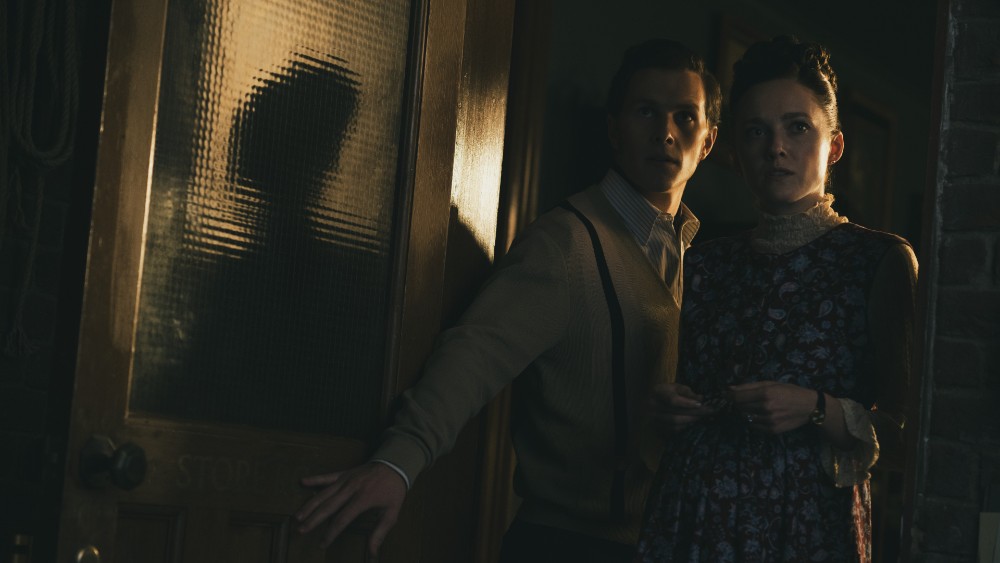
Q: You might be aware of all the supernatural weirdness surrounding the making of the original The Exorcist movie, so now that you’re making your third movie in The Conjuring series, have you experienced any of these sorts of things yourself?
Chaves: I did, and it was like it waited for this last movie.That is the question that you always get in these junkets: ”Did anything spooky happen on the set?” I think on La Llorona,I might’ve lied one time and I was like, “Oh yeah, there was some weird noises on the set.” I had no idea what I was doing. It’s my first movie, and I’m trying to shamelessly promote it, but nothing had ever happened until this film. I swear to God, and I was a skeptic up into this film.
Okay, so we’re shooting in London and I’m staying in this beautiful old house called the Old Vicarage – this place is like 200-plus years old, and it’s where the vicars would stay, which are like English priests. I didn’t know what a vicar was until I went to England, and so, [it’s this] beautiful old house. And my daughter says she’s seen things in the house, and she actually shows me a picture she took on her iPad of the hallway, and there’s a mirror at the end… obviously a weird parallel, since we have mirrors in our movie. It’s kind of a shadowy and grainy iPad picture, and she’s like, “Look right there, you see that guy?” And I’m like, “Sweetie, I don’t see him.” “He’s dressed in black. He’s right in the corner there.” And I’m like, “I don’t see it. I think you’re imagination’s getting away from you,” and I totally disregard it. She’s absolutely convinced that there’s something in that picture, and I don’t think anything of it.
One night the family is away–they’re in London and they’re going to see a show– and I’m just exhausted. I’m playing video games at home, it’s night, and I start to hear voices. I hit mute and it sounds like there’s voices outside talking, so I turn off the TV and I turn off the lights and I’m like looking out the windows. I’m like, “Is someone out there? Is someone on the property?” And then I listen, and it sounds like it’s coming from in the house, and I move through the house, like, “Is somebody in here?” I don’t know if they’re outside or somebody came in or what’s going on. It’s two guys talking, and I go through every room in the house and I cannot find it. By the end of it, I am convinced the house is haunted, and I’m convinced my daughter saw something there. By the end of it, I was relieved ‘cause I was like, “At least it’s not a home invasion.” Cause that would really scare me. I mean, I can live with ghosts but there’s some guys in my house, I don’t know what I’m going to do with that. But honestly, that totally made me into a convert. It was that and actually just working with the Smerls, hearing their story and their experience with it. It’s impossible to listen to their stories, all four of them, and not believe. I’m totally a believer after making this movie, and that is the God’s honest truth. I apologize to whatever journalists I lied to. [laughs]
Q: Despite this being the last Conjuring film, the universe isn’t necessarily closed. Is there anything more you’d want to do with this universe?
Chaves: I love this series. I would keep on making “Conjuring” movies – they had to pull me away from it. I’m so glad I’m not the one who made the decision that this would be the last one, ’cause if it was up to me, I would just keep on making “Conjuring” movies until the day I died. This really was designed to be a final chapter, and I think in terms of spinoffs, there’s always that the door is open, but I thinkthis was something that James, [Producer] Peter [Safran], and the studio really had the incredible confidence and wherewithal to say, “We’re gonna tell a final chapter. We’re gonna bring it to a close while on our own terms.” I am so glad that they made that decision, ’cause I would have kept on just dragging them around until they’re in their 90s.
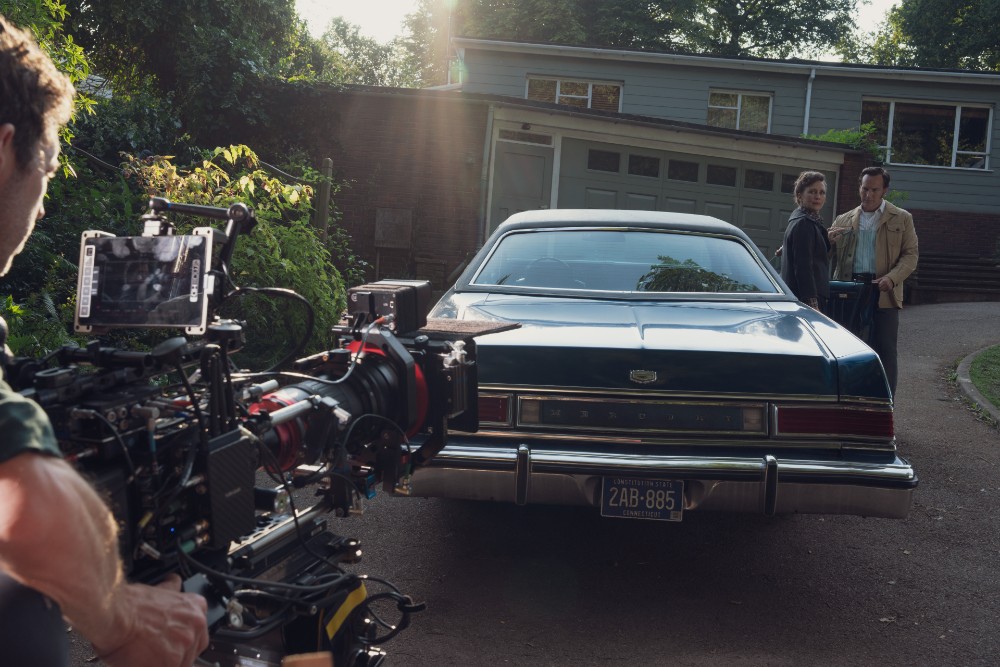
Next, you can read a few questions with James Wan, who directed the first two Conjurings, and has remained on for the rest of the franchise as a producer, including multiple Annabelle and The Nun movies, as well as Last Rites, said to be the last of the movies featuring the Warrens.
Q: Having directed the very first The Conjuring back in 2012, how do you feel about where this whole thing has gone with all these spin-offs adding to the universe, from where this whole thing started to where it is now?
James Wan: I feel like I’ve been doing this for a while now. I feel like I’ve been passing the baton to like two generations after me already. In terms of the actual franchise, I think that was part of the fun, I guess, with creating the overall world. For me, just shaping what I wanted the world to feel like, to be like. At some point, I just felt like I don’t really want to be directing every single one of these movies. And so, it’s a great opportunity to find an up-and-coming filmmaker, and give them the chance to play in this world. And so it’s been great, and that’s pretty much what I’ve been doing now for nearly the last 10 years.
Q: Why was now the best time to say goodbye to Warrens, and why make Last Rites as their finale?
Wan: That’s a good question. I think collectively, all of us, from the filmmakers, the studio and the actors and the cast, we feel like we want to go out on a high. we don’t want to be doing this, 20 movies down the line where we’ve driven the franchise into the ground. We love the idea that we’re going out with a big bang, whilst everyone’s still living the world, living the movies and living the characters. It just feels right. We’ve been doing this for over 10-12 years, and I think it’s nice to just take a big break from it. Yes, I think that’s more the case to want to go out on a high, whilst we’re still on top, so to speak. As for why this particular case? It’s actually pretty personal for me. The TV-movie that came out in the early ’90s, called The Haunted, starring Sally Kirkland, was the movie that introduced me to Ed and Lorraine Warren. And it just felt full circle for me to when I come back and use this particular case, the Smerl case, as the story to be the last one.
Q: Can you talk about your creative role as the film was shooting and your experiences on set working with Michael and providing any feedback to help his experience?
Wan: I mean, talk about statement-ship, right? I produced Michael’s very first movie with La Llorona, and at Atomic Monster, we’ve made four films with him. He’s actually technically made more movies in the Conjuring universe than I have, so he knows the world very well. The best thing about working with Michael is literally watching him grow, and I’ve seen him grow with each subsequent film, from the first one to the second movie to his third movie to this final one, and he’s truly improved with each film that he’s made. We’re all super proud of Michael, and I think he’s done a terrific job, and I’ve seen him put emphasis on the right thing with each movie. Obviously, he’s come to learn that what makes the Conjuring film, especially the Conjuring mothership movie so special, is basically Ed and Lorraine, it is Patrick and Vera, right? And so, he’s really focused his energy on those guys. The scares and the horror, obviously, are still very important for us, for the fans and all that, but he’s focusing on the right thing, and we all feel very good about this film.
Q: When it came to the emphasis and direction for the “Conjuring” franchise and this closing chapter, besides Ed and Lorraine, what else would need to be prioritized with the was it the sentimentality of the horror factor, Judy?
Wan: Obviously, it’s a horror movie at the end of the day, and so the scares were important for us. The horror aspect was important for us, just because it is what people love to a big degree. This is the fourth movie and the ninth or tenth in the Conjuring universe, so it was important for us to try and find sort of new flavor within the horror, and that can get tricky. Mike was definitely in, and I kind of helped Mike to try and find flavors and just different smelling scares, if you will. [chuckles] Ultimately, we felt the right thing to do with this last one was doing justice to sending the Warrens off, saying goodbye to Ed and Lorraine and saying goodbye to Vera and Patrick as well. We wanted to make sure we captured the emotionality of the family dynamic, which is why bringing the daughter, Judy, and her boyfriend/husband, Tony Spera into the fold was so important and crucial to wrap up the story for us, because the emotion and the love that fans have for this cinematic family is very important for us, and we just wanted to make sure we did justice to that.
Q: Having spent time with Lorraine herself, how concerned were you about switching some of the things that happened when people can easily Google stuff to learn the truth? For instance, Judy was actually born in 1945, so she would have been in her 40s by the time the Warrens investigated the Smerl case, and she wasn’t directly involved. Is it hard making these changes when people like Judy and Tony are still alive?
Wan: Yeah, I mean, it’s definitely one of the touchstones with making The Conjuring films, especially the mothership of The Conjuring and not so much the spin-offs, we want to try and be as close to the real thing as we can, especially the cases that each individual movie is based on. We want the audience to be able to watch the movie and then go, “Oh, that’s crazy. Let me Google this and then find out that it’s somewhat true,” right? That it’s Google-able. That’s kind of a term that we try to stick to that, that we want elements that we can research, and we say that these movies are quote-unquote “based on true lives.” So we definitely want to be as true to that as we can, but obviously, we are making entertainment, and we do take liberties, as we all know. At the very least, we want the spirit to be as close to the real people and the real world as close as we can.
Q: Mia did such a fantastic job as Judy, and Judy in real life became a paranormal investigator. Is this, as much as it is a really amazing emotional send-off to Ed and Lorraine, could this be a passing of the torch for the future?
Wan: That’s a very good question, which I have been asked a little bit in terms of the torch passing. I don’t know. I think, like, I guess never say never. The setup and the structure is, it’s inherently there. But in terms of for us right now, I guess we’re just really, at least for me, I’m just really focusing on just kind of putting this last one out there and saying that, this is the last one. I mean, I know there’s been talk outside the system and inside of the possibility of a phase two. But I don’t know. I’m a little bit superstitious and I don’t want to jump the gun. But if there is a phase two, something like that does not seem out of place. Actually, it feels very organic, if you will.
The Conjuring: Last Rites opens nationwide on Friday, September 5, with previews on Thursday. You can also read an interview with Patrick Wilson and Vera Farmiga.
[…] Our interview with Director Michael Chaves and Producer James Wan. […]