

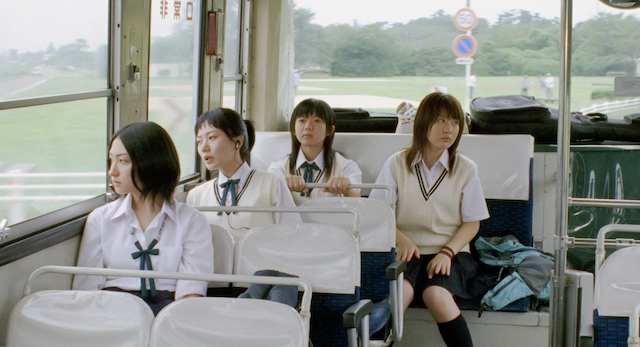
©Courtesy of GKIDS
The coming-of-age film ‘Linda Linda Linda’ has been digitally remastered in 4K to mark its 20th anniversary. GKIDS has secured the U.S. release of the film, which was also shown at this year’s Tribeca Film Festival. In this column, we asked director Nobuhiro Yamashita, who led the project, to reflect on the filming process.
[Linda Linda Linda Synopsis] : This film depicts the struggles of girls who decide to form a cover band of ‘The Blue Hearts’ for their final high school cultural festival. Director Yamashita captured the awkward yet heartfelt renditions of The Blue Hearts’ famous songs and the miraculous chemistry of the young cast in his first 35mm film, creating a youth film representation of the 2000s. Bae Doona (voice / International Student Son), Maeda Aki (drums / Yamada Kyoko), Kashii Yu (guitar / Tachibana Megumi), and Sekine Shiori (bass / Shirakawa Nozomi) are all present in the show.
 Photo by Nobuhiro Hosoki
Exclusive Interview with Director Nobuhiro Yamashita
Q : It has come to my attention that Director Yamashita, you produced films that featured protagonists which you portrayed the main character. And you shot ‘Linda Linda Linda’ around age 28. What was the motivation behind his depiction of high school girls this time? What motivated him to be involved in a project that featured a protagonist who was completely different from his previous ones?
Nobuhiro Yamashita : I’d been making films since my university days. I made about three indie films in Osaka, and in those, I was the protagonist, a character I projected myself onto. Around that time, Tokyo producer Hiroyuki Negishi launched a project about high school girls forming a cover band for The Blue Hearts, and it won an award at a project competition. That project existed first. Mr. Negishi, who had seen my films, approached me saying, “This is completely different from the films you made in the past, but how about doing something like this?” For me, it was both a chance to work on a commercial project and a challenge to broaden my horizons—though I had absolutely no plan at first—and accepting this project was the “start” of this film.
Q : I’ve heard that initially, the plan was to cast Kaela Kimura( a Japanese pop rock singer, lyricist, fashion model and television presenter) as one of the cast, shortly after her debut as a singer. She was just starting out at the time. I thought it might have been interesting to feature her, but casting Ms. Kimura might have risked overshadowing the other characters. What led to the decision to cast another actress instead?
Nobuhiro Yamashita : Her name is credited as a “collaborator.” Basically, everyone except Korea’s Bae Doona was cast through auditions, and Kaela Kimura came to those auditions too. I knew she could sing. We considered whether she could be cast in another role, but since her identity was stronger as a ‘singer’ than as an actress, she didn’t get a part. Instead, we kept her name in the credits as a “collaborator.”
Q : The film’s opening features somewhat rough footage of “high school students filming a video before their cultural festival begins.” I’ve heard Director Yamashita, you don’t do many retakes, but “Linda Linda Linda” starts with retakes. I wondered if filming the opening felt like breaking out of your own shell in a way. What was your intention there?
Nobuhiro Yamashita : That scene is like a self-parody. Essentially, it’s a “scene the director couldn’t decide on.” So the cameraman suggested, “Shouldn’t we do it again?” That’s how I (Director Yamashita) was back then. I was a director who struggled to make decisions, indecisive and unable to commit.

Q : There’s a scene where Yamada, played by Aki Maeda, is filmed in one take during the cultural festival preparations. How much preparation went into that one-shot sequence?
Nobuhiro Yamashita : We’d vaguely decided on that from the location scouting stage.
The cinematographer suggested a plan for the shot to be more frontal and parallel-moving, even though it’s shot from directly side-on. I demanded, ‘Please, shoot it from the side!’ I remember being very particular about that sideways tracking shot during that time.
Q : Did you get it in one take, or maybe two or three? It seems like a pretty demanding scene.
Nobuhiro Yamashita : I think we did it two or three times, but not that many takes.
Q : I hear the reason you cast Ms. Bae Doona stemmed from meeting Director Bong Joon-ho.
Nobuhiro Yamashita : Actually, I met Director Bong Joon-ho at the Morioka Film Festival. At the time, he was a jury member, and I was participating as an entrant in the competition. We met then, and although my film didn’t win an award, he remembered my work. Later, I saw his directorial feature debut film, “Barking Dogs Never Bite,” which starred Bae Doona. Seeing her performance, I thought she was fantastic and offered her the role.
I think she probably consulted Director Bong Joon-ho too. When she told him, “I got an offer from a Japanese director named Yamashita,” he encouraged her, saying, “His films are interesting. Why not do it?” So, it was a casting that came together through a series of coincidences.

Q : Her character being a foreign student and her halting Japanese were also interesting elements.
Nobuhiro Yamashita : Ms. Bae Doona herself was very interested in Japan and already knew a little Japanese. That made things much easier.
Q : One particularly memorable scene was when the karaoke shop employee and Son (played by Ms. Bae) were very particular about their drinks. Was that mostly improvised rather than scripted?
Nobuhiro Yamashita : We didn’t do much because Ms. Bae Doona was in Korea, but we did a lot of rehearsing with the other members and approached filming with thorough preparation. There was minimal improvisation on the set for this project.
However, one thing I remember is the scene where everyone climbs the ladder. There’s a line where Ms. Bae Doona says, “Everyone, your underwear is showing!” That was something we added on set after discussing it with her.
Q : As you probably know, the American band Linda Lindas named themselves after being inspired by this film. Have you actually listened to their music?
Nobuhiro Yamashita : Of course, of course. I bought their CD too.
Q : Have you ever met them in person?
Nobuhiro Yamashita : No, I haven’t met them.
Q : In this film, Masahiro Komoto, the younger brother of Hiroto Komoto who sang the song “Linda Linda,” appears. Is his appearance related to obtaining permission to use his brother’s music?
Nobuhiro Yamashita : Of course, we obtained permission for the song. However, at the time we were filming, the band “The Blue Hearts” had already disbanded. So, I believe we proceeded purely through standard procedures, like paying the song usage fee.
Even now, Hiroto Komoto is active in various bands, but it seems he basically maintains a clear separation from The Blue Hearts. So, our connection to The Blue Hearts was solely about “being allowed to use the song.” We asked Masahiro Komoto to appear purely because we liked him as an actor. That was the main reason.

©Courtesy of GKIDS
Q : What makes this work particularly memorable, I think, is how well it captures the vibrant energy of high school students. What did you focus on in terms of direction, and what did you pay special attention to back then, to vividly portray that unique energy only possible at that age?
Nobuhiro Yamashita : Well, everything was new to us, so as I mentioned earlier, we rehearsed intensively. Looking back, while it certainly helped the girls get into character, I also wanted to absorb and understand their vibe myself. That’s why we rehearsed the same scenes over and over. I think that’s what gave the work its realism. It might seem very improvisational at first glance, but I remember it actually involved tremendous preparation.
Q : Recent films like “It’s a Summer Film” and earlier ones like “Swing Girls” skillfully capture the unique charm only found in student days. Are there any youth films that influenced you personally, Mr. Yamashita?
Nobuhiro Yamashita : I often mention them: Director Shinji Sōmei’s “Typhoon Club,” “Moving Day,” and of course, “Sailor Suit and Machine Gun.” Director Sōmei was in a phase back then where he was making genre films using young actresses, and the protagonists were often women. While the themes differ slightly, I was hugely influenced by his approach and direction. I tried to steal his unique way of capturing the raw, vivid essence of young girls. He’s someone who influenced me. I don’t think I’ve managed to imitate it though (laughs).
Q : After making this film, you’ve directed many movies with female protagonists. Did this film change your perspective or approach as a director?
Nobuhiro Yamashita : Actually, for this film, I initially envisioned an ending where they didn’t get to perform. Like they ran out of time and the cultural festival ended. But the producers opposed it. Watching it again today, I still think the ending is so brilliant that the film simply couldn’t end without them performing.
Back then, in my twenties, I had this urge to subvert straightforward expression, to view things from an oblique angle. Hearing the song “Linda Linda” made me confront a certain directness, a raw, unfiltered feeling. I felt it on set too. Watching them perform, I just thought, “This is good.”
That was where I changed tremendously as a creator. From that point on, what I learned most from this film was the value of straightforward catharsis—the kind of catharsis audiences want to see.

©Courtesy of GKIDS
Q : This film is being screened at the Tribeca Film Festival and will soon be released in the U.S. through distributor GKIDS. What aspects would you like American audiences to focus on?
Nobuhiro Yamashita : It’s a strange film even to me—it’s not the kind with intricate plot devices or foreshadowing. Watching it again today, I realized it’s one of those films where you suddenly find yourself drawn to those four people. It’s just them playing at the end, yet it still packs a punch.
I feel like it’s a film that simply captures and records the charm of those girls back then, including the fact that I myself was young, just 28 at the time. That’s all it is, really. Probably, even if the same members gathered again, we couldn’t make the same thing twice. I think it’s a film where myself, them, and the entire staff back then just tried to preserve their charm and the quality of their music in a tangible form.
So, I think it’s enough if people simply enjoy their vibrant presence. It’s not a film heavy with messages or social themes, so I’d be happy if viewers could just savor their existence.
Q : I think that’s probably enough. That’s likely why it’s still being watched even after 20 years.
Nobuhiro Yamashita : Exactly. I don’t think it feels dated in terms of its narrative.

©Courtesy of GKIDS
If you like the interview, share your thoughts below!
Check out more of Nobuhiro’s articles.
Here’s the trailer of the film.