


Over the years, Noah Baumbach has been hit or miss, from his side hustle collaborating with Wes Anderson, most notably on The Life Aquatic with Steve Zissou, to his more fruitful collaborations with partner Greta Gerwig. Marriage Story might end up being the benchmark for everything Baumbach has done since, because it was clearly something written from his own personal experiences. Jay Kelly is another departure for the filmmaker, just as much as his adaptation of Don Delillo’s White Noise, but the filmmaker has become such a staple at Film at Lincoln Center’s New York Film Festival, now in its 63rd year, that its inclusion is not even remotely surprising.
The titular Jay Kelly is played by George Clooney, and essentially Jay Kelly *is* George Clooney, a hugely famous and recognizable actor, but one who has reached a crossroads in his life and career, mainly due to his younger daughter having grown up and possibly seeing her as infrequently as his estranged older daughter. Kelly’s mentor Peter, the director who first discovered him, has just died, and running into his former roommate from drama school (Billy Cruddup) at the funeral leads to a confrontation over Kelly having stolen his friend’s big opportunity. Before that can fully be resolved, Kelly is flown off to Tuscany by his beleaguered manager Ron (Adam Sandler) for a career tribute at a prestigious Italian festival. The celebrated actor is more interested in attending a jazz fest with his younger daughter before she heads to college, which leads to a madcap train ride across Europe, where the instantly-recognizable Kelly is thrown into “coach” with many adoring fans.
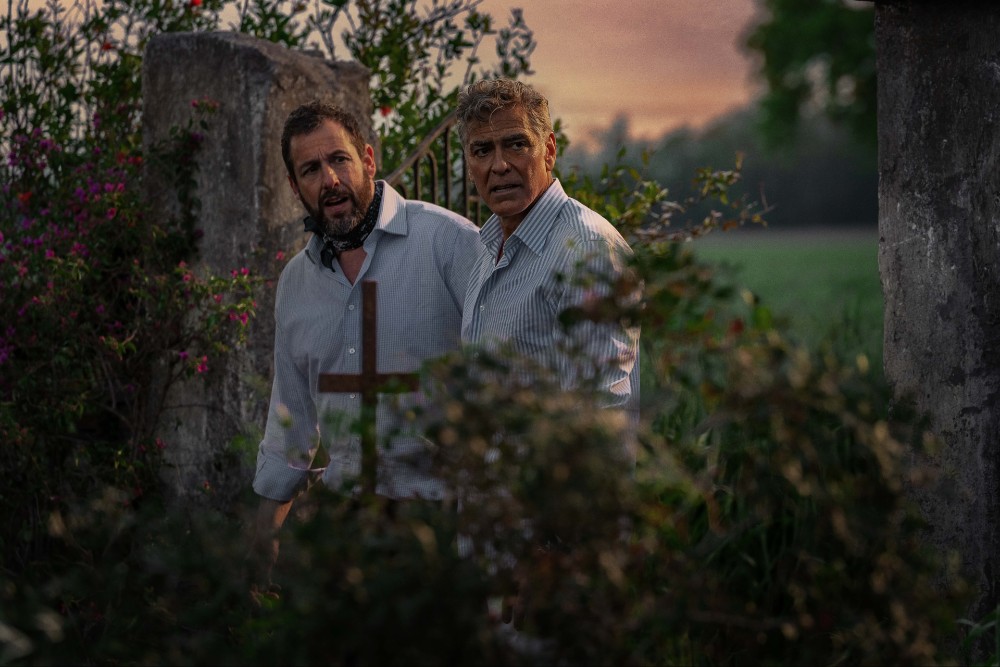
In many ways, it’s the journey of Ron and his ongoing relationship with Jay’s publicist (Laura Dern) that’s the far more interesting subplot in Jay Kelly than anything involving Clooney/Kelly and his daughters, since it allows us to see how difficult it is to be among Jay Kelly’s inner circle of employees. It’s certainly nice to see Baumbach reunite with the likes of Dern and Sandler, both of whom are fantastic in this, but there are just too many ideas thrust into this convoluted mess of a movie that is all over the place in terms of tone and even quality. Much of the casting around the primaries is notably bad, particularly the actress playing Kelly’s youngest daughter.
It was a surprise to learn that the screenplay was co-written by actress Emily Mortimer, who essentially has given herself such a nothing role as Jay Kelly’s long-time hair and make-up person, who appears for two scenes then disappears from the rest of the movie. An even worse injustice is done to Billy Crudup’s character who has an absolutely fantastic confrontation scene with Kelly and delivers what is clearly a pivotal moment and a fantastic performance, only for his character to never appear again to fully resolve things. Instead, we learn that he has sued Kelly for assault, and then an hour later, that situation is resolved fully off-camera, despite being a far more interesting subplot than any of the time we spend on the train or in Tuscany. We also get a few flashbacks to Jay Kelly’s earlier days in drama class that led to him getting the role that should have gone to his roommate, which is also far more interesting than Kelly’s time in Italy.
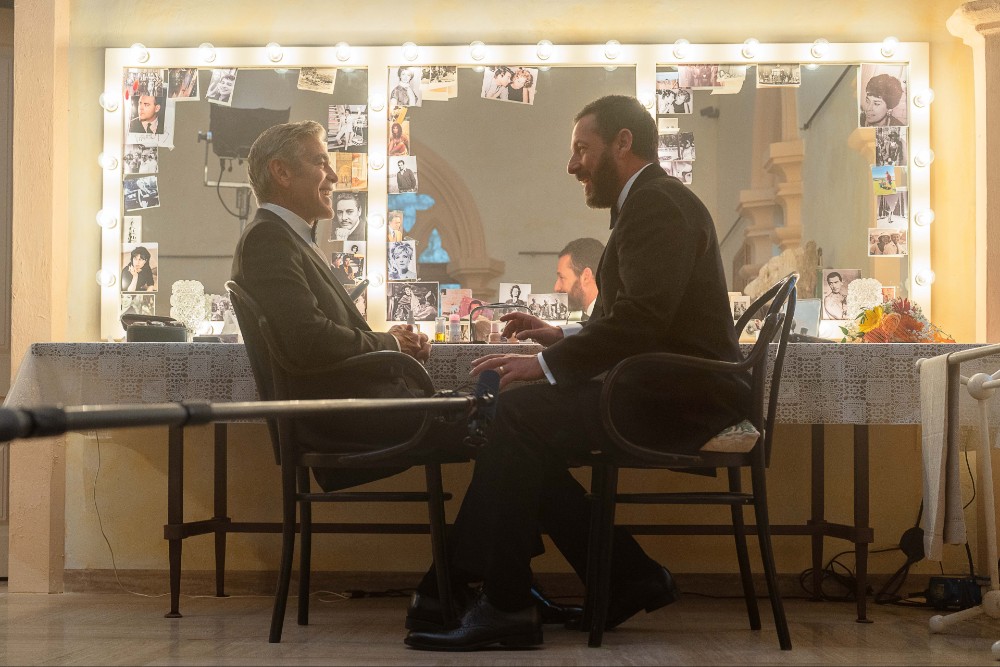
So much of the film’s humor falls flat, other than when Patrick Wilson shows up as another one of Ron’s big acting clients, who is constantly settling for second helpings to Ron’s star client i.e. Jay. When the two actors meet at the festival, Wilson’s character has his entire extended family with him, while Jay has absolutely no one, which is quite telling. This is an amusing reveal, but it’s just as “inside baseball” as most of the rest of the film. After watching the movie, I made a comment about it feeling like the work of the late Henry Jaglom only with a much bigger budget. That was not a compliment, since Jaglom also makes movies essentially for people in the industry who might fully appreciate this, rather than regular moviegoers who might throw this on, since they enjoy Clooney from previous roles. By the time we finally see the retrospective of Jay Kelly’s career, it’s impossible not to notice it’s essentially a montage of Clooney characters from his previous movies, which again, makes it impossible to separate the actor from his character.
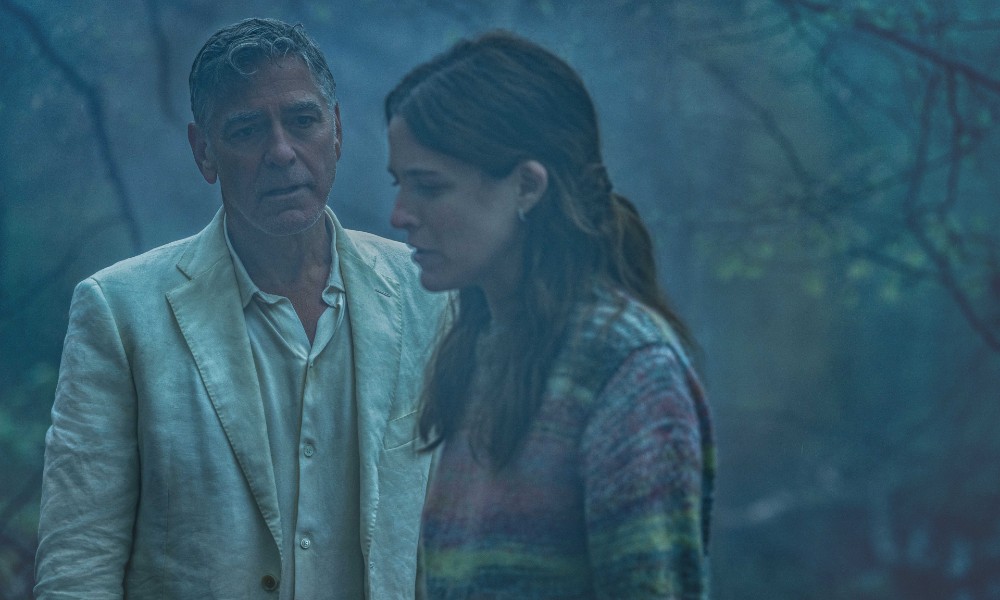
Jay Kelly has some nice moments for sure, including one beautiful moment between Clooney with Riley Keough as his elder daughter Jessica. Moments like that are surrounded by so much chaos – think of Sandler’s far superior teaming with the Safdies for Uncut Gems – that it’s impossible for the viewer to get their bearing with all the headache-inducing and mostly unnecessary zaniness. Baumbach also leans so heavily on Nicholas Britell‘s score and his constant piano noodling, it makes one wonder whether during post the filmmaker realized that the film’s moments meant to be emotional weren’t working without a score pandering to basic human emotions.
Baumbach’s latest is made even worse if and when you finally watch Joachim Trier’s Sentimental Value, which not only handles the film industry and being actor better than Jay Kelly, but also in handling the dysfunctional relationship between a man and his two adult daughters, who he mostly ignored to focus on his career.
Sure, Jay Kelly could very well be an Oscar player, because if there’s one thing the Academy loves, it’s a movie that celebrates their own industry, yet it’s a movie that falls short of some of Baumbach’s stronger efforts and makes one wonder how and why this got funded, presumably for a bigger budget than many of Baumbach’s better films.
Rating: C+
Jay Kelly plays at the New York Film Festival on September 28, 29, October 2nd and 8th, before getting a theatrical release on November 14 then streaming on Netflix beginning December 5.