

©Courtesy of Neon
Rave culture has always thrived outside the mainstream, an underground heartbeat pulsing against the silence of daily life. For many, the rave isn’t just music—it’s rebellion, refuge, and pilgrimage.
The ravers of “Sirāt“, Oliver Laxe’s Cannes Jury Prize winner and Spain’s Oscar contender, now creating buzz at the New York Film Festival, embody just that. We first meet them dancing in Morocco’s Sahara Desert by giant, bass-heavy speakers at an illegal party. Under the open sky, far from city streets, bodies move as one. Strangers from around the world surrender to rhythm and euphoria, as if the dance floor itself were the only homeland they’ve ever needed. They have found their Mecca. The opening of “Sirāt” literally shakes the screen.
Amid this charged atmosphere, Luis, a Spanish father (Sergi López of “Pan’s Labyrinth”, the only professional actor in the film), and his preteen son Esteban (Bruno Núñez Arjona) hand out flyers with a picture of Mar—their missing daughter and sister, who vanished five months earlier—searching for her among the anonymous crowd. Their dog Pipa trails faithfully by their side. Suddenly, authorities arrive to shut down the rave, citing near-apocalyptic global crises. “It’s been the end of the world for a long time,” someone mutters. The undertones evoke themes on migration and fascism. We are on the brink of World War III, in an alternative present or near future.
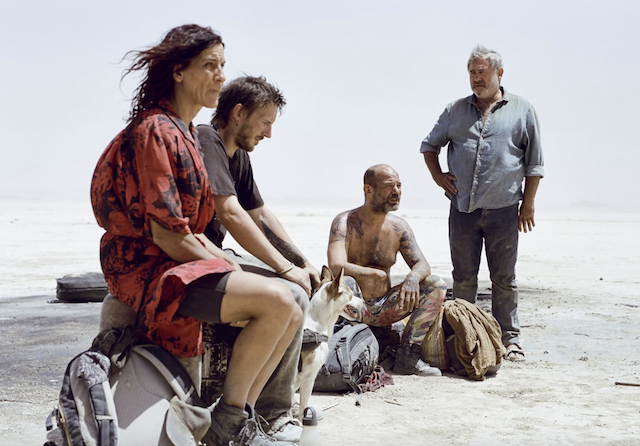
The father and son fall in with a group of vibrant ravers—tattooed, optimistic, some missing limbs—who escape toward another rave party in the desert gathering near the Mauritanian border. Luis and Esteban follow in their small van, still clinging to hope of finding Mar there. Suspicious at first, the ravers eventually welcome them into a found family.
What follows is an unexpected road trip, a sort of fusion of “Mad Max“, “Easy Rider“ (1969), and Tarkovsky’s “Stalker“ (1979). The result is a rare blend of accessibility and arthouse, an existential ride that burns into the heart and lingers on the skin. To say more would spoil its spell; Sirāt is a film to be entered blind, and to be seen on the largest screen possible.
Oliver Laxe, the French-Spanish filmmaker with Galician roots who lived twelve years in Tangier, Morocco, has always made cinema of poetic imagery, spiritual undertones, and deep ties to landscape. His films—“You All Are Captains“ (2010), “Mimosas” (2016), “Fire Will Come“ (2019), and now “Sirāt” — blend realism and mysticism, often turning landscapes into spiritual mirrors. Co-written with longtime collaborator Santiago Fillol and produced by Pedro Almodóvar, “Sirāt“ is fragile yet feverish, haunted by longing and loss, physical and emotional wounds. It lingers long after the last frame.
A central heartbeat is the score by Kangding Ray. One of Laxe’s earliest inspirations for the film was Nietzsche’s line: “I won’t believe in a God who doesn’t dance”. The result is a soundscape of deep bass, throbbing techno, and trance-inducing rhythms. The music drives Mauro Herce’s stunning 16mm cinematography, and together with the immersive sound design, turns the desert into a space both expansive and claustrophobic. Image and sound merge into one.
In the end, after sequences that make you want to cover your eyes, “Sirāt“ is, above all, a spiritual experience – a new experience. Oliver Laxe guides us across dimensions of reflection—on life, on mortality, on the razor-thin line between hope and despair. Just as sirāt means “path” in Arabic, with its religious connotations, this is a journey and a passage. And where better to walk it than the Moroccan desert, where the bass rules the day.
Grade: A-
If you like the review, share your thoughts below.
Check out more of Niclas’ articles.
Here’s the trailer of the film.