

Dancing can have a profoundly inspiring effect on anyone willing to embrace its transformative benefits. That’s certainly the case for the protagonist of Haru, a recent widow who uses the physical movements to come out of mourning, in the new romantic dramedy, Ha-chan, Shake Your Booty!
Josef Kubota Wladyka directed and produced, and also co-wrote the script with Nicholas Huynhor for, the movie. Rinko Kikuchi stars in the film’s lead role. Alberto Guerra, Alejandro Edda, YOU, Yoh Yoshida and Damián Alcázar co-star in the dramedy alongside Kikuchi.
Ha-chan, Shake Your Booty! stems from a place of true affection, as it’s dedicated to the American-born Wladyka’s Japanese mother. While the movie is not entirely based on her life, the film celebrates her exuberant spirit and love of ballroom dancing.
Set in Tokyo, Ha-chan, Shake Your Booty! follows Haru (Kikuchi) after her happy life with her husband and dance partner, Luis (Edda), comes to an end. Haru is initially unable to move on after her husband’s death, as they were fully settled in their integrated life together. Luis hailed from Mexico, and their home reflected their multicultural lifestyle.
But Haru begins to learn how to cope with Luis’ sudden and unexpected death during the middle of a ballroom competition. After nine months of a self-imposed isolation over her husband’s untimely passing, her solitude comes to an abrupt end. Her sister Yuki (Yoshida) and Hiro (YOU) begin to encourage her to leave the house.
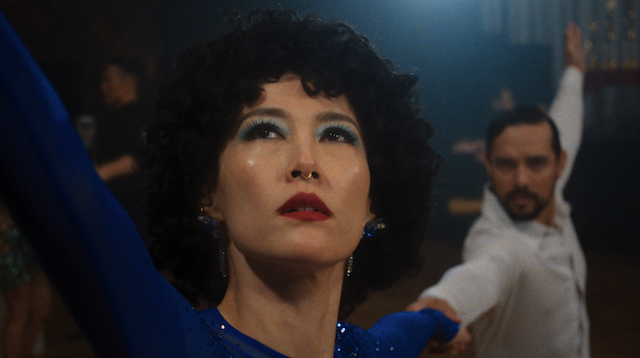
They decide to attend a dance class, where Haru becomes immediately smitten with her instructor Fedir (Guerra). As a result, an impromptu dance number ultimately breaks out to emphasize her embracing life again.
Wladyka and Huynh’s efficiently practical but equally emotional script forgoes explaining how Haru and Luis made their living. The story instead embraces how the spouses lived their lives, who they loved and how that all flowed together. Haru therefore becomes a relatable middle-aged female protagonist who realistically contends with her darker experiences and emotions.
The dramedy also conveys everything Haru has lost since her husband’s death through clever visual storytelling. Without emphasizing the protagonist’s secondary pain with excessive dialogue, the cinematography showcases her emotional progress since his passing.
Haru’s beloved dog is now shown to live with her steady sister Yuki (Yoh Yoshida) and her family, as the main character is no longer to fully care for her pet everyday. The sisters’ vibrant cousin Hiromi (YOU) has travel to Tokyo from the United States for an extended visit in order to help cheer Haru up.
Kikuchi delivered a beautifully nuanced performance, built almost entirely from small gestures. She quietly showcaseed the protagonist’s grief and initial reluctance to reintegrate into her former life. When Haru begins dancing, the actress starts emphasizes how the experience isn’t immediately liberating for her character; instead, it’s uncomfortable, sometimes to the point of embarrassment. As a result, Kikuchi makes Haru’s eventual confidence feel earned and justified.
Kikuchi, who was nominated for an Oscar for her supporting role in Babel, elegantly navigated the changing tones. She emphasized how her character becomes heartbroken when Luis’ father and sister plead with her to let them take his body back home to Mexico for burial. Haru resists, saying his spirit will never be at rest unless he is cremated.
But as the movie progresses, Kikuchi becomes increasingly comedic when her crush on Fedir makes her become more comfortable the world again. Emerging from her isolation, the protagonist boldly asks Fedir out to dinner, and to her happiness, he accepts her invitation. Kikuchi continued to make Haru believable, even when her behavior becomes whimsical as she develops and shares feelings for her new dance instructor.
The film’s unexpected light tone is especially evident in surreal scenes that easily fit into the story’s realistic trajectory. The dramedy’s cinematographer, Daniel Satinoff, makes those transitions clear and smooth. The background light changes as a spotlight narrows to highlight Haru as she shares her fantasies. She sees herself dancing alone with Fedir, for instance, when in fact she is just one member of his class.
The filmmakers shoot the dance sequences with refreshing restraint. Rather than flashy editing, the camera often lingers on Haru, in order to showcase her initial mistakes that lead into gradual improvement. Showcasing how the physicality of dance grounds people’s emotions and life trajectories reinforces the idea that healing is not abstract but bodily.
Wladyka’s effervescent depiction of a woman dancing through her grief is as heartwarming as it is fun. Ha-chan, Shake Your Booty! combines visual boldness with a whimsy grounded in emotional truth, which created vivid, emotionally relatable characters. Kikuchi helped bring a profound sensitivity to her leading role of Haru. The protagonist deftly balances the weight of being a mourning widow with the spark of newfound desire.
The overall movie draws its emotional weight from the pain of processing grief. But the character’s journey bursts with so many chaotic life experiences that it serves as a joyous reminder of the beauty of living.
Overall: A
Ha-Chan, Shake Your Booty! premiered in the U.S. Dramatic Competition of this year’s Sundance Film Festival on Thursday, January 22 at the Eccles Theatre in Park City. The dramedy’s helmer, Josef Kubota Wladyka, went on to win the festival’s Directing Award: US Dramatic. Sony Pictures Classics acquired the movie after its Sundance debut.
If you like the review, share your thoughts below!