
©Courtesy of Miyu Productions
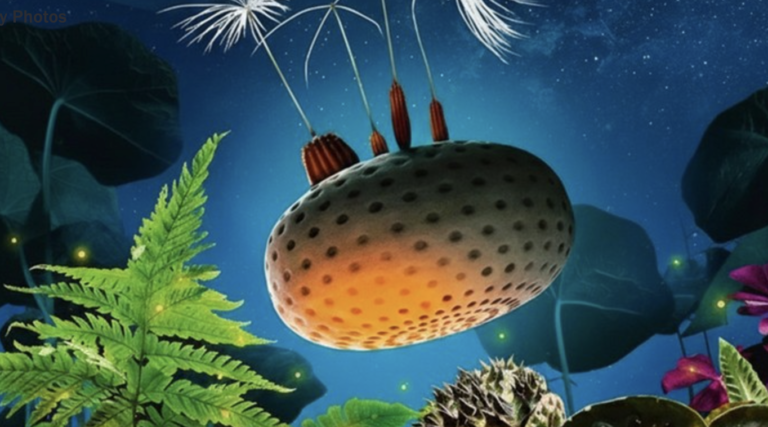
Dandelion’s Odyssey :Dandelion, Baraban, Léonto and Taraxa — four dandelion achenes that survive from a series of nuclear explosions destroying Earth — are propelled into the cosmos. After crash-landing on an unknown planet, they set out in search of soil where their species might survive. However, they must face countless obstacles: the elements, fauna, flora, the climate.
Director : Momoko Seto
Producer : Emmanuel-Alain Raynal, Pierre Baussaron, Emmanuel Chaumet
Screenwriter : Momoko Seto, Alain Lavrac
Production Co : arte France Cinéma, Miyu Productions, CNRS Images
Genre :Sci-Fi, Animation, Adventure
Original Language : French
Runtime : 1h 16m
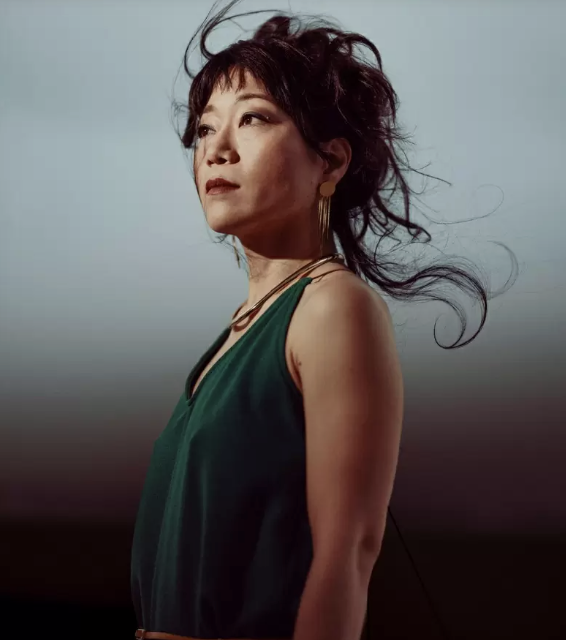
Exclusive Interview with Co-Writer/Director Momoko Seto
Q: Ms. Seto, you studied at the Le Fresnoy – National Studio of Contemporary Arts in France. What led you to decide to study in France?
Momoko Seto: I attended a French school in Tokyo, Japan—specifically, the Lycée Franco-Japonais de Tokyo—so I followed the French curriculum from kindergarten through high school.
Q: Was that because your parents spoke French, or was it something like that?
Momoko Seto: My parents couldn’t speak French at all; if anything, they spoke English. Well, my mother had lived in the UK, so she was more comfortable with English, but it was really my mother’s decision. I have an older brother who went to a Japanese school, but my mother wasn’t very fond of Japanese schools. Since I was the second child, she wanted to send me to a different kind of school—an international school. There are quite a few American schools, but my mother wasn’t particularly fond of America; she was more of a fan of the UK and Europe.
Q: I suppose there are probably a lot of people like that among those interested in the arts.
Momoko Seto: That’s right. Both of my parents are humanities majors and work as journalists, but it just so happened that there was a French school right next to my parents’ company, and since it was easier to get into that one, I enrolled there. So I went to that French school—even though no one else in my family spoke French—and I stayed there through high school. After graduating from high school, I wanted to attend an art university, so I went to one in France.
Q: After that, you went on to make films at the CNRS (French National Center for Scientific Research). How did that come about? Did you join as a researcher?
Momoko Seto: So, I moved to France when I was 19 and enrolled at the École des Beaux-Arts in Marseille (there are 59 national and public art and design schools in France, and these art schools—equivalent to art and design universities in Japan—are collectively referred to as “Beaux-Arts”). I studied art there for five years. I was mainly in the film department, and after that, I attended the École Nationale Supérieure d’Art Contemporain Le Frenois—it was sort of like a master’s program—where I continued my creative work. There, I made my very first short film for a short film festival, which served as my graduation project.
However, while I was attending the École des Beaux-Arts, I had a friend who went to the Lycée Français in Japan with me. That friend’s father was a Japanologist—a sociologist named Jean-François Sabre—and he wanted to make a film. He was looking for someone to edit the video footage he had shot as part of his research, and since I was studying film at art school, I used my filming skills to help him create something like a sculpture using the formations of salt crystals.
I thought that if we used time-lapse photography, we could see the process of how those salt crystals form. I used to help him edit those videos during summer break and such. Then, little by little, I started working part-time jobs while I was a student, and when I graduated from the École Nationale Supérieure des Arts Contemporains (Le Frenois) in France, the CNRS (French National Center for Scientific Research) was looking for a film director, so I applied, went through interviews and exams, and got in.
Q: In your short films, you directed the series “PLANET”, which consists of four short films. How did that lead to the creation of a feature-length film? Is there a connection between those short films and this latest work?
Momoko Seto: The series “PLANET,” consisting of four short films, was my graduation project. In it, I used a time-lapse filming technique to create salt crystal formations—sort of like salt sculptures. I would place a rope in saltwater, and as the salt crystals dried, they formed these salt crystal sculptures. If you look closely, salt crystals are actually perfect squares. I was fascinated by the fact that even though I was just leaving them in water naturally, they formed such perfect squares.
Also, depending on the shape of the rope, the salt crystals form something like a hedgehog’s quills. I thought those quills had an interesting shape, and by using time-lapse, you can actually see with your own eyes how and why that formation happens, right? So I made the salt crystals grow quickly, as if I were watching a new creature emerge, and created a short film with a slightly 70s-esque, somewhat unique sci-fi vibe.
I thought time-lapse was such an interesting technique, so I created a second planet called “Planet Z“. There, I filmed phenomena like moss and mold—things that aren’t normally visible to the naked eye.
“Planet Z” was a professional short film I made after graduating from film school. I wrote a story about plants and mushrooms competing for survival, and it was about a 10-minute film. From there, I started getting invited to major film festivals like the Berlin Film Festival.
Then, for my third work, titled “Planet SIGMA,” I decided to introduce Godzilla-like insects onto the planet. I shot the insects in macro slow motion—capturing them moving slowly or making sounds like “thud, thud”—and incorporated footage of grasshoppers and the like into a scenario where a frozen planet gradually heats up.
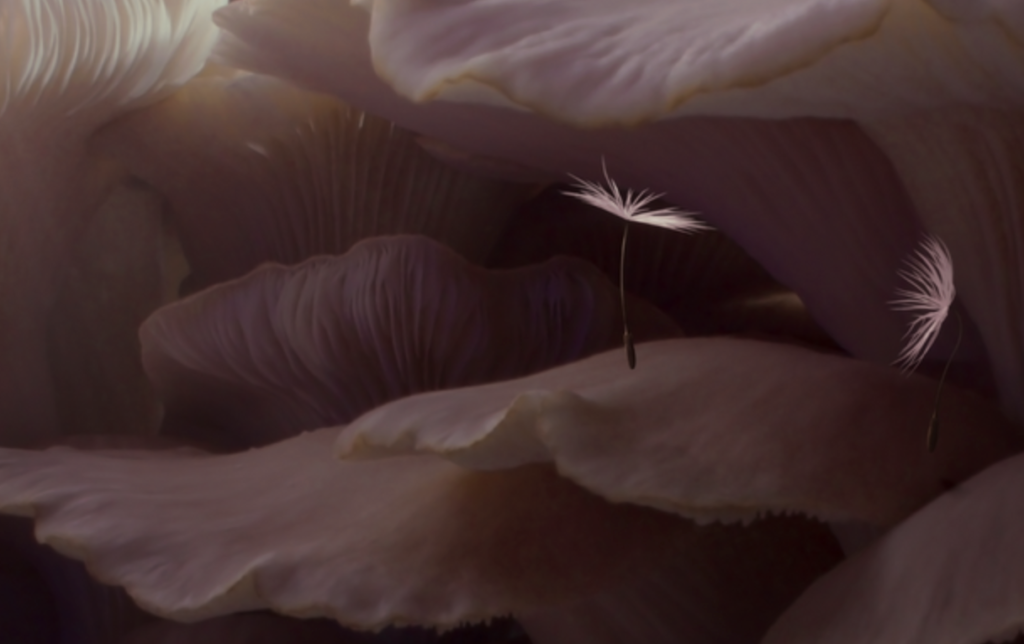
My fourth work is It’s a virtual reality piece called “PLANET INFINITY“. That one was more about exploring the differences in scale within virtual reality. We projected images of tadpoles and strange mushrooms, and while the motifs from this feature film also appear in that short… (her kids are fighting in the background; she tried to stop them)… Sorry…
 ©Courtesy of Miyu Productions
Q: That’s fine. So, you worked on “PLANET INFINITY”, and that led to the feature-length film, is that right?
Momoko Seto: That’s right. So, while I was making those four shorts and experimenting with different techniques—like changing the scale to a macro world or speeding up and slowing down the movement of nature—a friend in the film industry mentioned that they wanted to see more of it. They suggested, “Why not expand this world beyond short films and create something a bit longer, like a 10-minute piece or more?”
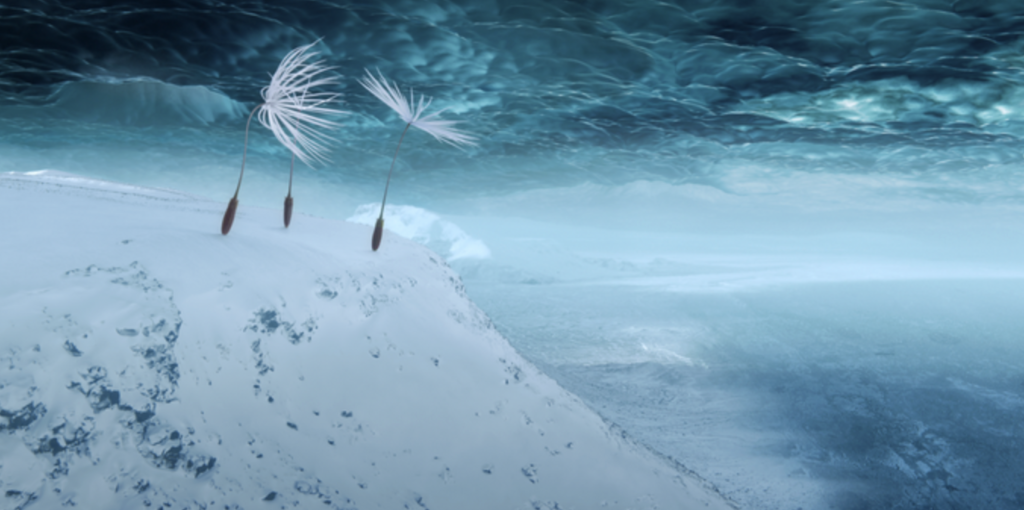
The producer I was working with at the time said, “Well, let’s try developing it!” There’s a co-screenwriter named Alain Layrac, and he introduced me to him. I’d written a treatment of about 10 pages outlining what I wanted to shoot and the general vibe of the story—like how the first planet was frozen, and then, as it gradually warmed up, animals living inside icebergs would emerge—and so on. From there, it took me three years to expand that into a 60-page screenplay, and then we moved into production.
Q: Could you tell us why you chose a dandelion seed as the protagonist? Of course, the fact that the seed can travel to various worlds as it flies is part of it, and there are all sorts of encounters along the way, but I’d like to hear about the reasoning behind focusing on the idea of making a dandelion seed the protagonist.
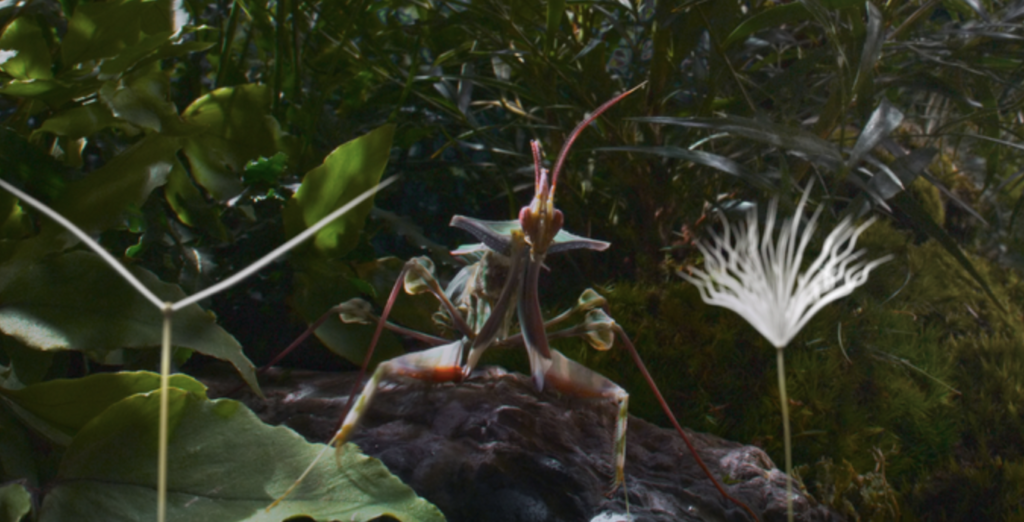
Momoko Seto: The idea was that I wanted to write an adventure movie using a plant. Once a plant is planted, it doesn’t really move much, does it? It grows, but among plants, seeds are definitely the most active in terms of movement. They get blown away, get tossed around in the soil, get eaten by other animals, or get washed away by water—they have all these different ways of moving. I thought, “If I attached a tiny camera to a seed, wouldn’t that make for an amazing adventure movie?” That’s how I came to find seeds kind of interesting.
And then, when I was looking at a dandelion’s fluffy seed head, I thought it looked incredibly futuristic. When I looked closely at the fluffy seed heads, I noticed the lines of the seeds were incredibly straight and repeated, making them look like a futuristic space shuttle. From there, I started imagining seeds being scattered, with the space shuttle crew (the dandelion seeds) arriving at various new planets and embarking on new adventures—and that’s where I began writing. That’s how the initial image took shape, and I thought, “I want to make an adventure movie.”
Q: I think what makes this work so appealing is that, while the design of the dandelion characters isn’t overly anthropomorphized, it still manages to convey the distinct personalities of each of the four characters—that sense of balance is incredibly compelling. I think the fact that they seem to have emotions is crucial to conveying that without resorting to anthropomorphism. When the audience watches the story, there are parts they can relate to. What aspects did you focus on when characterizing the dandelion seeds, or rather, when structuring them?
Momoko Seto: Well, when you add eyes and a mouth to living things or objects, it just feels very American to me. In the old Disney “Silly Symphonies” (a series of short animated films produced by Walt Disney Animation Studios), there are scenes where trees talk—they have eyes, branches as arms, and leaves as hair. To me, that feels very American.
From a Japanese perspective, there’s still this sense that you can empathize with things even without eyes or mouths. It’s not exactly animism, but it comes from Shinto—the idea that objects have souls, or that trees and leaves have souls—there’s definitely that kind of culture. My parents weren’t religious at all, but I’ve always had this feeling that even rotten things have a soul, or something like that.
I was about 80% convinced that even without eyes or a mouth, you could empathize with a dandelion seed as the protagonist. Like, I was absolutely convinced it was possible. I deliberately avoided that Western-style approach, and my counterpoint was really about figuring out how to break out of that paradigm—whether there might be a different way of thinking. I was very conscious of doing that.
And, just like in Noh theater, there are no facial expressions, right? Even without facial expressions on a mask, expressing sadness or joy through sound and movement is common in Japan. I speak many languages—and I think Shin-san (the author) is the same—but I had a sort of language disorder when I was little. I grew up speaking French, but for a long time, until a certain age, I couldn’t speak either Japanese or French perfectly.
In the arts, conveying sensations through editing, music, sound, color, framing, and camera movement is something that’s been done for a very long time. That’s partly why I went to art school. That way of communicating or conveying emotion doesn’t necessarily come from words.
In fact, if you really think about it, for example, instead of telling Nobu-san (the author) right now with a single word like “I’m sad,” if I say nothing—just hunching my body, letting my face fall, tears streaming down, or flashing a slight smile—even though I’m not saying a word, that expression alone conveys a much more complex sadness.
Just by saying I’m sad, it feels like that very emotion gets crushed. There are so many different nuances to it. When you try to put the incredibly varied nuances of sadness and joy into words, it feels like they get crushed by a bulldozer. I really feel that small movements, subtle shakings, pauses where you don’t move right away, or taking a moment before continuing—those kinds of physical gestures—allow for a much richer expression of emotion.
Conversely, by not using words—and of course, since Tanpopo(Dandelion) doesn’t speak, she doesn’t use human language—I felt on a very deep level that there must be so much more we could do. I really wanted to explore that. Yeah, that’s the idea. From the scriptwriting stage through editing, sound, and animation, we worked together with everyone to figure out how Tanpopo would express her emotions, building layer upon layer to create that.
 ©Courtesy of Miyu Productions
Q: I see. I heard that the live-action portions of this film were shot over a total of 260 days in three locations: France, Iceland, and Japan. Was there a specific reason for choosing those locations? I suppose even though they’re all life forms on the same planet, were there specific locations you had in mind—places you felt would be particularly well-suited for the visuals? Obviously, with Iceland, it’s clear because of the icebergs, but for places like France and Japan, how did you go about deciding on those locations during location scouting?
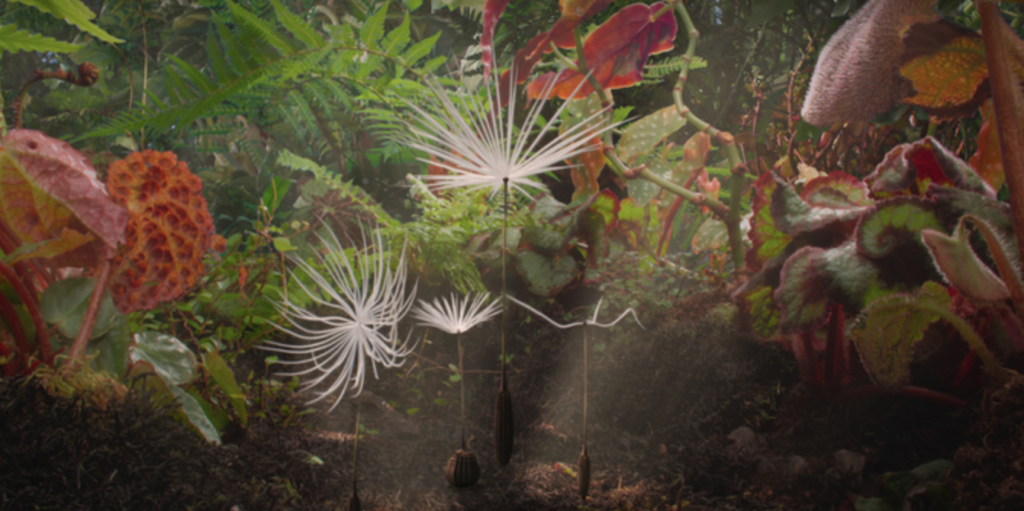
Momoko Seto: Yes. That’s right. Of course, the entire frozen world in the beginning was filmed in Iceland. As for France, since the production is based there and the team is mostly French, we used France as our base and did the longest shoot there. We wanted to rent a greenhouse in the Burgundy region of France. The idea was that with a greenhouse, we could film a set where various plants were planted.
We planned to shoot in the summer inside a building that could withstand rain and wind while using natural light, and we were looking for a place like a greenhouse where natural light would come in and allow the plants to grow. So, we rented a place that looked like a castle in Burgundy. Since everyone had to live there, we had to secure accommodations for the entire crew. We also used 18 cameras to film time-lapse sequences inside that greenhouse.
At the same time, in a 200-square-meter studio next door, we were filming various SFX, special effects, and insect shots, so when we were looking for a location of that scale, a castle in Burgundy, France, agreed to host us. We all lived there for nine months, and all the scenes featuring plants in the film were shot there.
In Japan, there’s a scene in the movie set in space before arriving at the first planet, where the stars gradually transform into firefly squid. I wanted to film the firefly squid in Toyama, Japan. The concept was that the protagonists arrive in pitch-black space, where glowing firefly squid appear, and then a huge, sea-urchin-like creature comes along, creating a new Milky Way canal.
The stars gradually take on the shape of squid, and it turns out that the squid is actually the planet’s ring. At first, it’s hard to tell if the firefly squid are actually stars or squid, so I went to the Firefly Squid Museum in Toyama to film them. After that, I lived on Yakushima for two months. Since Yakushima is famous for its moss, I wanted to use the moss there for scenes where moss actually appears.
Also, there’s a white flower in Japan called Ginryusou that doesn’t exist in Europe or elsewhere. In the movie, a slug is attacked by a mushroom, the slug dies, and the mushroom grows out of its body, but right next to it, there’s this pure white flower standing there—it’s like it’s watching over the scene, or acting as a guardian at the gateway to death.
I searched for that flower, but since Ginryusou is a Japanese flower that doesn’t grow in Europe, I couldn’t film it there. Also, there’s a beetle that appears in the opening scene, and later on, there’s a moth that appears alongside a mantis—we filmed that moth in Japan as well. We filmed some unique animals that can only be found in Japan right there in Japan.
Q: In France, you also filmed at the Roscoff Aquarium, right?
Momoko Seto: Yes. In France, there’s a place called Roscoff in the Brittany region, near Burgundy, which is sort of like a deep-sea research institute. We filmed all the sea anemones there, and we also filmed a river in Iceland. There’s a scene where the sea anemones are attached to the riverbanks like huge trees, and we filmed those sea anemones in France, We filmed those sea anemones in that part of Brittany. Since it’s a research institute, we even had a team that went diving to collect the sea anemones.
Since the height and other specifications of the tank we built ourselves were fixed, we placed the sea anemones inside that handmade tank, filled it with seawater, and used a filtration system to keep the water clean. As you can imagine, we needed quite a bit of equipment. Although sea anemones are marine creatures, the film presents them as if they weren’t underwater, so the water had to be kept clean at all times, which is why we used a filtration system.
From there, we filmed in Iceland using a drone. We programmed the drone’s GPS into a robot so that it could replicate the same movements the drone had made while filming a 200-meter stretch of river—but in an 80-centimeter-deep tank. We spent three weeks in the Brittany region doing that.
Q: Wow, that must have been a huge production.
Momoko Seto: You’re exaggerating… (wry smile)
Q: Watching it, I can really tell how much effort went into it, but between the macro live-action shots, the time-leap scenes, and now 3D animation as well… Having all these exceptional filming techniques—3D animation, macro live-action, time travel, and the cinematography—all gathered into a single film really gave me the sense that this was a movie unlike anything I’d ever seen before in terms of its expressive style. That’s why I think many people will be surprised when they see this film. I was left with the impression that you’re someone who approaches filmmaking in a truly unique way. What kind of films influenced you personally, and which works inspired you to take on these kinds of challenges in your own work?
Momoko Seto: Yes, there are many, but I grew up watching Hayao Miyazaki’s films. “Nausicaä of the Valley of the Wind” came out when I was about six years old, and my mother often told me that I apparently watched it every day.
That film has had a huge impact on me. I watched it so often that I knew every single line of dialogue. The giant Ohmu looked just like a giant caterpillar that had grown enormous, and the idea that humans had destroyed the world, turning it into the Sea of Decay—a rotten world—really gave me a strong post-apocalyptic vibe. After that, of course, I grew up watching “Castle in the Sky”, “My Neighbor Totoro”, and “Howl’s Moving Castle”.
Later on, as I got older, the person who really left a lasting impression—who I truly thought was a maestro—was Jean-Luc Godard. Every time I watched one of his films, I’d think, “What a free spirit this man is.” I once watched Godard’s “Passion” while I was studying abroad in San Francisco, and after seeing it, I was so depressed I stayed in my room for two days. I was just really down, and I wondered what kind of films I would be able to make after that.
It’s incredibly free and incredibly deep. He doesn’t really do anything that big, but it’s incredibly deep. I was really influenced by that, and also by Godard’s 1960s films—“Contempt”, “Weekend”, “A Woman Is a Woman”, “Masculine Feminine”—those are also free and full of wordplay. And when Godard went on to make 3D films later, I realized this guy is really like a child—he loves new things and wants to challenge himself with all sorts of things.
It’s like, honestly, I feel like he’s more of an artist than a film director. The artists I like—well, how should I put it? Rather than the traditional role of a film director, they’re more like—I come from an art background myself, having gone to art school—they experiment with all sorts of things, try out new techniques, and possess that kind of innovative spirit. I’m really influenced by those artists, and I definitely feel that we should be free.
 ©Courtesy of Miyu Productions
Q: I hear you’re working with the production company MIYU Production on this project. Could you tell us a bit about what kind of company MIYU Production is and what role they’re playing in this production?
Momoko Seto: MIYU Production is an animation studio that’s been around for about 15 years. They tend to make more traditional animation—focusing on hand-drawn animation and traditional animation techniques—and don’t do much 3D work. The producer at MIYU Production, Emmanuel Aaron Leonard, had seen one of my short films before, and when I met him at a film festival, we ended up talking about my work. At the time, I was in development with a production company called Edge Films, but Edge Films got into a bit of trouble during the COVID-19 pandemic, so I had to look for a new production company. That’s when we decided to look for a co-production partner.
Since the characters are animated, I thought an animation studio might be a good fit. Edge Films specializes in live-action, not animation, and since my project combines live-action and animation, an animation studio would have the necessary expertise.
So, when I approached MIYU, it turned out they were in the middle of producing a feature film at that very moment— a feature film compiling Haruki Murakami’s short stories, which she was shooting with a French director, and she was also developing other feature films. I approached her at that time, told her I wanted to do this project, and we started this co-production. In the end, MIYU ended up taking the lead. MIYU actually has close ties to Japan; that film “Anzu-chan the Cat” was also a co-production with them.
Q: So, that company, MIU, has quite a bit of involvement with Japanese works, doesn’t it?
Momoko Seto: That’s right. I’m Japanese, but I don’t really have that “Japanese” vibe…
Q: I’m the same way. I’ve been in the U.S. for quite a long time, so I don’t really have much interaction with Japanese people. Part of it is that I haven’t really been around many Japanese people to begin with… Since I haven’t really interacted with Japanese people living in the U.S., most of my friends are American, so I think you’re probably in the same boat, Ms. Seto.
Momoko Seto: That’s right, you’re right.
Q: Well, to a certain extent, that was the only way to do what I wanted to do…
Momoko Seto: I understand, really.
Q: I think this is a film that will really draw in a wide range of viewers, from children to adults, regardless of age or gender. At the same time, I believe it’s a film with a strong message that really makes you think about the environment and the future. You’ve also created a series of short films called “Planet,” and I imagine there are various issues surrounding global warming and the like. Through this work, what specific aspects of environmental issues and related topics did you personally hope to convey?
Momoko Seto: Well, yes. My hope stems from reading works on eco-philosophy—the idea that if we shift our perspective from that of humans to that of other animals or living creatures, we can see things differently and feel them differently.
There’s a famous American anthropologist named Anna Chin who wrote a book about matsutake mushrooms. It was originally written in English, but I read the French translation, *The Mushroom at the End of the World: On the Possibility of Life in Capitalist Ruins*, which is a book about Japanese matsutake mushrooms.
In that book, she talks about how nature—which she used to think of as just a backdrop—isn’t a backdrop anymore, but rather actors, just like us. She says, “It’s not a background anymore; it’s actors like us.” She suggests that if we view nature from that perspective, we might experience it with a different sense and see nature in a whole new light.
Also, the idea of film through the camera is truly wonderful. When you lower the camera’s perspective—from 160 cm down to just 2 mm above the ground—the sensation is completely different. The way you perceive what you’re looking at changes. If humans could apply that different perspective—that different viewpoint, different movement, different flow of time, and different interaction—to other things, what we see would change entirely. We wouldn’t have that sense of humans dominating everything around us like some kind of supermachine.
The point is that we have to start by changing our perspective. Of course, when it comes to environmental issues, there are all sorts of things people say—like we shouldn’t fly or we shouldn’t eat meat—but the first step is to change our perspective. The films I make aren’t documentaries, nor are they eco-political films; they’re sensory films about how to use art. So, for the duration of the 1 hour and 10 minutes (the runtime), let’s transform our bodies into seeds. Become a seed and see things from a seed’s perspective.
Through the film’s editing, camerawork, and sound—and through that physical transformation—and what you feel there, only then will the audience realize, “Ah, I could feel what a seed feels! Seeds, just like humans, are looking for a home. Seeds, just like humans, travel from one country to another, trying to establish their roots in that country.
Nobu-san (the author) and I are in the same boat—our goal is to go to a new place, to make that place our roots, and to put down roots there. By realizing that seeds share the same struggle to take root as we humans do, I started to think that maybe we’re all connected—or perhaps we’re all the same. It shifts the perspective from a pyramid-shaped view to a more horizontal one. I definitely felt that there was something I could do to help change that perception, even if just a little bit.
 ©Courtesy of Miyu Productions
Q: Finally, based on “Dandelion’s Odyssey”, what kind of films would you like to make in the future?
Momoko Seto: I think it would be interesting to observe the behavior of things and creatures other than humans—to explore what we can learn from plants, insects, air, and water, or to consider how things we currently take for granted might one day no longer be so. I’d like to develop a perspective that challenges conventional wisdom, allowing us to reexamine our relationships with one another and with the world around us. I believe that’s what’s truly important.
If you start by asking whether this is more important than just being interesting, you’ll find there are already so many ways to tell stories. I think that just by shifting our perspective, we can see all sorts of things—from plants, woodlice, and water. Yes, rather than just centering on humans, I’m really thinking about how we can use these various tools to think laterally.
Q: Has distribution for this film already been decided in Japan and the U.S.?
Momoko Seto: It hasn’t been decided in the U.S. yet, but it has been decided in Japan. It will be released this fall.
Q: Which company is distributing it in Japan?
Momoko Seto: It’s called Portre. They don’t seem to distribute many feature films, but they were deeply moved by it and agreed to distribute the film. We’re currently looking for a distributor in the U.S.
If you like the interview, share your thoughts below!
Check out more of Nobuhiro’s articles.
Here’s the trailer of the Film.