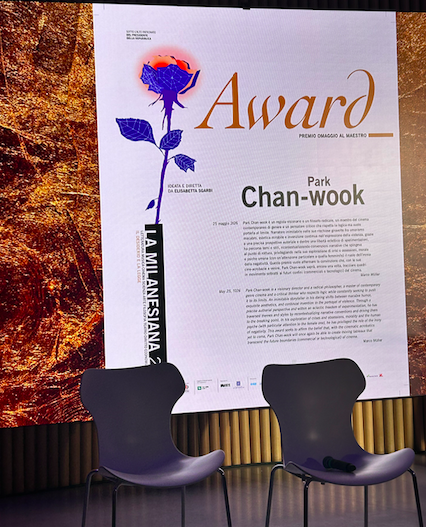

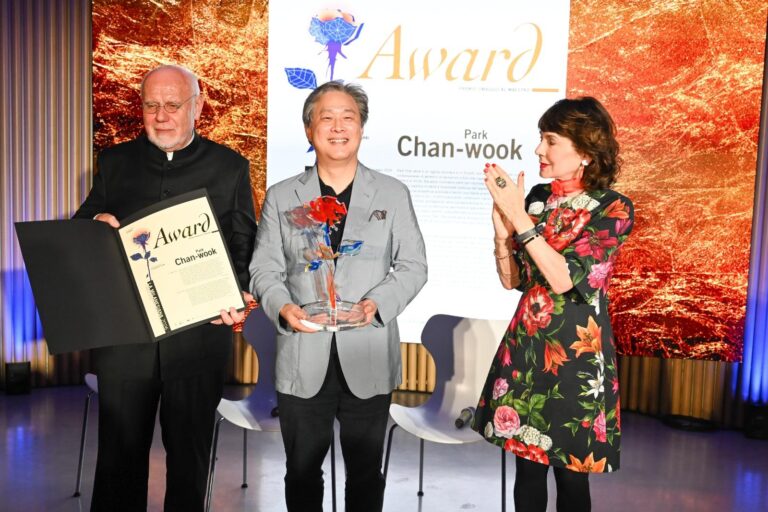
After presiding the 2026 Cannes Film Festival Jury, Park Chan-wook has been part of the 27th edition of La Milanesiana conceived and directed by Elisabetta Sgarbi. Two days homaged the award-winning South Korean director — with a Masterclass moderated by Marco Müller and a screening marathon of his The Vengeance Trilogy (Sympathy for Mr. Vengeance, Oldboy, Lady Vengeance) — to retrace his artistic universe.
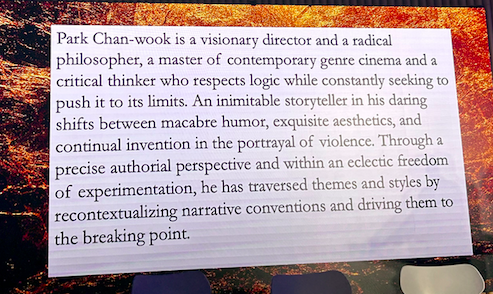
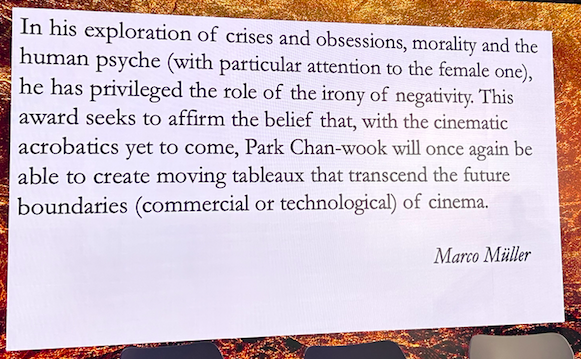
The Masterclass that took place at the Volvo Studio in Milan was characterised by the screening of the filmmaker’s medium-length film Judgement — that had a huge success at the Festival of Clermont-Ferrand — and an Award to praise his visionary and groundbreaking work. In his acceptance speech Park Chan-wook explained that receiving this recognition in Milan was exceptionally meaningful, because Italian filmmakers such as Michelangelo Antonioni and Luchino Visconti greatly inspired him as a cineaste.
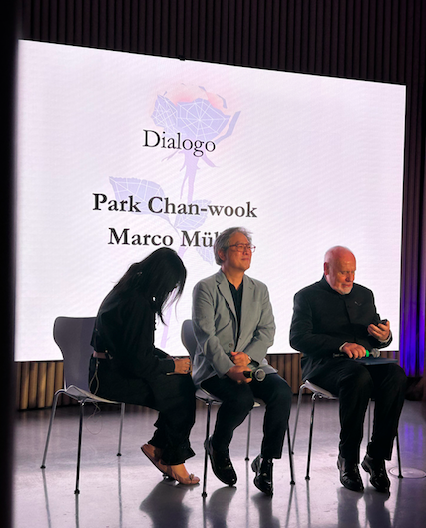
The evening uncovered the filmic approach of Park Chan-wook, that echoed this year’s theme of La Milanesiana ‘Desire and Law.’ These two opposing, but deeply intertwined forces, were the fil rouge of the conversation moderated exquisitely by film critic Marco Müller, whose knowledge of cinema and Asian culture is attested by his fluency in Chinese, his professorship at Shanghai University and his work at the helm of film festivals such as Venice, Pesaro, Locarno, Rome, Rotterdam, Pingyao and Hainan Island.
In fact, Marco Müller began the conversation by contextualising the historical evolution of Korea, that today has restructured its identity through the K-culture phenomenon. It all began on November 19th 1999, when the Beijing Youth Daily (Běijīng qīngnián bào) for the first time used the term ‘Korean Wave,’ i.e. hallyu. This means the South Korean wave crossed all of Asia and beyond, with cultural products such as K-pop, K-drama, K-beauty, and K-food like Bingsu ice-cream. South Korea became the new trend-setter in popular culture, often using YouTube as a platform to allow the content to be accessible worldwide, as we witnessed with PSY’s song Gangnam Style in 2012. The phenomenon of hallyu kept growing over the course of the 21st century with K-series such as Squid Game. This K-pop culture has based the foundations for the economic boost of South Korea.
Within this dimension, Park Chan-wook represents an antidote to the Hallyu-wood phenomenon. The cineaste recalled Korea’s dynastic past and how the Japanese rule affected the Korean population, especially because this period coincided with the modernisation of his culture. After World War II the country was liberated, but colonialism continued with the USA and the Soviet Union, which marked the division between North and South Korea. Therefore the Korean identity was confused and shifted from its origins, transforming itself into a hasty, passionate, earnest and at times harsh culture. As a matter of fact, Marco Müller underlined how the South Korean filmmaker grasped the phenomenon of ‘the adventurous spirit of fatherless children’ that shaped the nation’s cinematic language.
During the early Nineties, only American mainstream movies and Korean films were available, but none of the motion pictures from the rest of the world. Classic films were not available, and South Koreans eventually discovered them through VHS tapes. Park Chan-wook recalls having his cinematic epiphany when he saw for the first time Alfred Hitchcock’s Vertigo on a small television set. He also explained that it wasn’t until the Eighties that in his country films arrived in colour. It was a culture shock for him to discover that certain pictures he had seen in black and white were actually in colour, like Apache directed by Robert Aldrich. There was also a specific tv channel for American soldiers in Korea, showing films that weren’t available elsewhere. But the problem was there were no subtitles and he did not understand English too well. Hence, this language barrier was an excellent exercise to imagine and recreate stories.
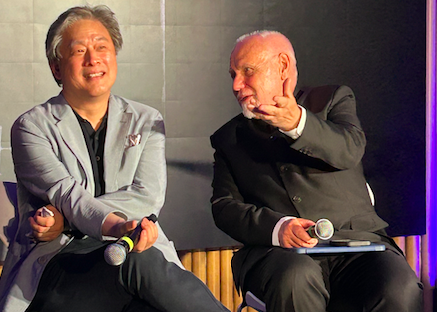
Park Chan-wook’s early works were so innovative that the producers of the Chungmu-ro neighbourhood (located in the Jung District of Seoul which was known as the ‘Hollywood of Korea,’ before the film studios relocated to the Gangnam District), considered Park Chan-wook a dangerous cinephile. In these regards the filmmaker shared an amusing anecdote concerning how he convinced these reluctant producers to invest in a high budget film like Joint Security Area — which eventually conquered the box office in Korea. The story goes that the investors tried to discourage Park Chan-wook from pursuing their support by asking him to make a storyboard of the entire film, saying that this was what was usually requested in Hollywood. He believed them and drew from the first to the last scene of the film. Only years later later, when the filmmaker shot Stoker in Hollywood, did he discover the scam. But the South-Korean director cherishes the experience of storyboarding, because it helped him in the making of the film, and it set a method that was followed by other film directors.
His filmography coalesces the macabre, irony, compelling aesthetics and always delivers a philosophical reflection on the human psyche and its place in society. This trait might be a result of Park Chan-wook studying philosophy at Sogang University. He joked on the fact he never completed his studies because he loved making movies more. His artistry undoubtably lies not only in how he translates his themes in visual representations, but also in the fact he has ventured in different film genres. In fact, in 2002 with other young directors he created Egg Films, before he founded his own indie company Moho Film. However, around that same time, the South Korean filmmaker made an agreement with the mainstream distribution company CJ for his film I’m A Cyborg, But That’s OK. Therefore he managed to make the indie and mainstream approaches coexist in his craft, as well as producing the works of burgeoning filmmakers, like Bong Joon-ho’s Snowpiercer and Lee Kyoung-mi’s Crush and Blush.
Park Chan-wook also collaborates with his brother Park Chan-kyong on visual art projects, through the duo they’ve created called PARKing CHANce. These works can be made rapidly with small budgets and shown on the internet like Night Fishing (that won the Golden Bear for Best Short Film, bestowed by Nan Goldin at the 61st Berlin International Film Festival), or in museum venues like the short Decades Apart. The latter was part of CinéFondation Cartier’s exhibition Il nostro tempo (Our Time) in the Triennale Museum in 2025 [for which I had the pleasure of moderating the press conference]. This specific 3D video installation from 2017 is set in the Panmunjeom village, inside the DMZ area where the armistice between the two Koreas was signed in 1953. The famous demilitarized zone dividing North from South Korea was actually recreated in Namyangju, northeast of Seoul. The way PARKing CHANce captured, 17 years later in Decades Apart, the same set that had been used in the year 2000 for Joint Security Area, is the perfect metaphor of the country’s historical decadence.
The psychological realism of Park Chan-wook’s films, characterised by his radical visual rendering, aligns with Marco Müller’s observation: his style echoes François Truffaut’s praise of ‘les grands films malades,’ that is to say those films that are flawed and broken but in a fascinating way. Such films can expose an artist more directly than those that are executed perfectly. This can also be attested in the way many of Park Chan-wook’s movies after their official release get an extended director’s cut.
Moreover, Park Chan-wook was pioneering in his craft also by being one of the first filmmakers in South Korea to use all the technological tools available, especially dedicating himself to the digital intermediate. His experience as President of the Jury in Cannes made him realise how certain motion pictures can benefit from this modern touch, like Ken Russell’s 1972 The Devils, which was in the Cannes Classics section with a 4K restoration which he thought made the film more beautiful than the original version. Despite his predilection for the opportunities offered by digitalisation, Park Chan-wook shared his longing to eventually shoot a film on reel.
Not only do we look forward to a new work of his made using film roll, but we also await his first movie in 3D, since he made an attempt with The Handmaiden in 2016 that did not follow through. Meanwhile, those who want to admire his sensibility with still images, Park Chan-wook will have his first ever photographic exhibition in France, which will open in July at the exhibition space Lee Ufan Arles.
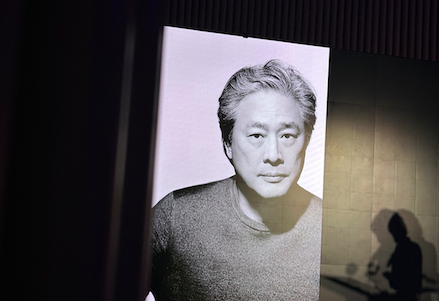
From the BBC series The Little Drummer Girl to the winner of the Venice Film Festival’s Golden Lion in 2025 No Other Choice, Park Chan-wook’s body of work creates a tableaux of images that move on the big screen as much as they move your soul to the core. These films shake perception and haunt your grasp on reality in multiple ways. They never grow old and always find an alignment with current times, as NEPAL (Never Ending Peace And Love) — with the loss of identification through the process of migration — and Day Trip that reprises the figure of the pansori (a traditional Korean musical storyteller), to describe a spiritual awakening.
Personally, the phenomenology of Park Chan-wook’s films has evoked in me the ideas of contemporary South-Korean born philosopher Hwa Yol Jung, when its comes to transversality, embodiment and intercultural dialogue. Cinema represents one of the relational ways in which we understand the world and cross boundaries. Park Chan-wook brings to the silver screen the carnal hermeneutics we experience as human beings wandering on this planet.
Check out more of Chiara’s articles.