

Founded in 2021, the Chicago Japan Film Collective will celebrate its 5th anniversary with the Backstreet Cinema Series taking place from September 2025 until February 2026. This series highlights films that capture “the spirit and scenery of Japan.” One of the movies of the programme, that conveys the beauty and nostalgia towards Nipponic traditions, is Laugh, Everyone! In this occasion, the film directed by Taichi Suzuki will have its international premiere.
Laugh, Everyone! is a film that reminds audiences about the importance of laughter. In the 1941 film Sullivan’s Travels the protagonist at one point says “There’s a lot to be said for making people laugh. Did you know that that’s all some people have? It isn’t much, but it’s better than nothing in this cockeyed caravan.” Whilst in Singin’ In The Rain, Donald O’Connor sings Make ‘Em Laugh, that expresses his character’s delight in making people laugh. Along these lines Taichi Suzuki brings together contemporary stand-up comedy, with the 400-year-old tradition of comic storytelling in Japan known as Rakugo.
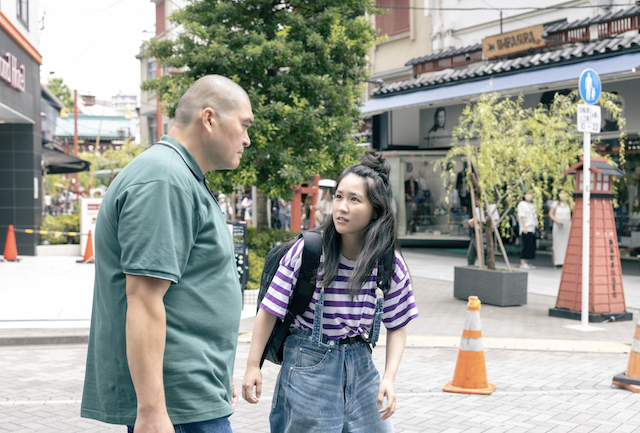
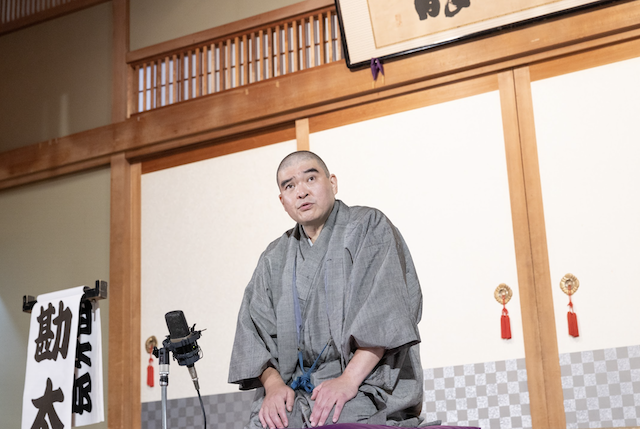
The film shows this by juxtaposing the destinies of a fifty-year old and a girl in her twenties, along with those of their families. Tamon (Tomizo Nobe), is a struggling second-generation rakugo storyteller trying to find his place in the world, he works a part-time job, and takes care of Kanzo (Tetsu Watanabe), his father who is struggling with dementia, as he has assumed his stage name to perform. Meanwhile, Kiki (Nagiko Tsuji), an aspiring stand-up comedian, hears a story at Tamon’s show that her mother, Yoko (Reiko Kataoka), once loved. With her friend and artistic partner Chi, Kiki uses this story about the All-Star Game in her act, setting off a chain of events that changes all their lives.
Beyond the family drama, Laugh, Everyone! offers a glimpse into the traditions of rakugo, the minimalistic performance art that features a lone storyteller (rakugoka), dressed in a kimono, who entertains his audience from a raised platform (kōza), in the kneeled sitting position (seiza). The performer uses only a paper fan (sensu) and a small cloth as props. This Japanese verbal comedy, is part of the tradition of yose, a form of spoken theatre in the Edo period. The idea of pairing this ancient art of entertainment through laughter, with stand-up comedy is exceptionally perceptive. Especially because rakugo usually is structured around a story that involves the dialogue of two or more characters, and it’s almost as if these two performing expressions were put in conversation with one another. Furthermore, it mirrors also the Japanese tradition of manzai, the double act comedy that involves two performers (manzaishi).
What transpires while watching the picture is the director’s sensibility towards Humanities and Social Sciences, that he studied at university. The film genuinely delivers the challenges of inheriting cultural legacies and the responsibility in honouring them, and incorporating them in the modern world. The Land of the Rising Sun has a bountiful supply of performing arts, from Kabuki to Nō theatre — that have more frequently been homaged by motion pictures. Suzuki shines a light on another art form, that is less known by the Western world.
Like every good comedy, Laugh, Everyone! has a touch of drama, the film could even be considered as a dramedy, as it gently brushes upon serious issues such as aging, mental health, solicitation of prostitution and violence against women. Through it all we are reminded about the therapeutic effect of laughter. Thus, the power of satire — whether from centuries past or from the present — breaks tensions, initiates reflection and affects the social sphere at a micro and macro level. In these regards Taichi Suzuki completely nails it!
The Film also available on Online link.
Final Grade: B
Photo Courtesy of CJFC